







A former bus driver from Stockton-on-Tees has become one of the pioneering participants in a groundbreaking medical trial that grafts donor skin onto transplant recipients to provide early warning signs of organ rejection.
Darren White, 53, received a lung transplant in late 2024 and credits the innovative technique with catching his body's rejection response swiftly enough for successful treatment.
"Anything that might help to avoid rejection was worth a try," he said. "Having something that might be able to catch it much sooner than otherwise was really appealing."
The Sentinel trial, led by Oxford-based researchers, uses a straightforward concept by attaching a small piece of donor skin to the patient's forearm during their transplant surgery.
TRENDING
Stories
Videos
Your Say
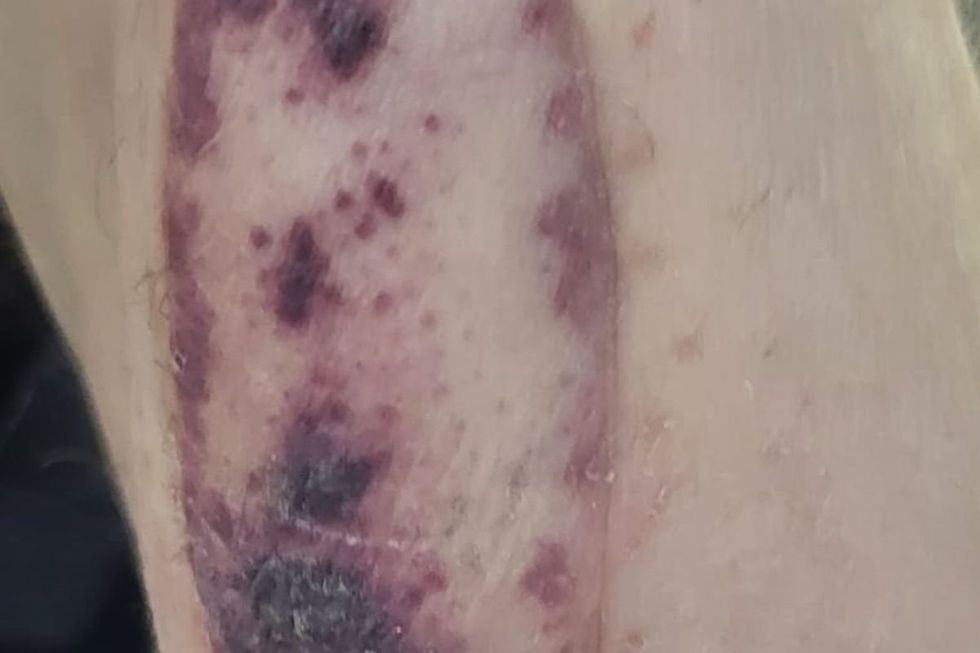
The skin patch acts as a window into the body's immune response
|PA
This patch functions as what scientists describe as a "window" into the body's immune response.
Medical experts believe that skin tissue shows signs of rejection more rapidly than internal organs, and crucially, any adverse reaction becomes immediately visible on the surface.
When a rash develops on the grafted skin, clinicians can intervene promptly with treatment, potentially preventing lasting harm to the transplanted organ itself.
LATEST DEVELOPMENTS
NHS Blood and Transplant notes that lung rejection affects nearly a third of patients yet remains notoriously difficult to identify through conventional methods such as blood tests, biopsies and x-rays.
Three months following his transplant procedure, White observed a purple rash emerging on the grafted skin patch.
A subsequent biopsy confirmed that mild rejection was occurring, prompting doctors to administer steroid treatment without delay.
"I definitely believe the skin patch helped to stop the lungs from being rejected," he said.
The 53-year-old now enjoys an active life with his young son, able to walk and visit the park together.
"I'm over a year post-transplant now and doing really well. Who knows if that would be the case if the rash hadn't shown up and rejection wasn't spotted until further down the line," White reflected.
Plastic surgeons at the University of Oxford are conducting skin graft procedures as part of the Sentinel trial.
 |
| PA
Henk Giele, the trial's chief investigator and an Oxford plastic surgeon, said: "It seems logical that having a window to your transplant can provide an early warning system of rejection or reassure you that you don't have rejection, but we have to prove it works."
"We hope it will change what we know about transplant and make patients' lives better and longer," he added.
The study aims to recruit 152 patients across five NHS hospitals: Freeman Hospital in Newcastle, Harefield Hospital in London, Queen Elizabeth Hospital in Birmingham, Royal Papworth in Cambridge and Wythenshawe Hospital in Greater Manchester.
Ten patients have participated thus far, with the trial scheduled to conclude in 2027.
Our Standards: The GB News Editorial Charter