










Astronomers believe they have uncovered traces of an entire galaxy consumed by the Milky Way billions of years ago.
A research team has identified 20 peculiar stars within our galaxy's disc that appear to be leftovers from a small dwarf galaxy swallowed during the Milky Way's formative years.
The findings, published this month in the Monthly Notices of the Royal Astronomical Society, point to a cosmic merger that occurred approximately 10 billion years ago.
Scientists have dubbed the hypothetical parent galaxy Loki, drawing inspiration from the Norse trickster deity.
These ancient stars are classified as very metal-poor, containing virtually none of the heavier elements found in younger stellar populations.
Their chemical signatures indicate they formed within the first two to three billion years following the Big Bang.
What makes these stellar objects particularly intriguing is their unusual movement through space.
Eleven of the stars travel in prograde orbits, following the same rotational direction as the galactic disc.
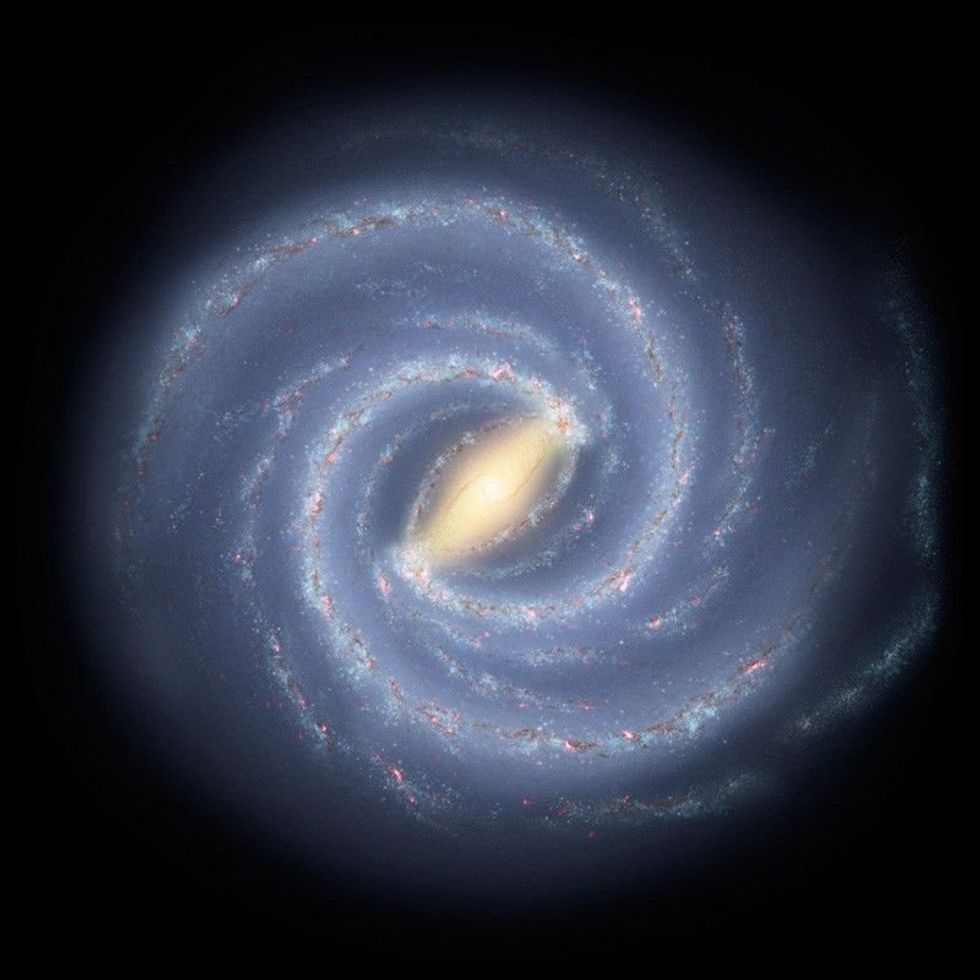
Astronomers believe they have found the remains of an entire galaxy absorbed by the Milky Way
| NASAThe remaining nine move in retrograde fashion, orbiting in the opposite direction entirely.
Ordinarily, astronomers would interpret such mixed orbital patterns as evidence of two separate source populations with comparable histories.
However, detailed analysis revealed the chemical fingerprints across all 20 stars to be remarkably similar.
This near-identical composition across both orbital groups strongly suggests the stars share a single point of origin rather than emerging from distinct systems.
LATEST DEVELOPMENTS
The puzzle of how one absorbed galaxy could scatter its stars into opposing orbital directions became the central question driving the research team's investigation.
The research drew upon observations from the European Space Agency's Gaia telescope, which mapped the positions, velocities and compositions of two billion stars across our galaxy between July 2014 and January 2025.
Dr Federico Sestito, a postdoctoral fellow at the University of Hertfordshire's Centre for Astrophysics Research, led the study alongside colleagues who conducted follow-up observations using the high-resolution spectrograph at the Canada-France-Hawaii Telescope near Maunakea's summit.
The stars sit roughly 7,000 light-years from our solar system, with chemical compositions suggesting ages exceeding 10 billion years.
Sestito explained the naming choice reflected the difficulty in deciphering the stars' origins: "Similarly, our accreted stars gave us some hard time in understanding their origin. At first it was not easy to reconcile the fact that an accreted system can disperse its stars in both prograde and opposite orbits."
The discovery carries significant weight for understanding how our galaxy assembled itself over cosmic time.
Dr Alexander Ji, assistant professor in astronomy and astrophysics at the University of Chicago, noted that major galactic mergers can fundamentally alter the Milky Way's developmental trajectory.
"If this is real, it would indicate that we are missing a major part of our Milky Way's formation history, and we might need to revisit our current picture to see the impact of such an event," Dr Ji said.
The proposed Loki merger would rival the scale of the well-documented Gaia-Sausage-Enceladus collision, which occurred between eight and ten billion years ago and helped transform our galaxy from its chaotic early state into its current stable disc structure.
Dr Ji expressed appropriate caution, noting that apparent new merger discoveries sometimes prove to be extensions of previously identified systems.
Our Standards: The GB News Editorial Charter