










Astronomers at the Harvard-Smithsonian Center for Astrophysics have pioneered a groundbreaking technique to reconstruct the 12-billion-year history of a distant spiral galaxy using chemical signatures embedded in its gas.
The research, published in Nature Astronomy, merged theoretical modelling and observational data to mark the first application of detailed chemical archaeology beyond our own galaxy, establishing an entirely new astronomical discipline termed "extragalactic archaeology".
Lisa Kewley, lead author, Harvard professor, and director of the Center for Astrophysics, said: "This is the first time that a chemical archaeology method has been used with such fine detail outside our own galaxy.
"We want to understand how we got here. How did our own Milky Way form, and how did we end up breathing the oxygen that we're breathing right now?"
TRENDING
Stories
Videos
Your Say
The research team utilised observations from the Typhoon survey, conducted at the Irénée du Pont telescope at Las Campanas Observatory in Chile, to examine NGC 1365 - a nearby spiral galaxy positioned face-on from Earth's perspective.
Their instruments achieved sufficient resolution to distinguish individual star-forming clouds within the galaxy.
Young, hot stars emit intense ultraviolet radiation that excites surrounding gases, causing elements like oxygen to produce distinctive bright emission lines.
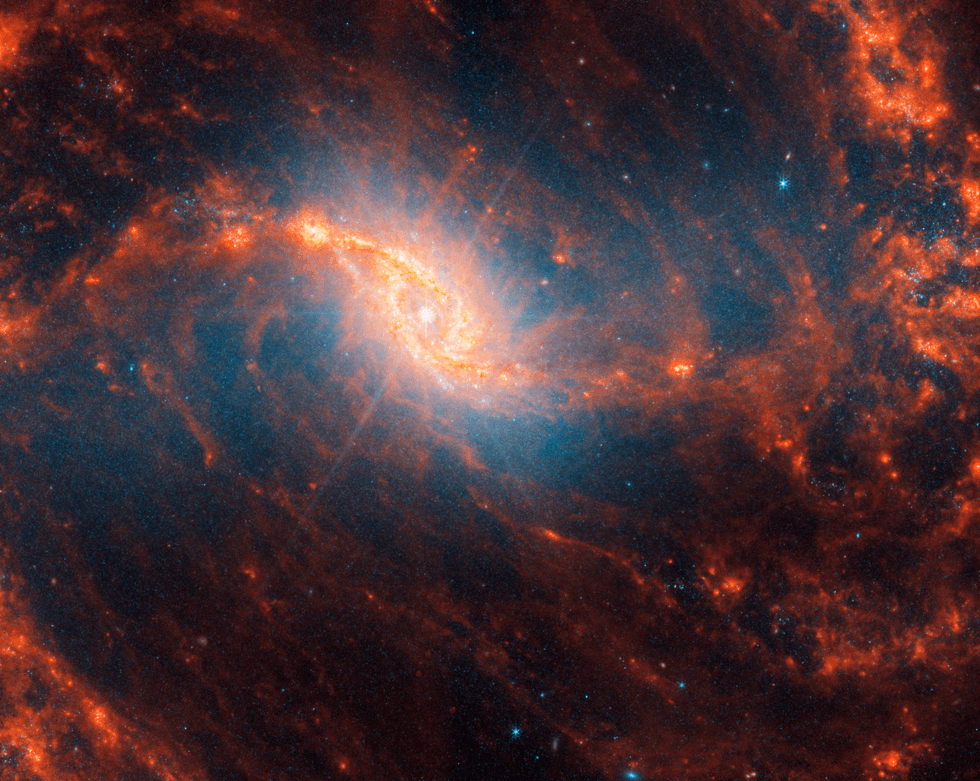
The discovery comes in the barred spiral galaxy, NGC 1365
|NASA
Scientists understand that galactic centres typically contain higher concentrations of heavy elements compared to outer regions.
The team analysed oxygen distribution patterns across NGC 1365 and matched these against sophisticated computer models from the Illustris Project, which simulates approximately 20,000 galaxies from the early universe to present day.
The analysis revealed that NGC 1365's core developed during the galaxy's earliest period, accumulating substantial quantities of oxygen.
LATEST SPACE DISCOVERIES
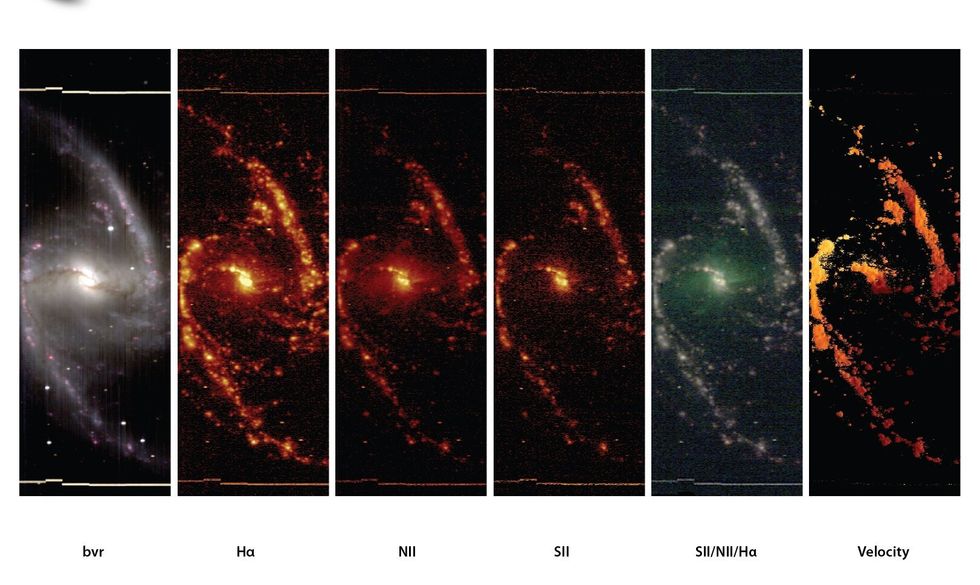
Six views of the spiral galaxy NGC 1365, as extracted from its spectro-photometric data cube
|Carnegie Institution for Science
Material in the outer regions accumulated over 12 billion years through successive collisions with smaller dwarf galaxies.
The spiral arms likely formed comparatively recently, within the past few billion years, drawing in gas and stellar material via absorption.
Lars Hernquist, Mallinckrodt Professor of Astrophysics at Harvard and a CfA astronomer, said: "It's very exciting to see our simulations matched so closely by data from another galaxy.
"This study shows that the astronomical processes we model on computers are shaping galaxies like NGC 1365 over billions of years".
The findings demonstrate that NGC 1365 transformed from a modest galaxy into an enormous spiral structure through repeated mergers with dwarf galaxies, establishing chemical fingerprints as a powerful tool for decoding galactic histories.
Because NGC 1365 shares characteristics with our own Milky Way, the research offers potential insights into whether our galaxy followed a similar evolutionary path.
"Do all spiral galaxies form in a similar way?" asked Ms Kewley, "are there differences between their formation? Where is their oxygen distributed now? Is our Milky Way different or unique in any way?"
"Those are the questions we want to answer".