









Scientists have revealed the habits of a massive "kraken-like" giant octopus - the size of two London buses.
Newly-identified fossils were analysed by Hokkaido University paleontologists, who found that some ancient species were up to 19 metres in length.
The research, published in the journal Science, suggests the prehistoric octopuses could have preyed upon vertebrates such as the mosasaurs and plesiosaur.
Little was known about the giant creatures as their rigid beaks are the only remains preserved as fossils and previous research assigned the fossils examined by the researchers as belonging to vampire squids.
TRENDING
Stories
Videos
Your Say
Dr Yasuhiro Iba: "Our study shows that these were not simply large versions of modern octopuses.
"They were giant predators at the very top of the Cretaceous marine food web. This changes the view that Cretaceous seas were dominated only by large vertebrate predators."
The newest analysis concluded the beaks belonged to a genus of ancient octopus relatives known as Nanaimoteuthis, with the team uncovering an additional 12 octopus beaks dating 72million to 100million year ago.
Taking the relationship between jaw size and body length in modern octopuses, the team estimated the species Nanaimoteuthis haggarti spanned between seven and 19 metres long, and would have been the largest invertebrate on record.
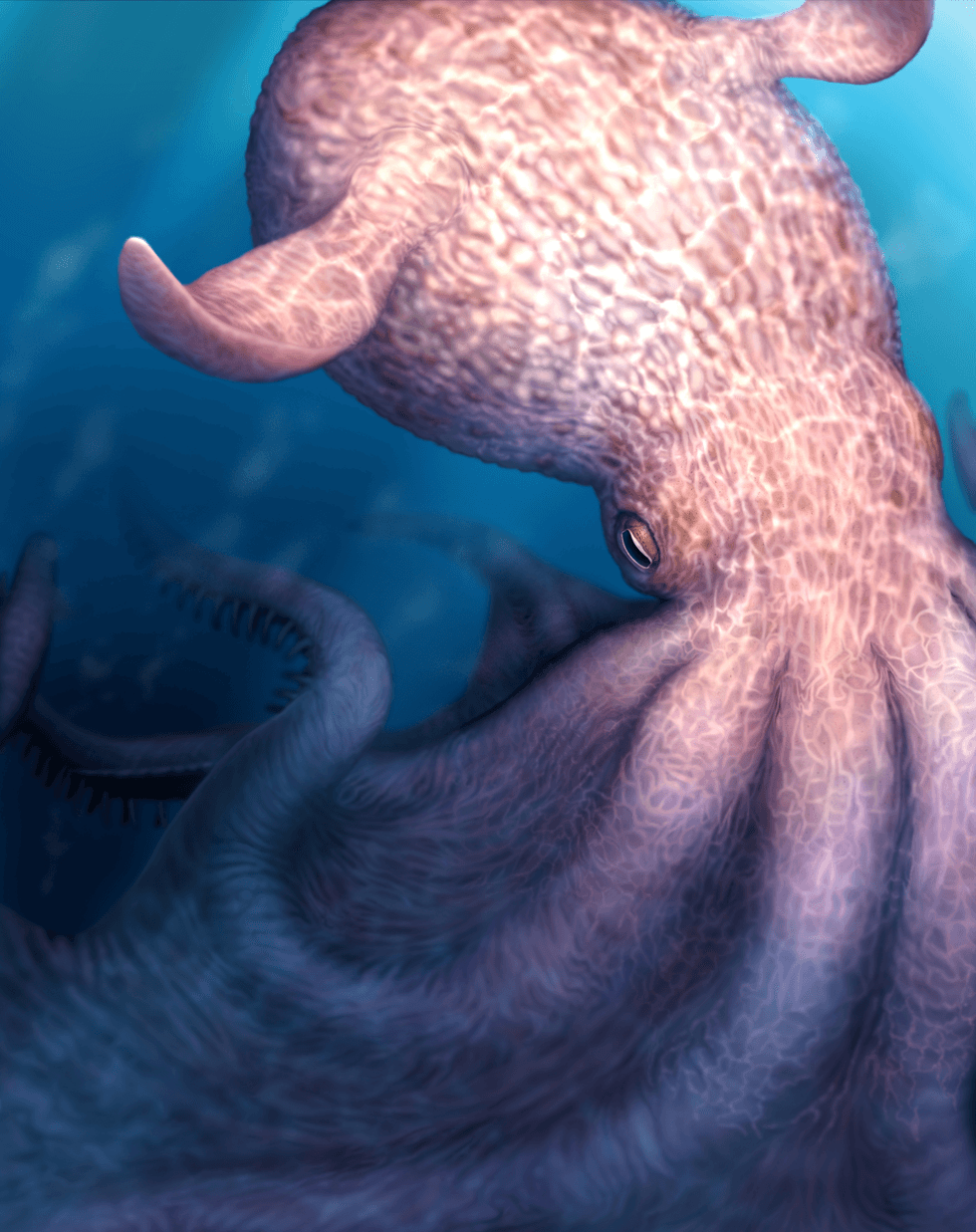
An illustration of the giant octopus, depicted by Hokkaido University
|HOKKAIDO UNIVERSITY/YOHEI UTUSKI
AI-assisted CT scans allowed researchers to rebuild the structure of the animal with a higher level of precision.
Dr Thomas Clements, a palaeobiologist at the University of Reading - not involved in the research - said: "To see a beak this size is quite amazing, to be honest. It was a massive animal.
"I certainly wouldn’t have wanted to go swimming in the ancient oceans if these things were swimming around."
Modern octopuses use their long arms to capture their prey before tearing apart the animal with its beak.
MARINE MYSTERIES - READ MORE:
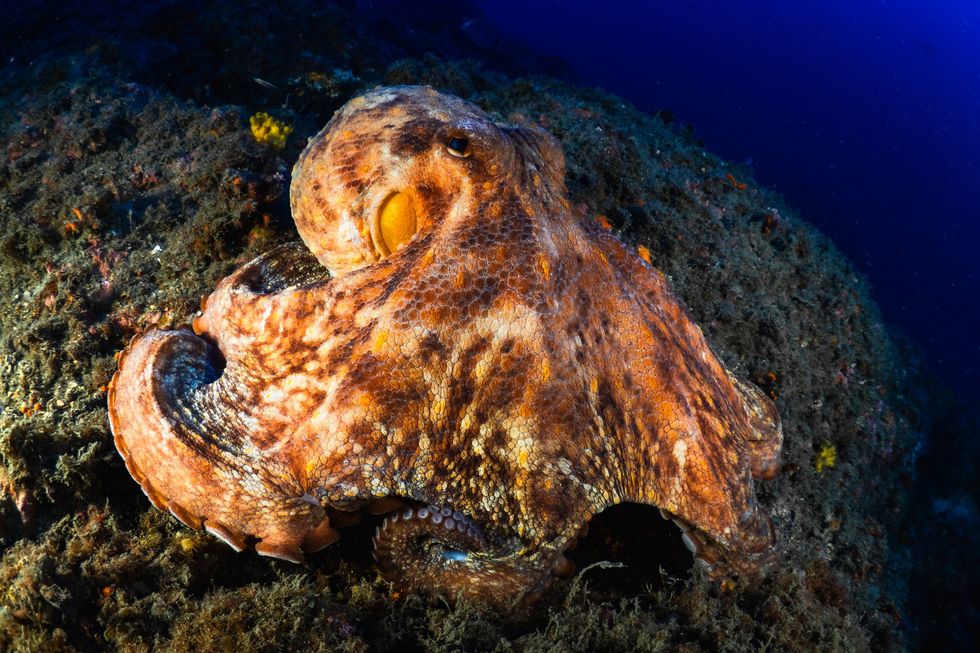
Similar to modern octopuses, ancient giant octopuses likely used use their long arms to capture prey and then ate them with its beak
|GETTY
The fossils showed the giant octopus likely had similar hunting and predation methods.
Mr Iba said: "It probably used its long arms to seize prey and its powerful lower jaw to crush hard structures such as shells or bones. The strong wear on the jaws indicates frequent processing of hard prey."
Ancient giant octopuses likely ate bony fish, shelled animals, and possibly other apex predators it would have rivalled in size.
Mr Clements said: "Whenever you see artistic reconstructions, it’s always a vertebrate eating a cephalopod. It is quite nice to imagine an octopus eating a large vertebrate for once.
"As a cephalopod researcher I’m very excited to see invertebrates that may have rivalled vertebrates."
The wear on the beaks showed evidence of lateralised behaviour, the favouring of one side of the body over the other.
This indicates that similar to modern octopus, the N haggarti preferred some arms for exploration and other for feeding.
Ancient octopuses developed soft bodies with high mobility which allowed them to become active hunters, tackling large prey.
The authors said: "Long after the rise of vertebrate top predators, octopuses evolved body plans capable of rivalling them."