








Researchers at California's SLAC National Accelerator Laboratory are working to uncover what is believed to be the earliest known celestial chart ever created.
The ancient star catalogue, attributed to the Greek astronomer Hipparchus who lived between approximately 190 and 120 BCE, lay concealed for centuries beneath religious text on a medieval parchment.
The document, called the Codex Climaci Rescriptus, dates from the 6th century and originated from a monastery. During the Middle Ages, parchment was costly, leading monks to scrape away existing ink and reuse the material.
In 2022, scholars first identified that astronomical content might be hidden underneath the visible writing.
TRENDING
Stories
Videos
Your Say
The team employs a synchrotron particle accelerator to examine the fragile pages. This device generates X-rays by propelling electrons at velocities approaching the speed of light.
These powerful beams can differentiate between various chemical compounds within the material without causing damage.
The medieval monks who wrote over the original text used iron-based ink, whilst the underlying Greek astronomical writing contains a calcium signature. This chemical distinction allows scientists to separate the two layers visually.
The scanning has already yielded results. Researchers have uncovered multiple descriptions of stars along with a reference to the constellation Aquarius.
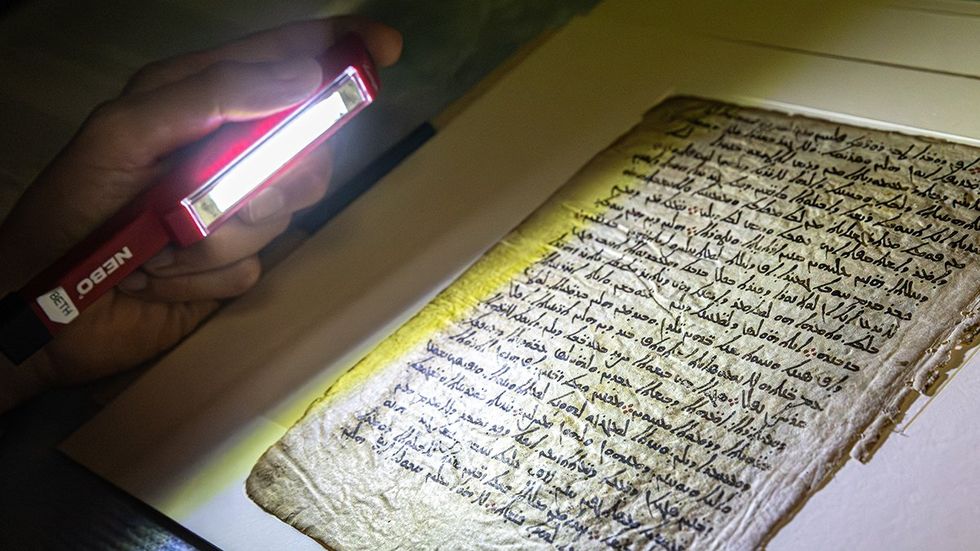
The ancient star catalogue is attributed to the Greek astronomer Hipparchus, who lived between approximately 190 and 120 BCE
|SLAC
"The goal is to recover as many of these coordinates as possible," historian Victor Gysembergh, from the French national scientific research centre CNRS, told KQED. "And this will help us answer some of the biggest questions on the birth of science."
"Why did they start doing science 2,000 and more years ago? How did they get so good at it so fast? Because the coordinates we are finding are incredibly accurate for something that is done with the naked eye."
Gysembergh expressed his enthusiasm about the project's progress. "I am at the peak of my excitement right now," he said. "Because of this new scan that we started, line after line of text [is] showing up in ancient Greek from the astronomical manuscript."
The manuscript is thought to have been recovered from St Catherine's Monastery in Egypt, recognised as the world's oldest continuously inhabited Christian monastery.
LATEST DEVELOPMENTS

California's SLAC National Accelerator Laboratory are working to uncover the earliest known celestial chart ever created
|For this analysis, the Codex Climaci Rescriptus travelled from the Museum of the Bible in Washington DC under extraordinary precautions.
Pages were placed in bespoke frames and humidity-controlled containers, then transported by hand. Lighting in the scanning facility is carefully managed to prevent further ink deterioration.
However, a significant challenge remains. Only 11 pages are currently undergoing examination at the laboratory.
The complete manuscript comprises roughly 200 pages, with the remainder dispersed across various locations globally, requiring future coordination efforts.
Our Standards: The GB News Editorial Charter