










Nasa has set a date for mankind to live full-time on the Moon under radical new plans for a lunar base.
The space agency has revealed new details on its plans to establish a semi-permanent presence on the Moon's surface.
The base is set to be in working order by 2029, after a "phase, practical strategy" to build it in partnership with the "commercial industry, academia, international agencies, and innovators around the world".
Plans unveiled at a press conference on Tuesday showed how the lunar colony will span "hundreds of square miles", and could look "like a city" according to its chief architect.
But the first step is to reliably and consistently get astronauts to the Moon through the Artemis mission.
After Artemis II, where astronauts flew around the Moon and returned to Earth, Nasa aims to land on the lunar surface in late 2028 as part of Artemis V, three lunar launches from now.
Artemis III, set to launch in late 2027, will announce its crew on June 9, the agency also announced.
Nasa has laid out a number of unmanned missions which will be held this year.
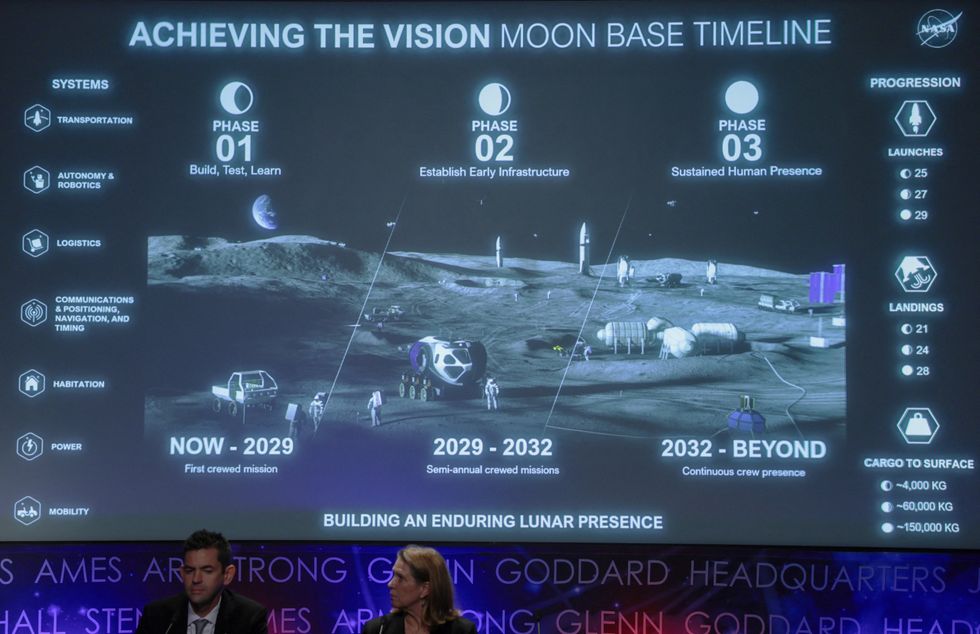
The Moon Base plans consists of three phases, starting from this year, with plans for a steady human presence by 2023
|REUTERS
The first of these missions, Moon Base 1, will be "the first privately funded lunar lander mission in history", conducted in partnership with Amazon chief Jeff Bezos's Blue Origin.
Moon Base 2 will carry US firm Astrobotics' Griffin 1 lunar lander - transporting more than 1,000 pounds of cargo and a Moon rover to the lunar surface.
The Moon Base 3 mission will be primarily scientific in nature, and deliver payloads from international partners the European Space Agency and South Korea's space agency.
Phase one of its triple-phase mission will last until 2029 and comprises 25 launches including 21 landings, delivering four tonnes of cargo to the lunar surface.
LATEST SPACE NEWS:

Jared Isaacman said Nasa plans to include progressives' viewpoints
|GETTY
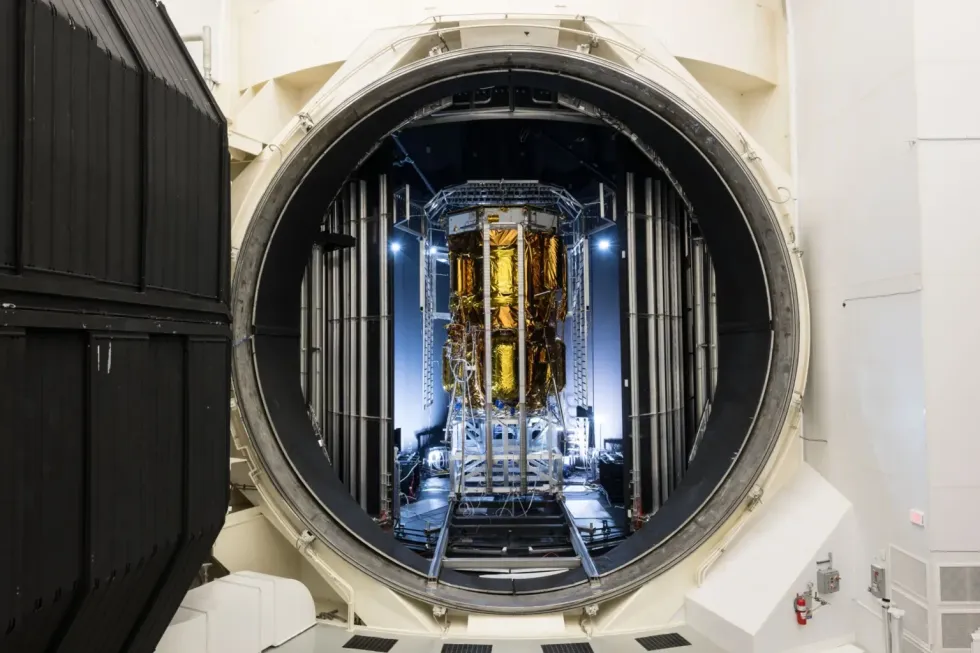
The Blue Origin Lander, used for the Moon Base 1 mission
|NASA
The moon base, which will be built on the Moon's South Pole, represents the first step towards future Mars missions, with Nasa chief Jared Isaacman saying it was needed to "learn the skills" to land on the Martian surface.
He said: "Really, it is to have an environment where we can work with the water, ice and master the skills for where we go next, which is Mars.
"And it would be nice to do that when you're four days away from home, you know, than many months away from home."
The Nasa administrator said the main goal of the mission was to "plant the starts and stripes on Mars someday".
Nujour Merancy, the base's chief architect, said the expansive size of the base was due to the fact there was no terrain on the Moon to fulfill all requirements of a base, including technology, habitation, and science.
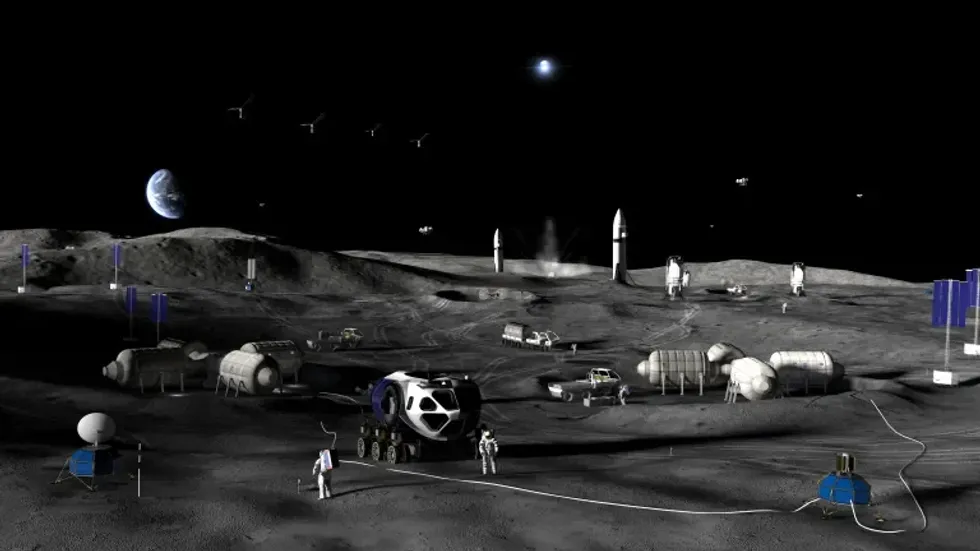
Nasa's render of its phase three Moon Base plan, which would represent a semi-permanent presence on the lunar surface
|NASA
Habitats will be placed on top of hills to get sunlight, but power systems will sit more than a kilometre away because of radiation risks.
She added: "All these things, when you start putting them together, end up sprawling a little bit more like a city as you start building it out."
Nasa said it is currently in the first phase of the Moon base mission, with a goal to "secure reliable access to lunar surface and experiment".
Initial moon base operations will last from 2029 to 2032, with a goal to establish a consistent human presence by the latter year.
The base will work with commercial partner Blue Origin, Mr Bezos's space tourism company, who will be used to build one of the lunar landers.
Mr Isaacman vowed to "take the world along" with Nasa as it establishes a Moon base, using modern communication tools to communicate the space agency's journey.