










Nasa's hunt for life on Jupiter's ice moon Europa is "likely" to be in vain, as any sign of life is looking increasingly unlikely.
Researchers at Washington University in St Louis have concluded that Europa's seafloor is probably far too quiet to support living organisms.
The team's findings, published in Nature Communications, paint a rather bleak picture of what lies beneath the moon's frozen surface.
Despite Europa boasting a massive ocean hidden under its ice shell – holding more water than all of Earth's seas combined – the rocky seafloor appears to lack the volcanic and tectonic activity that life would need to thrive.
The scientists examined whether Jupiter's immense gravitational pull could generate enough internal heat through tidal forces to keep Europa geologically active.
On Io, Jupiter's innermost large moon, this gravitational tug creates violent tides that make it the most volcanically active body in our solar system.
But Europa sits in a much more stable and distant orbit, which means those tidal forces simply are not strong enough to stir things up.
While the moon does experience some tidal heating – enough to prevent it from freezing solid – it is nowhere near sufficient to drive the kind of geological activity seen elsewhere.
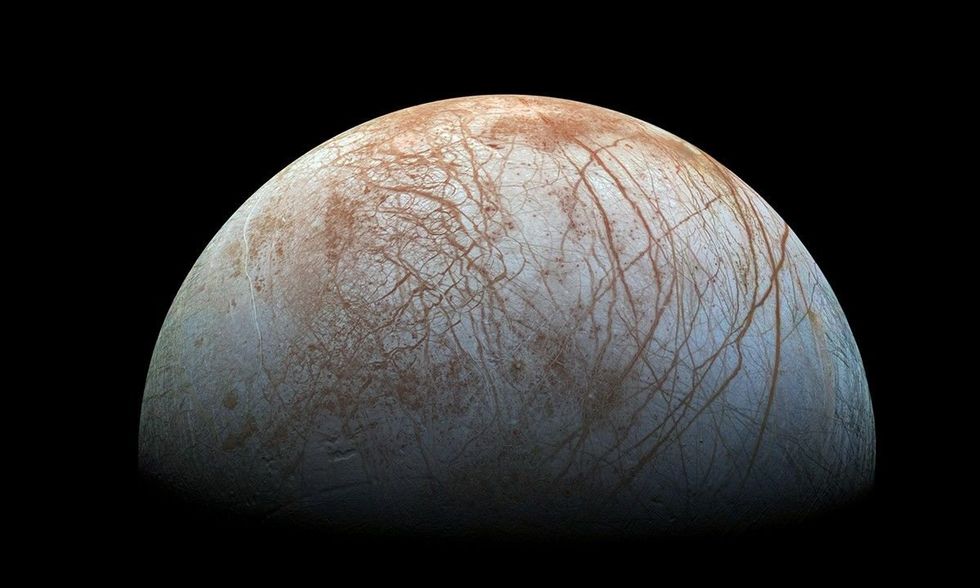
Nasa's hunt for life on Jupiter's ice moon Europa is 'likely' to be in vain, as any sign of life is looking increasingly unlikely
|NASA
Paul Byrne, who led the study, said: "If we could explore that ocean with a remote-control submarine, we predict we wouldn't see any new fractures, active volcanoes, or plumes of hot water on the seafloor.
"Geologically, there's not a lot happening down there. Everything would be quiet."
The professor of Earth, environmental and planetary science added that while there's been plenty of excitement about Europa's ocean, the seafloor has received surprisingly little attention.
"The energy just doesn't seem to be there to support life, at least today," he said.
LATEST DEVELOPMENTS
Despite these findings, two spacecraft are currently making their way to Europa to take a closer look.
Nasa's Europa Clipper, launched in 2024, is expected to reach the moon first with flybys beginning in spring 2031.
The European Space Agency's Jupiter Icy Moons Explorer, known as Juice, launched in 2023 and will perform its own flyby in 2032.
Prof Byrne remains enthusiastic about what these missions might reveal, noting they will capture detailed images and take precise measurements of the ice cap and ocean beneath.
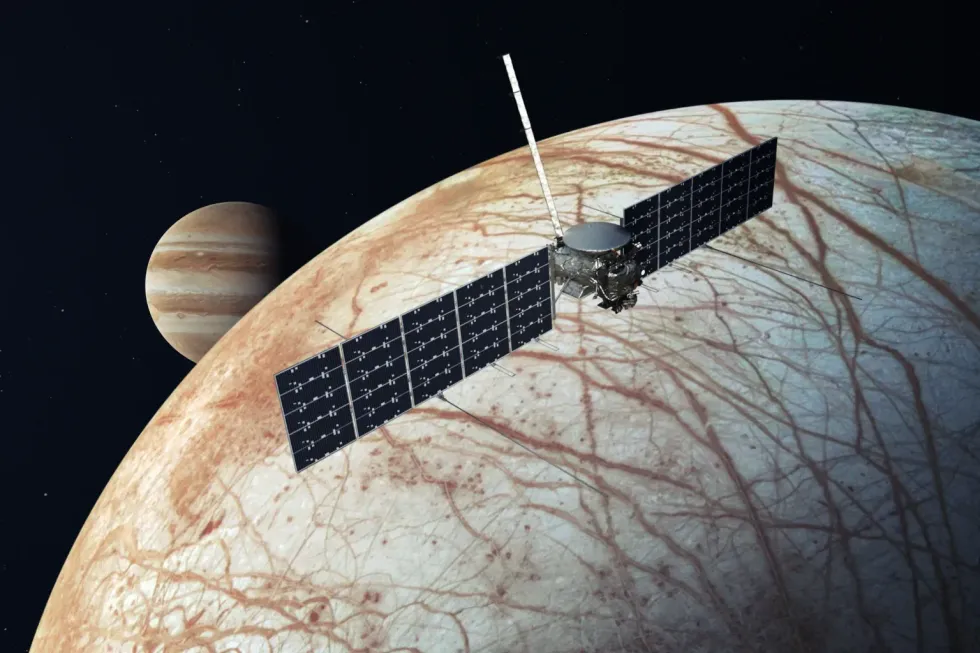
NASA's Europa Clipper is expected to reach the moon first with flybys beginning in spring 2031
|NASA
"Those measurements should answer a lot of questions and give us more certainty," he said.
And even if Europa turns out to be lifeless, Prof Byrne is not losing hope, as he said: "I'm not upset if we don't find life on this particular moon," he said.
"I'm confident that there is life out there somewhere, even if it's 100 light-years away. That's why we explore – to see what's out there."
Our Standards: The GB News Editorial Charter