










Archaeologists have discovered a piece of ancient Roman treasure from Hadrian's Wall - more than 1,000 miles away in Spain.
The bronze cup, thought to be some 1,900 years old, bears an image of the historic wall and military fortifications in England.
The discovery was detailed in research published last week in the journal Britannia.
Researchers believe the colourful vessel served as a keepsake for a Roman soldier who defended the empire's frontiers.
The artefact, dubbed the Berlanga Cup, was found in Berlanga de Duero in central Spain.
This location sits roughly 1,200 miles from the famous barrier that guarded Rome's northern boundary during the second century.
Authors suggest the cup was crafted as a personal memento of military service - a common practice at the time.
The vessel measures approximately 11.4 centimetres wide by 8.1 centimetres tall.
Its surface displays vibrant enamelled patterns alongside a Latin inscription referencing four military installations.
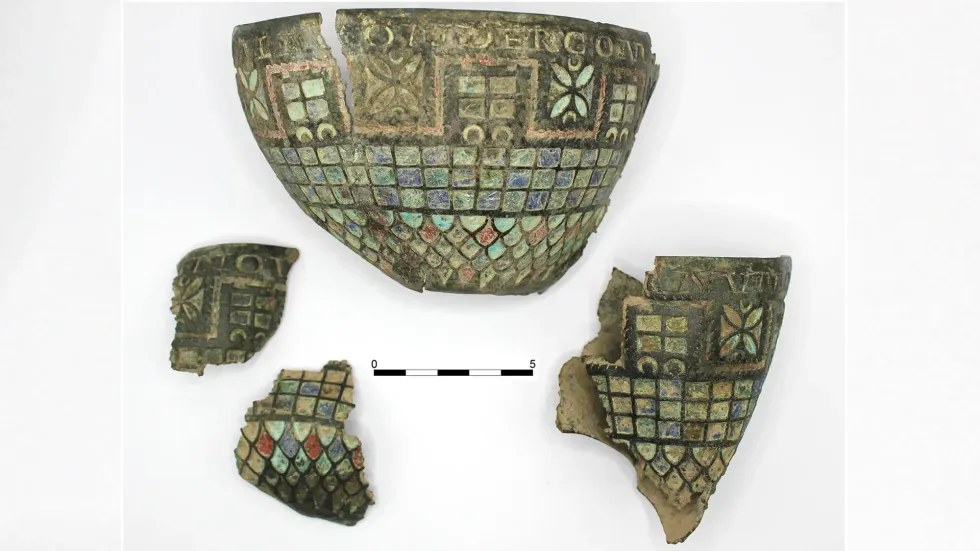
The artefact, dubbed the Berlanga Cup, was found in Berlanga de Duero in central Spain
|ROBERTO DE PABLO
"The cup is a small representation of a functional vessel called a Roman trulla — a bronze or clay cup with a handle used to drink water," said Jesus Garcia Sanchez, an archaeologist at the Archaeological Institute of Merida in Spain and co-author of the study.
"It is not only crafted with metals, but also expensive enamels, and later on customised. It is definitely not an industrial product."
The inscription identifies four fortifications along the eastern stretch of Hadrian's Wall: Cilurnum (modern-day Chesters), Onno (Halton Chesters), Vindobala (Rudchester), and Condercom (Benwell).
Each fort appears on the cup as four squares paired with two half-moons, representing either turrets or gateways.
ARCHAEOLOGY MYSTERIES - READ MORE:
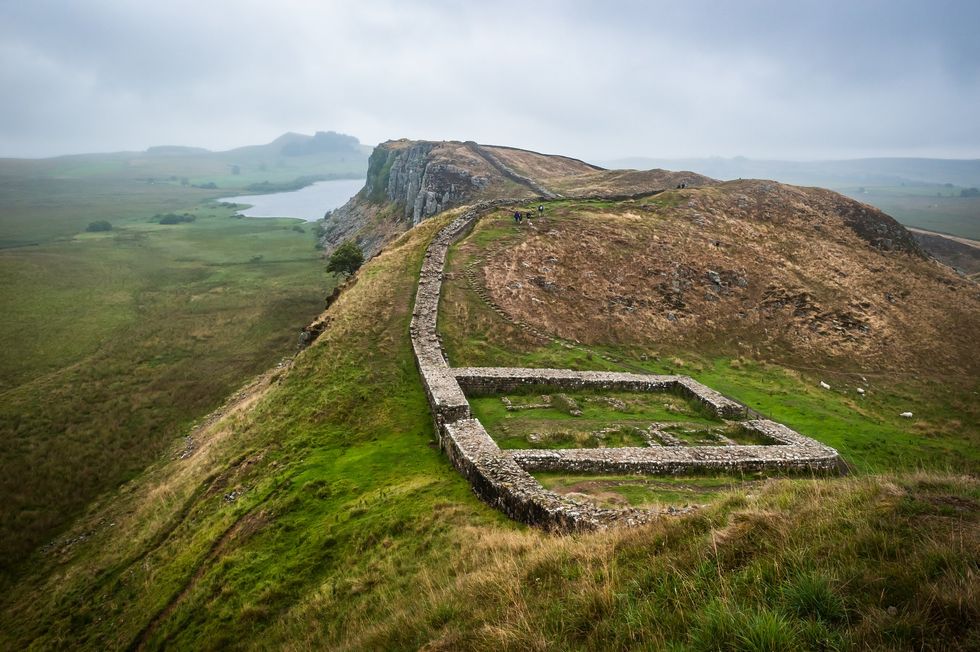
The cup was found some 1,200 miles from the northern edge of the Roman Empire at Hadrian's Wall
|GETTY
Beneath these run two decorative bands featuring red, green, turquoise and navy-blue enamel.
Scientific analysis confirmed the cup was made from bronze containing copper, tin and a significant quantity of lead.
The lead likely originated from mines in northern England.
These findings indicate a local craftsman near Hadrian's Wall produced the vessel between AD 124 and 199.
But its journey to Spain remains somewhat mysterious.

PICTURED: A 3D mockup of the ancient vessel, pieced back together virtually by researchers
|3D STOA - ARCHAEOLOGY AND HERITAGE
Berlanga de Duero likely corresponds to the ancient Roman settlement of Valeranica.
Archaeological digs in the area have uncovered Roman pottery fragments and masonry walls, possibly from a rural villa occupied between the first and fourth centuries.
Researchers propose the cup belonged to a soldier from the Cohors I Celtiberorum, a Roman auxiliary unit recruited from the Celtiberian region where the artefact was discovered.
This unit served near Hadrian's Wall during Emperor Trajan's reign from AD 98 to 117.