









Archaeologists have unearthed the remains of a Viking-era man who shows evidence of having undergone an early form of brain surgery.
The unusually tall 6ft 4in skeleton was found at Wandlebury hillfort, located just south of Cambridge.
Believed to have been between 17 and 24 when he died, the individual would have been nearly a foot taller than the typical male of that period, who averaged around 5ft 6in.
Most remarkably, his skull bears evidence of trepanation, an ancient surgical technique involving boring a hole through the cranium while the patient was still alive.
TRENDING
Stories
Videos
Your Say
Historically, trepanning was performed to treat head injuries, relieve pressure on the brain, or expel what were believed to be evil spirits causing illness.
In modern medicine, controlled versions of the procedure are still used in neurosurgery to relieve intracranial pressure or access the brain following trauma or bleeding, but under strict clinical conditions.
On the newly found Viking skeleton, an oval opening on his skull measured roughly three centimetres across and showed signs of healing, indicating he survived the procedure.
Dr Trish Biers, curator of the Duckworth Collections at the University of Cambridge, believed the trepanation and the young man's unusual stature may be explained by a medical condition.
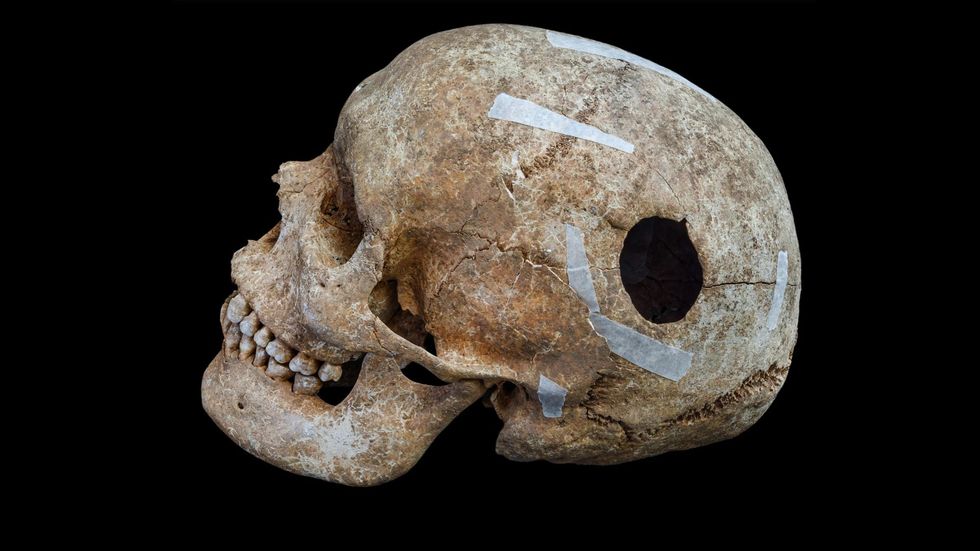
A Viking era skull has been discovered with evdience of an early form of brain surgery
|CAMBRIDGE ARCHEOLOGICAL UNIT/DAVID MATZLIACH
She suspected a tumour affecting his pituitary gland could have triggered an overproduction of growth hormones.
"We can see this in the unique characteristics in the long shafts of their limb bones and elsewhere on the skeleton," Dr Biers said.
Such a growth in the brain would have created increased pressure within the skull, resulting in severe headaches.
The trepanation procedure, she suggested, may have been an attempt to relieve this painful symptom, a treatment approach "not uncommon with head trauma today".
LATEST DEVELOPMENTS:
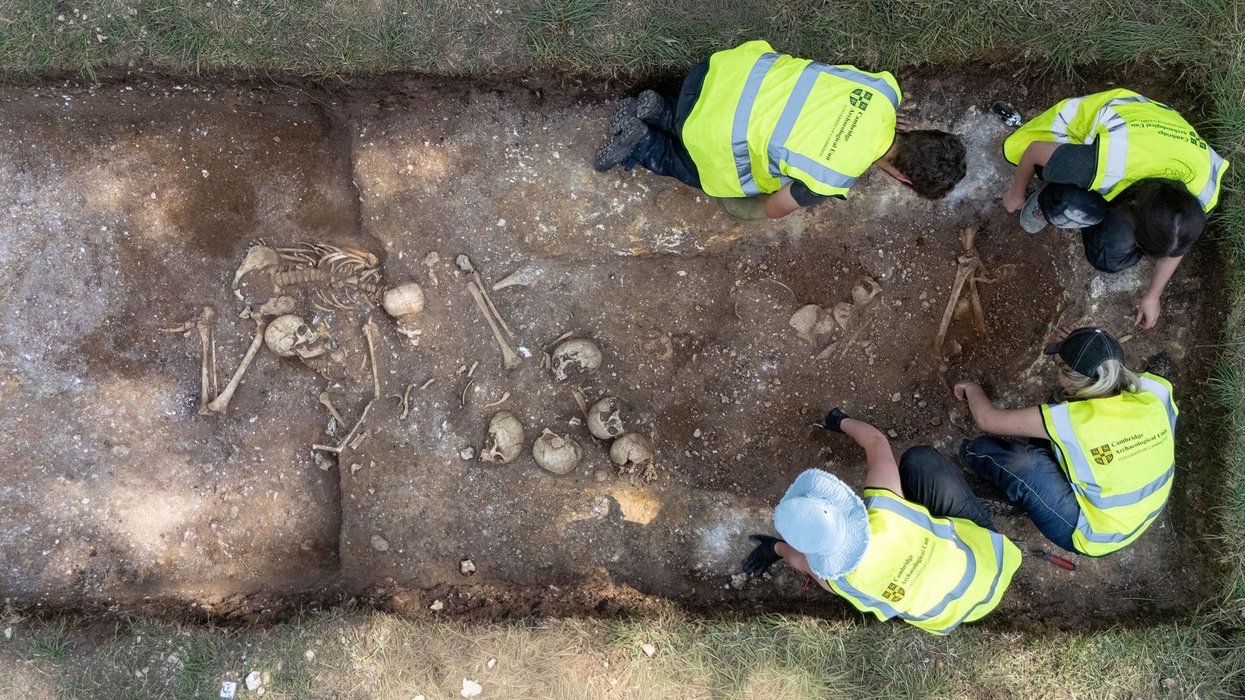
The body was found discarded face down in a burial pit alongside nine other men, with the remains dating to the 9th Century
|CAMBRIDGE ARCHEOLOGICAL UNIT/DAVID MATZLIACH
The body was found discarded face down in a burial pit alongside nine other men, with the remains dating to the 9th Century.
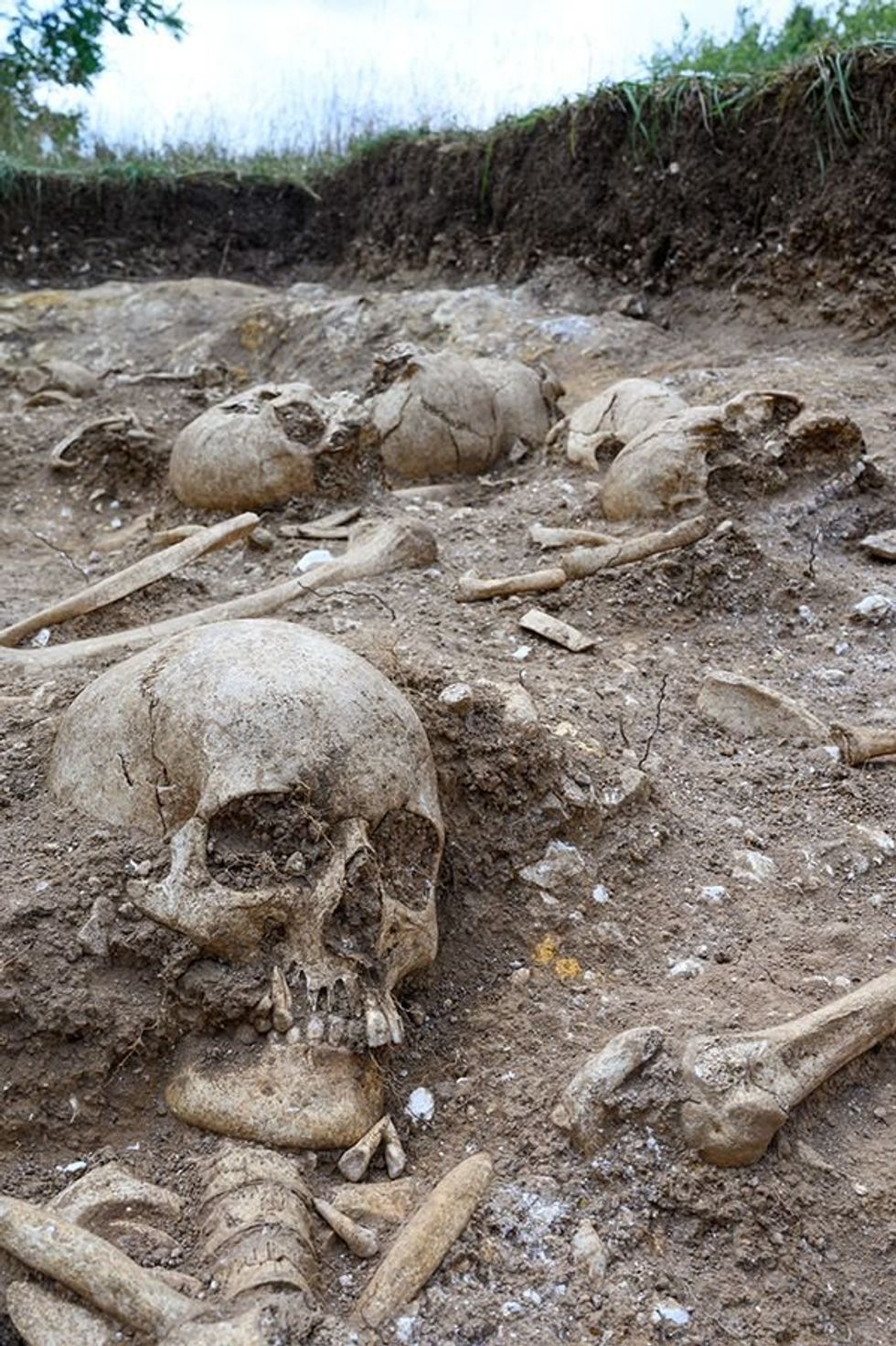
Alongside four complete skeletons, the pit contained a cluster of skulls without accompanying bodies and what researchers described as a "stack of legs".
Some of the intact remains were positioned in ways suggesting the individuals had been bound before death.
The mixture of whole bodies and dismembered parts is highly unusual, even for a mass burial of this kind.
One victim had clearly been decapitated, while another appeared to have been restrained, pointing towards possible executions rather than battlefield casualties.
The discovery dates to a turbulent period when Cambridge sat on the frontier between the Saxon kingdoms of Mercia and East Anglia, which fell to Viking forces around AD870.
The Viking Great Army then sacked Cambridge in the year between AD874 to 875.
Dr Oscar Aldred, who led the Cambridge Archaeological Unit training dig, offered a possible explanation for the grim scene.
The discovery dates to a turbulent period when Cambridge sat on the frontier between the Saxon kingdoms of Mercia and East Anglia, which fell to Viking forces around AD870
|CAMBRIDGE ARCHEOLOGICAL UNIT/DAVID MATZLIACH
"Those buried could have been recipients of corporal punishment, and that may be connected to Wandlebury as a sacred or well-known meeting place," he said.
He suggested some of the separated body parts may have been displayed as trophies before being gathered and buried with the executed or slaughtered individuals, per the BBC.
Researchers will now conduct DNA and isotopic analysis to determine whether the dead were Viking invaders or Saxons.