







The legendary "golden armour" of Tang Dynasty soldiers has been reconstructed in full for the first time in history, after centuries of mystery.
Chinese archaeologists have just unveiled a stunning restored suit of gilded bronze armour – the sole surviving physical example from this remarkable period in Chinese history.
The Key Laboratory of Archaeological Sciences and Cultural Heritage at the Chinese Academy of Social Sciences revealed the meticulously reconstructed armour on January 14.
It took nearly four years of painstaking work to piece together this 1,200-year-old treasure, discovered in fragments at a royal tomb on the Tibetan Plateau.
The armour was unearthed from the Xuewei No1 Tomb in Dulan County, Qinghai Province, where excavations began in 2018.
The burial belonged to a king of the Tuyuhun, a once-powerful people who controlled vast stretches of China's western frontier.
When researchers first entered the tomb, they found the bronze plates and lacquered horse armour scattered together, badly broken and corroded.
Some pieces were so fragile they risked shattering at the slightest touch.
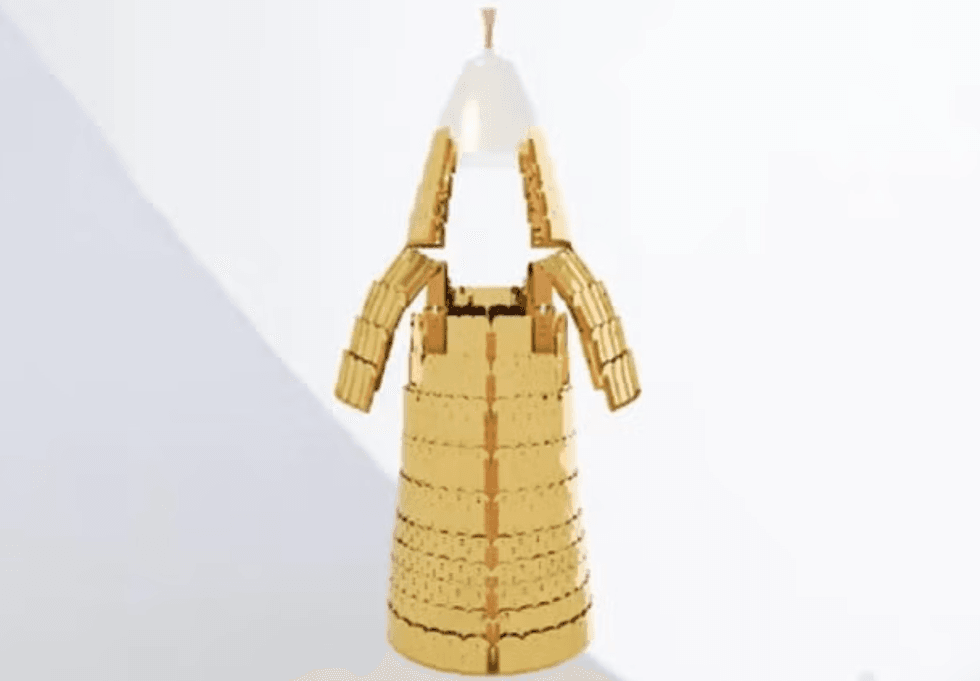
The legendary 'golden armour' of Tang Dynasty soldiers has been reconstructed in full for the first time in history, after centuries of mystery
|CHINESE ACADEMY OF SOCIAL SCIENCES
Tang poet Wang Changling had famously written: "We will not leave the desert till we beat the foe, although in war our golden armour be outworn 100 times."
Until now, those words seemed more poetic flourish than historical fact.
The conservation team at the Chinese Academy of Social Sciences employed cutting-edge technology to tackle the puzzle.
Each fragment was captured using 3D scanning to record its precise original position, while scanning electron microscopy and ultra-depth microscopy revealed how the plates were crafted and what metals they contained.
LATEST DEVELOPMENTS
"We adopted a strategy of 'disassembling the whole into parts and reassembling the parts into a whole', conducting layered cleaning, extraction and protection while meticulously cataloguing each armour plate," cultural heritage conservation expert Guo Zhengchen explained at the unveiling press conference.
The team also created a detailed video reconstruction showing the armour's likely original appearance.
The tomb's occupant was confirmed as a Tuyuhun king, and researchers believe the golden armour was likely among his most treasured possessions – probably serving a ceremonial role to signal royal power rather than for actual battlefield use.
Gold artefacts and silk textiles found alongside the armour point to elite status, while tree-ring dating of the wooden tomb structure places the burial firmly in the mid-eighth century.
Dulan County itself was a crucial stop on the ancient Silk Road, connecting the Tang capital of Chang'an (modern-day Xi'an) with Central Asia and Persia.
Our Standards: The GB News Editorial Charter