










Sir Keir Starmer has been handed the blueprints for how to roll out digital ID without risking the public's wrath.
A Home Affairs Committee report has determined a lack of consultation and poor communication had "raised fears of Government over-reach" when the PM tried to introduce the controversial scheme last year.
Chairwoman Dame Karen Bradley said the rollout of digital ID was "nothing short of a fiasco", which "came out of the blue and made little sense".
She added: "It raised fears of Government over-reach into people's lives and was so poorly thought out that they had few answers to ease these concerns.
"It is worth bearing in mind that this was a policy direction that was generally well received by the public before they were spooked by the Government’s poorly thought out and badly explained plans."
Despite determining the initial rollout to be a failure, the Home Affairs Committee determined that digital ID has "potential" - and revealed how it could be successfully put in place.
The scheme, announced last year, would have made digital ID mandatory on phones for British citizens and legal residents - primarily as proof of the right to work.
As Sir Keir announced the policy at last year's Labour conference, he said: "Let me spell it out: you will not be able to work in the United Kingdom if you do not have digital ID."
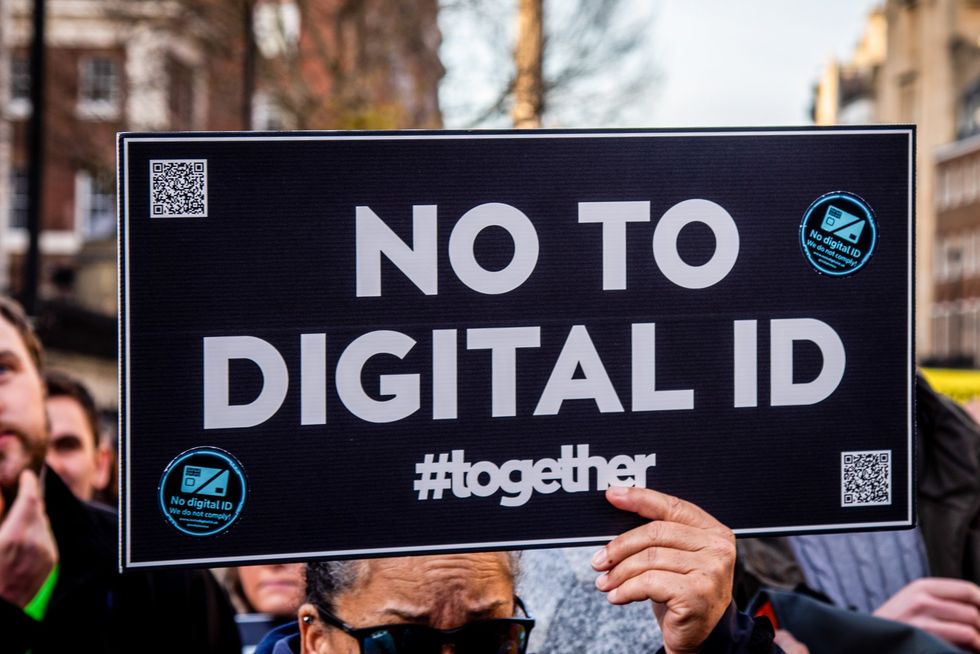
The announcement of digital ID resulted in protests and outrage over fears of 'Government over-reach,' the Home Affairs Committee said
|GETTY
Labour went on to U-turn and drop the mandatory requirement, but ministers are still pushing for it to be required for digital right-to-work checks.
It has urged the Government to be "clear about the evidence base behind its decision-making" for future digital ID plans.
Labour should explore how to "include a broad range of perspectives" in digital ID strategies, the committee said.
It added: "The decision to carry out innovative public consultation and engage with stakeholders is welcome.
"Consideration should be given to further innovations, including repeating its People’s Panel to consider any proposed future expansion of digital ID."
MORE ON DIGITAL ID:

Dame Karen Bradley said digital ID was a 'policy direction that was generally well-received by the public' before poor implementation by the Government
|HOUSE OF COMMONS
The Government's People Panel surveyed a "diverse group" of 120 people, "selected independently to be broadly representative of the UK population".
The panel met for seven online and in-person workshops and developed "shared recommendations for Government".
The Home Affairs Committee has also instructed the Government to develop a "detailed roadmap" for implementation of the technology, and use the expertise of existing digital verification services.
The digital verification sector soared in value to more than £2billion after the Online Safety Act, with the majority of the 266 firms operating in London.

Sir Keir Starmer announced the policy at last year's Labour Conference
|GETTY
The Home Affairs Committee has also said the Government should "address the question of what identity documents will be required to work in the UK in future", and provide support to those who could be at risk of falling out of the job market.
Dame Karen said: "Ministers have rightly gone back to the drawing board and begun the difficult task of rebuilding trust in what has the potential to be a valuable tool for government. Alongside potential benefits remains the potential for significant changes in the way people access services or interact with the state.
"That is why Government must include voices from across society in deciding the direction of digital ID.
She added: "As well as learning from early mistakes in the announcement of this strategy, it must be mindful of long-term failures in government delivery of IT delivery.
"Each element of its future digital ID strategy must have clearly defined aims, a comprehensive plan for delivery and strong safeguards
"Any future mistakes might prove fatal for public confidence."