



John Swinney was re-elected as First Minister of Scotland today – 11 days after the SNP became the largest party north of the Border.
Although it is mathematically unlikely anyone but the leader of the largest cohort of MSPs takes up the mantle of First Minister, the top job comes down to a vote by MSPs after all party leaders put themselves forward.
Holyrood heard from six party leaders for the first time since the election on May 7: incumbent First Minister and SNP leader John Swinney; newly elected Malcolm Offord leading Reform UK; Scottish Labour’s Anas Sarwar; one half of the Scottish Greens leadership, Gillian Mackay; Russell Findlay with his decimated Scottish Tories; and the Scottish Liberal Democrats' Alex Cole-Hamilton.
One MSP has already been deducted from the SNP's 58 elected officials after Cunninghame North's Kenny Gibson was chosen as the Scottish Parliament’s Presiding Officer last week and assumes neutrality.
Mr Gibson introduced the candidates alphabetically, beginning with Mr Cole-Hamilton, calling on the Parliament to put the constitutional question of independence “in deep freeze”.
Regrouping after a dismal set of election result for the Tories, Mr Findlay acknowledged the process was a “foregone conclusion” but followed the Liberal Democrat leader in urging Mr Swinney to listen to voters who wanted to avoid “a distracting and painful return to arguments of the past”.
Ms Mackay hailed “the biggest ever independence-supporting majority and the biggest ever majority for parties who are socially progressive".
She added: “Those who lost this election were the ones chasing those votes to the right and that has to inform what we do this session.”
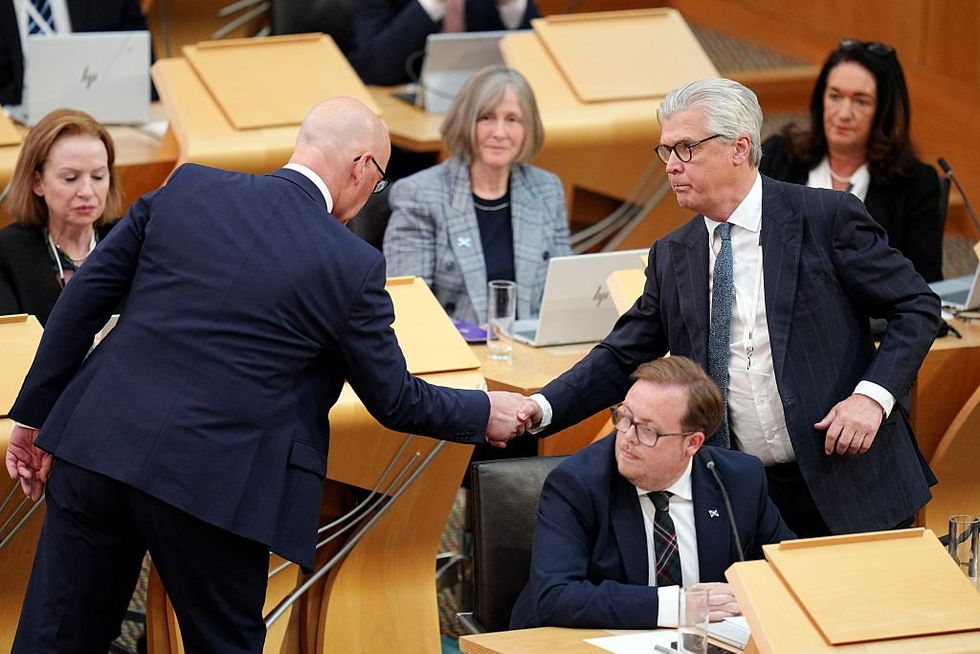
First Minister John Swinney shaking hands with Reform UK's leader in Scotland Malcolm Offord in the Scottish Parliament
|GETTY
For the first time in its history, Reform UK nominated a First Minister candidate in Lord Offord, who criticised the SNP for the abandonment of the ideals of influential Scottish philosopher Adam Smith.
He said: “The engines of prosperity are straining and we find ourselves punishing those who aspire, those who are ambitious for themselves, their families and communities simply for trying to enjoy a good decent life.
“This can’t continue – this must not continue – if we wish to build a prosperous Scotland that works for all we can not be led by this ideology of impoverishment.”
Mr Sarwar preemptively congratulated Mr Swinney on a well-fought election and noted the historic group of colleagues that has more first-time MSPs than ever before.
LATEST DEVELOPMENTS
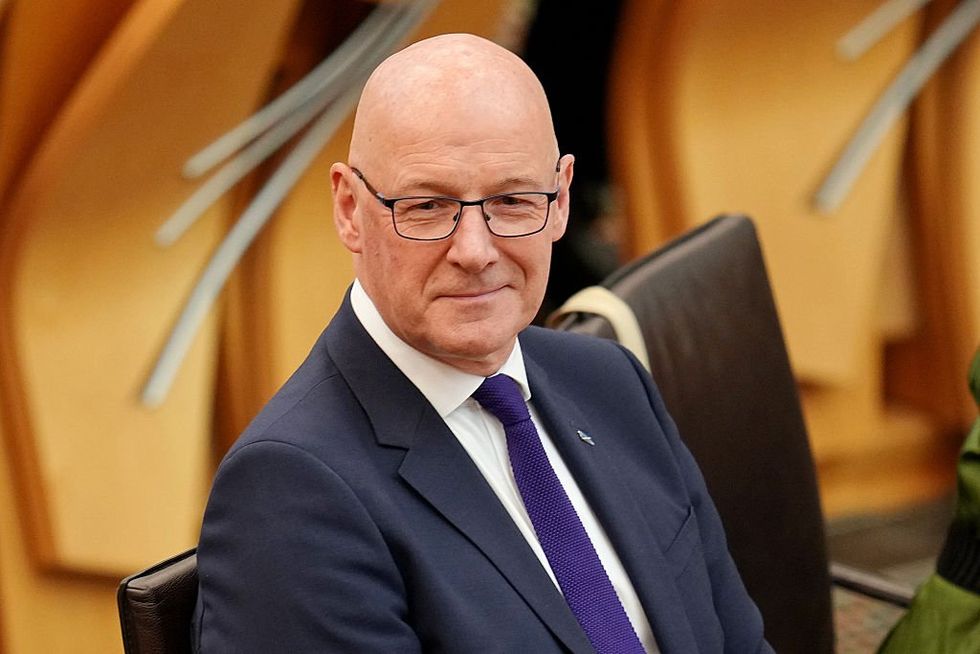
John Swinney has been selected as First Minister in Holyrood’s seventh parliamentary term
|GETTY
Mr Swinney introduced his “clear mandate from the people of Scotland” for his re-election as First Minister.
After reconfirming his determination to “press for the future of Scotland to be decided by the people of Scotland” he admitted: “No government delivers alone, and certainly not a government that alone, does not command a majority in this parliament."
During his closing remarks, he stated what Scotland needed is “delivery”, not “debate”.
Breaking the tension of eliminations through 20 long rounds of voting, the Presiding Officer explained to two members why their votes were forfeit and reminded Scottish Green MSP Q Mannivanian to stand up with addressing with a point of order, stating “we’re all on a steep learning curve here".
Addressing the Parliament in his acceptance speech, Mr Swinney said: "Today I feel many of the same emotions as when I first became First Minister two years ago: the same sense of humility; the same profound sense of responsibility of holding this office.”
“I remain firmly of the view that when we engage in constructive dialogue, we are capable of tremendous progress.
"I believe I can achieve a majority for every ambition I have for this parliament, and I look forward to working with many here to do so.
“That of course includes the question of Scotland’s constitutional future – which I recognise there are profound differences of opinion on – but the people have now elected the largest pro-independence majority in the history of devolution.”
He acknowledged a unique vantage point from being one of only four MSPs remaining “from the class of ’99”, which also includes Mr Gibson and Scottish Labour's Deputy Leader, Dame Jackie Baillie.
“By electing a parliament of minorities, the voters have given us clear instruction to work together,” he said.
Mr Swinney will be sworn in at the Court of Session in Edinburgh in the coming days, after which he will announce his Cabinet at the First Minister’s Bute House residence.
He will then reveal whether he plans to forge a formal alliance with any of the other parties.
Our Standards: The GB News Editorial Charter