




British businesses are set to be hammered by new EU regulations under Keir Starmer's EU 'reset'.
It comes after the Department for Environment, Food and Rural Affairs (Defra) Secretary Emma Reynolds made a statement to the Commons yesterday regarding negotiations for the incoming ‘SPS’ food and drinks deal, telling companies to get ready for the regulatory changes coming as soon as next year.
Charts compiled exclusively by think tank Facts4EU in collaboration with Stand for our Sovereignty and CIBUK.Org, now reveal the scale of the changes coming down the chute, which will affect half a million UK businesses involved in the food, farming, and ancillary sectors.
Critics accuse the Government of reversing the result of the historic referendum held in 2016, with former Conservative MP John Redwood telling the People's Channel the pact "makes us a colony of the EU" and John Longworth, Chairman of the Independent Business Network and former boss of the British Chamber of Commerce, calling it an "absolute disaster".
What the deal entails
The deal, known as 'dynamic alignment' in Brussels, de facto hands oversight of trade in food and agricultural products back to the European Court of Justice (ECJ).
The Government insists aligning with the EU standard will remove frictions imposed by Brexit, making it easier for products to flow back and forth between Britain and the bloc.
However, the authors of the Facts4EU report explain the ‘SPS’ food and drinks deal prevents Britain from using its world-beating expertise in areas like preventing crop disease through genetic modification, increasing efficiency and productivity per acre.
Britain will revert to the "lower standards" of agriculture in the EU, they warn, adding: "Once again, our farmers will get hit, just when many of them are struggling to survive the new laws imposed on them."
The report only scratches the surface of the changes coming, as there are many other areas to consider. One example is the impact on businesses that are importing from non-EU countries.
Going forward, the ability to import certain products will be restricted, even if they are cheaper than the alternatives available from the EU.
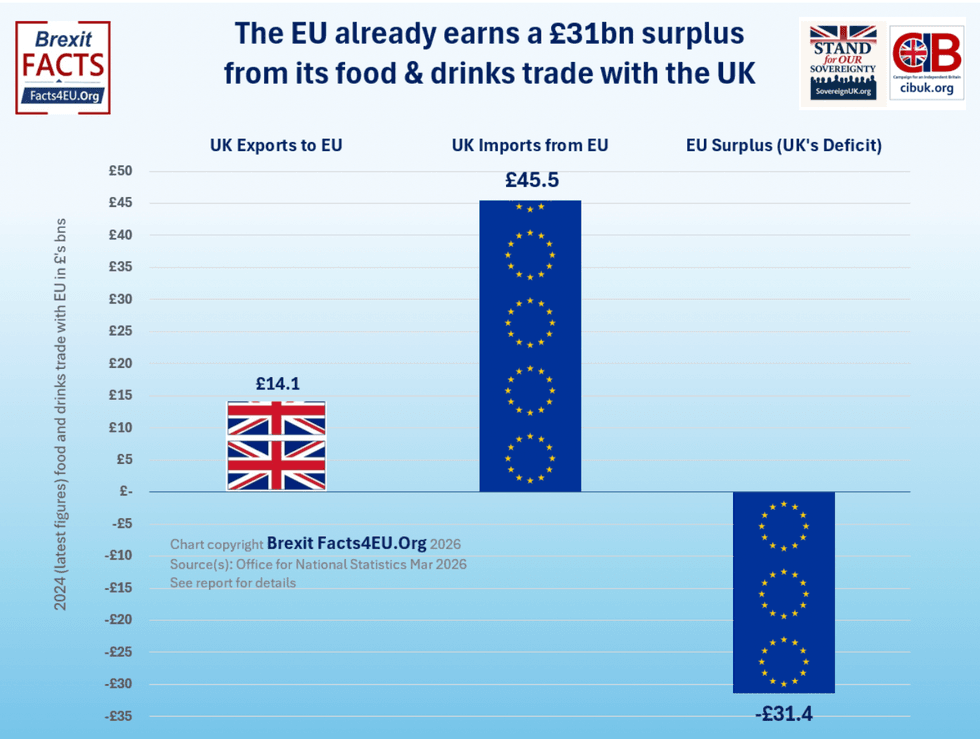
The existing arrangement already benefits the EU, which runs a £31billion surplus in the food and drinks trade with Britain
|Facts4EU
As the chart above shows, the existing arrangement already benefits the EU, which raises serious questions over what's in it for Britain.
The EU runs a £31billion surplus in the food and drinks trade with Britain, accounting for 71 per cent of all food and drink imports to the bloc.
Although all exports contribute to Britain's GDP and are therefore important, those heading to the continent only amount to £14billion, with Britain racking up a trade deficit with the bloc of £31billion.
Exports of food and drink are particularly meagre, representing just 0.5 per cent of UK GDP (see chart below).

The list goes on
To illustrate the sheer number of sectors and businesses coming into the EU's regulatory crosshairs, Facts4EU has compiled a list of EU Regulations and Directives which will have to be followed from next year (see chart below).
It should be noted these businesses will not only have to adapt to the new deal from next year, but also on a dynamic basis going forward, as the EU’s regulations get added to or changed.
This will therefore involve annual costs in order to keep checking on, and applying, the new Regulations and Directives.
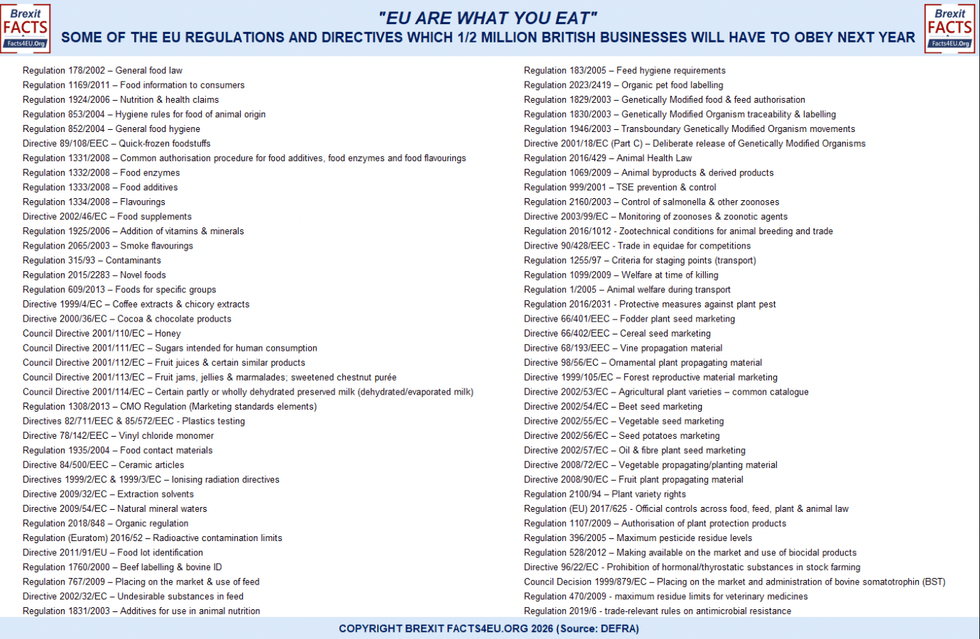
The number of sectors and businesses coming into the EU's regulatory crosshairs
|Facts4EU
Reacting to the new deal, Mr Redwood said: “The Government has no idea how to negotiate or how to grow the economy. In a hopeless attempt to increase our very small food exports to the EU, they propose to land our large and successful domestic food industry with extra costs and many damaging rules, hitting their competitiveness and ability to innovate.
“The Government gives in to EU demands to pay them money and to accept their laws. They never even ask for them to pay us money to continue their access to our very lucrative market, or to adopt UK laws which are better for business.
“This is not building a partnership but by stealth gradually making us a colony of the EU, paying them tribute and doing what they tell us to do.”
More From GB News