









A new report makes the case for reversing Brexit hard to defend in a further blow to pro-Remain campaigners.
With Keir Starmer's negotiation with the European Union well underway, a bombshell new report rebukes claims by Remainers that Brexit damaged economic growth.
The report from thinktank Facts4EU, shared exclusively with the People's Channel, is based on the official data from the Office for National Statistics.
The data shows conclusively that if Sir Keir is determined to take the United Kingdom back under EU laws and regulations again in 2026, he will not be able to do so by using one pretence after another.
The new graphs are in stark contrast with claims made National Bureau of Economic Research (NBER), a leading US think-tank, who published a decade-long analysis concluding that Brexit has reduced UK GDP by between six and eight per cent.
It was brought up by Liberal Democrat MP for Surrey Heath, Dr Al Pinkerton.
On December 9, Dr Pinkerton told the Commons: "Up and down the country, businesses know it, the public feel it and it is time that this House found the courage to lift our whispered voices and admit it: Brexit has been an abject economic failure.
"It has choked business investment, shattered economic resilience, strangled trade, shrunk the economy and left every single one of us poorer."
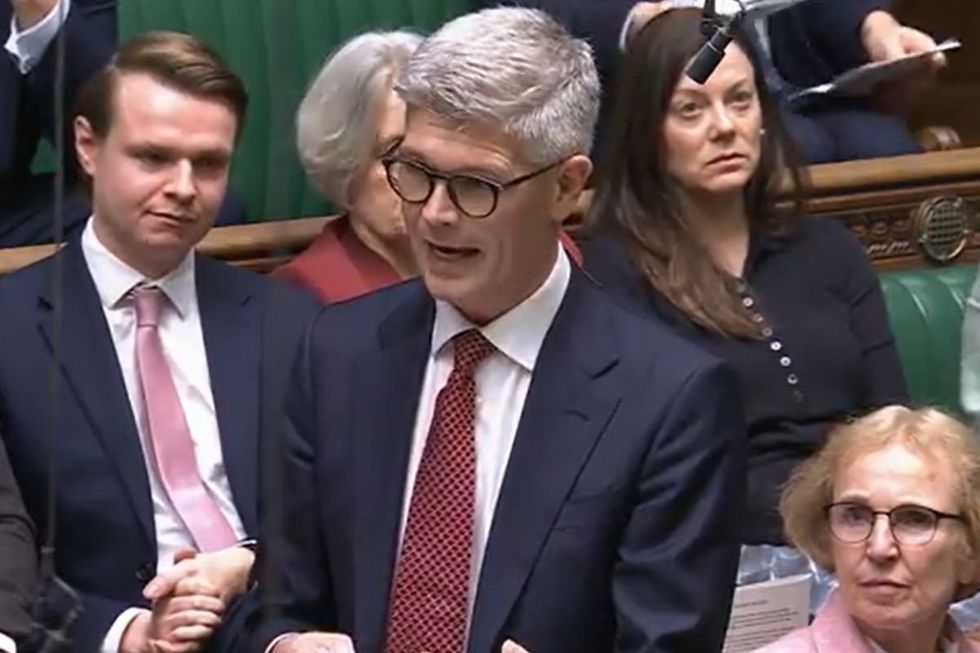 The Ten Minute Rule Bill was brought forward by Liberal Democrat MP Dr Al Pinkerton | PARLIAMENT TV
However, the paper by the NBER does not claim that Brexit has "shrunk the economy".
Instead, it forecasts, in effect, that the economy is six to eight per cent smaller than if there had been no Brexit.
The first chart demonstrates the actual position of the UK and the EU’s top three economies. The second chart is what it would look like with the UK’s GDP eight per cent higher, ie: "without Brexit."
As the second chart demonstrates, it is highly unlikely that the UK would have out-performed the EU's top three economies by such an amount.
This is partly due to the refusal of the British establishment to take advantage of Brexit freedoms to follow better growth policies holding us back.
LATEST DEVELOPMENTS
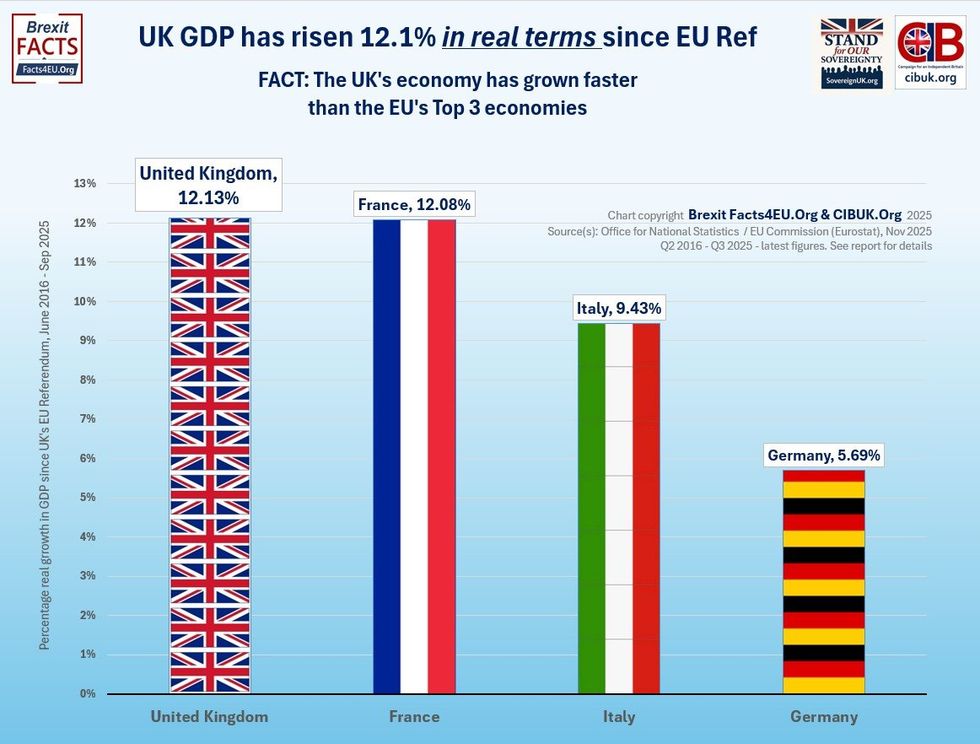
A chart showing real term GDP growth
|BREXIT FACTS4EU
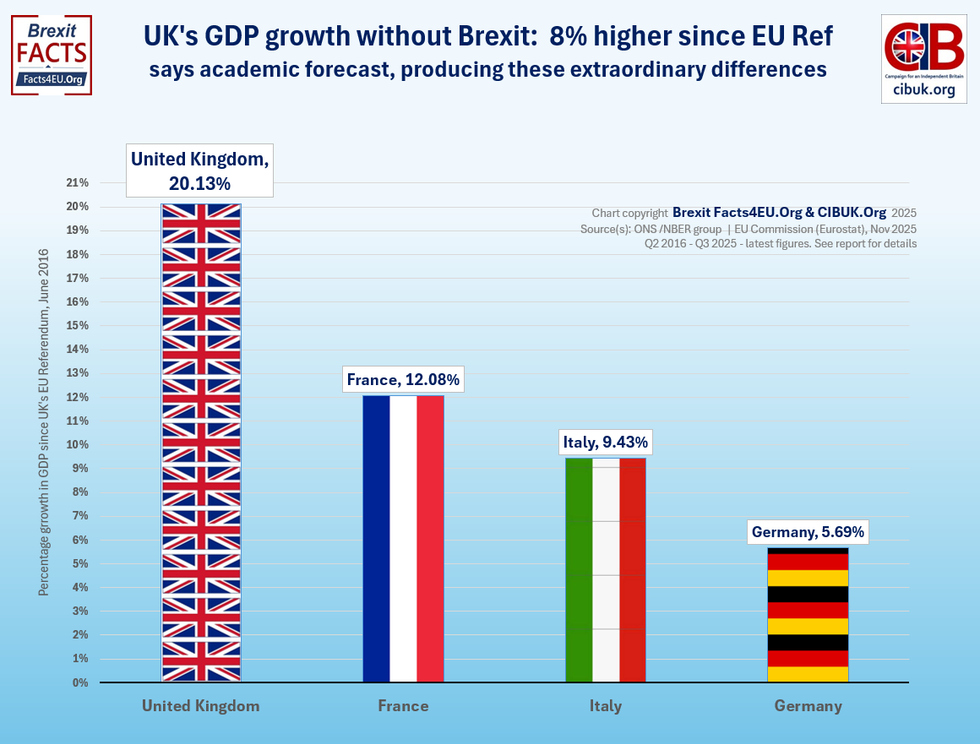
The differences between the UK and the 'Big Three' of the EU are stark
|BREXIT FACTS4EU
It is important to emphasise that although this academic paper covers the 10-year period for which there are facts such as annual GDP, it does not use them.
Nor does it compare the UK to its closest competitors, as Facts4EU typically does.
Instead the team at Facts4EU created their own formulae to make forecasts of what the UK economy might have looked like without Brexit. The most important problem, however, concerns the methodology.
To arrive at its conclusions, the ‘NBER’ working paper uses different countries for its comparisons. It would be hard to pick a more bizarre list.
In the crucial GDP series, it uses 60 per cent US, 11 per cent Estonia, 10 per cent Greece and 10 per cent Italy and Ireland.
The normal thing to do would be to compare with similar economies. None of the countries on the list is remotely comparable with the UK with the possible exception of Italy.
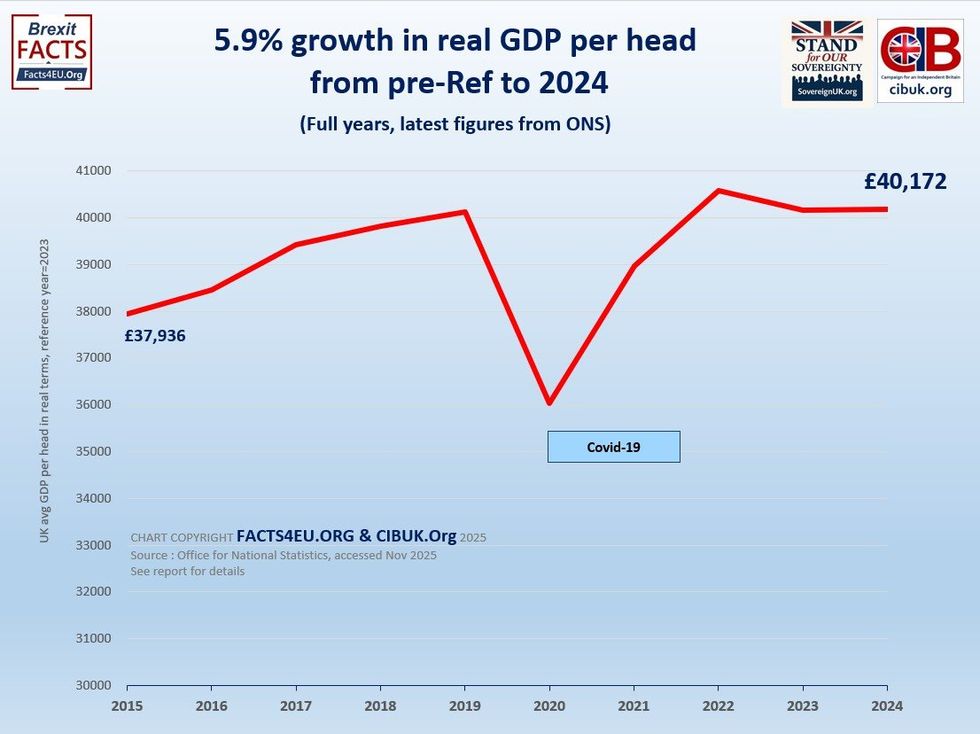
The growth in GDP per head since 2015
|BREXIT FACTS4EU
The US is far larger and has had superfast growth from lower taxes and digital supremacy. Former Soviet Estonia is an economic outlier and its economy is 1/85th of the size of the UK’s.
Ireland has fast growth from extra low business taxes making it a home for US digital giants.
Greece is recovering from the Euro crisis with generous EU subsidies, as is Italy to a lesser extent. France and Germany, the two most similar economies to the UK, are nowhere on the list.
The paper also mentions GDP per head. Once again, contrary to what the public are told, this has actually risen. Below is the proof, with data from the Office for National Statistics.

Sir John Redwood has addressed the findings
| GB NewsCommenting on the findings, Tory MP Sir John Redwood said: "The OBR forecast made before the referendum said that UK productivity could suffer a 0.25 per cent per annum decline, leading to a potential four per cent loss over 15 years.
"This became translated falsely into a loss of four per cent of GDP from Brexit, which many have wrongly claimed has already taken place.
"The crucial things to note in the OBR version was it was a long-range forecast, it was not an actual reduction in GDP nor even a reduction in productivity, but a forecast of a slightly slower rate of growth in productivity.
"So what has gone wrong with interpretations of it?
"It is not possible to accurately forecast an outturn in 15 years’ time when so many things affecting growth and productivity will come to weigh on the results.
"A list of things affecting productivity today for the UK would lead with the deliberate closure of some of the most highly productive industries including oil, gas, oil refining, heavy industry, and diesel and petrol car making.
"It would include the impact of working at home and the collapse of productivity in the UK public sector brought on by the Covid lockdowns.
"On the positive side there would be the impact of Artificial Intelligence which had not been dreamed up when the OBR made its long-range guess."
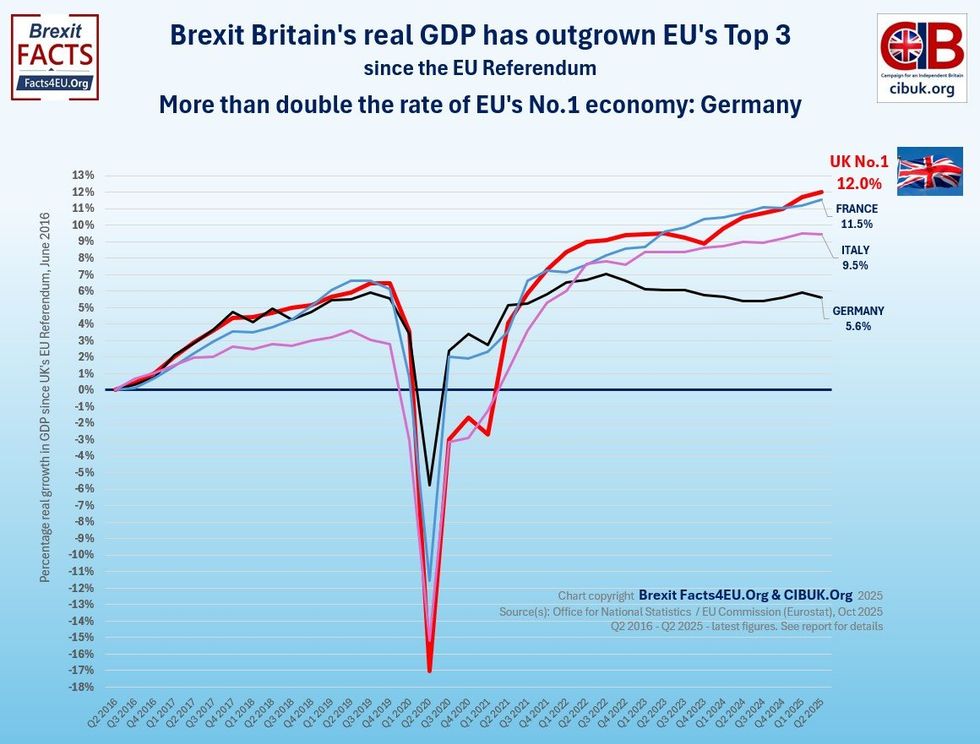
A chart showing the Real GDP Growth since the EU Referendum
|BREXIT FACTS4EU
Collectively, the figures demonstrate the UK has grown slightly faster than the leading EU economies out of the EU. It has not suffered a Brexit fall.
They show we along with the EU have continued to fall further and further behind the fast-growing United States.
The heavy burden of tax and regulation which the UK still shares in large part with the EU holds us back. Brexit is full of opportunities which so far governments have failed to grasp fully to free us from excessive EU-style government.
The ending of UK money contributions to the EU has helped our budget, and the new trade deals with India, Trans Pacific Partnership (CPTPP) and others have helped boost our non-EU trade.
Our Standards: The GB News Editorial Charter