







I won’t forget Wednesday evening in a hurry. I was surrounded by police. And I’m not talking your local response cops here, I’m talking about a very serious show of force.
Actually, the Metropolitan Police has not called itself a force for a long time now; it prefers to be known as The Metropolitan Police Service, but somehow, ‘a show of service’ doesn’t quite have the same ring to it.
Regardless, there were a lot of them, and many very senior ranks as well. Leading the troops was none other than Assistant Commissioner Laurence Taylor, who heads up Specialist Operations, so if detectives want to covertly enter the home of a global criminal kingpin and plant bugs all over the place, he’s the Guvnor that will ultimately sign it off.
His day job also includes being Britain's most senior counter-terrorism officer. Top brass indeed.
Next in the pecking order was Deputy Assistant Commissioner Lou Puddefoot, who, like me, started her police career in Peckham, south London.
Unlike me, Lou has now achieved no less than seven promotions, and having joined The Met in 2001, I suspect she’s not finished climbing the greasy pole of promotion yet.
Who knows, if she successfully scales the next three rungs on the ladder, she’ll be the commissioner, the country’s top cop.
There were many more, including a superintendent, two chief inspectors (one of whom was a detective), at least two inspectors, a number of sergeants (plain clothes and uniform), and of course, that bedrock of policing, frontline constables.
They’d even called out a detachment of cadets, who, when it came to smartness and civility, were an absolute credit to themselves, those who have raised them, and anyone else who has taught them how to buckle their boots, engage politely, and stand to attention.
A number of lanyard-wearing and therefore readily identifiable police staff were attentively busying themselves. From what I saw, they all seemed willing to go the extra mile if required.
Was this considerable turnout of officers and staff an effort to keep the peace at a pro-Palestine march? No, of course it wasn’t, I mean, why would I go to one of those revolting gatherings?
I have no desire whatsoever to wrap myself in a keffiyeh and chant genocidal hatred, nor do I wish to call for the death of another nation’s army.
Rather, I was at an extremely well-behaved gathering of concerned local people like me, who had grabbed ourselves a ticket to attend a meeting held by The Met to promote its ‘A New Met for London – Phase 2’ plan. We’d been told that we were going to hear how the old bill planned to fight crime in our area, so I deemed my attendance compulsory.
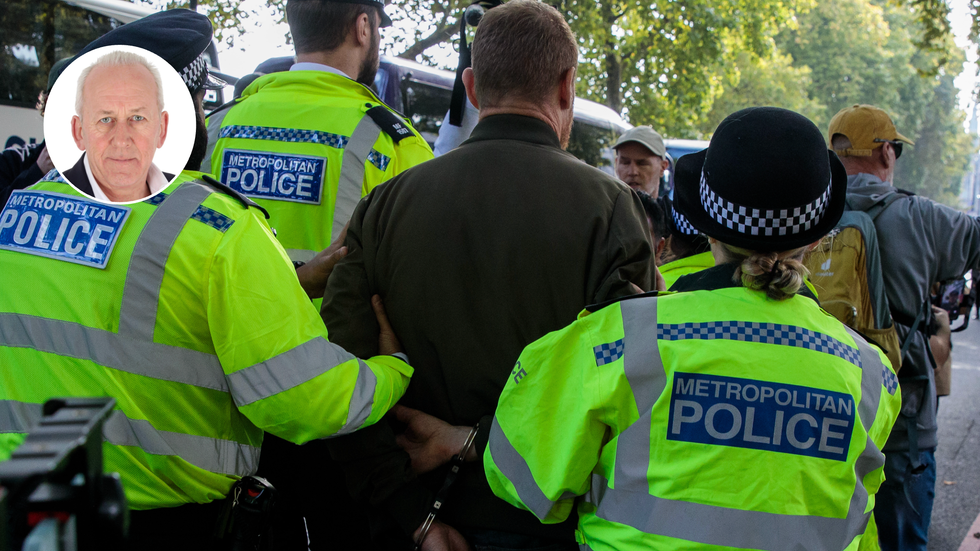
Good riddance to police and crime commissioners — but hell no to who is replacing them - Peter Bleksley
|Getty Images
I also knew there was going to be a question and answer session, so I saw it as an excellent opportunity to listen to what the police had to say, and perhaps, in a small but important way, try to hold them to account, because police accountability is extremely important.
When Sir Robert Peel laid down his foundations for establishing the police, he said, ‘the police are the public and the public are the police’.
Assistant Commissioner Taylor even quoted this principle on Wednesday evening, so if it is to be abided by, it quite naturally follows that it should be the public that scrutinises what our police do.
The Tory–Lib Dem coalition government of austerity didn’t see it that way and foolishly set about abolishing the largely volunteer ‘Police Authorities’ that had been in existence since 1964.
Whilst these authorities had not always been robust enough in holding Chief Constables and their officers to account, a beefing-up of those arrangements would have been, in my opinion, far better than what was to follow.
Police and Crime Commissioners (PCCs) were locally elected for the first time in 2012. Voter turnout was generally low and has remained so.
The overwhelming majority of PCC candidates were political sops who needed to be aligned to a major party in order to get the campaign assets and profile that would get them their very well-paid roles.
Some incredibly hapless characters suddenly found themselves enjoying salaries that now range from about £70,000 to £100,000, depending on the size of the constabulary they were supposed to call to heel.
LATEST DEVELOPMENTS
Political influence, rather than neutral local concerns, often interfered with policing. Some PCCs cosied up to their Chief Constables, knowing all the while that the money they were earning would be a career highlight, because no one in the public sector would ever reward such little talent with so much money.
I debated with a number of these out-of-their-depth elected officials on national television, once most notably on GB News.
I unashamedly and unmercifully shredded this wittering PCC by exposing her lack of understanding of the law, and the challenges that frontline officers face.
If that live debate had been a boxing match, the referee would have stopped it to save the PCC from further punishment, but it wasn’t, so the presenter brilliantly allowed me to expose this commissioner’s blathering political hogwash for exactly what it was.
On Thursday, I was very pleased to see that the government are, not before time, going to abolish the roles of Police and Crime Commissioners. I was surprised and delighted that lamentable Labour were finally going to get something right.
No sooner had Policing Minister Sarah Jones MP finally given me cause for optimism than she announced in the same breath that powers to hold the police to account would be devolved to locally elected mayors.
"What!" I shouted at my telly, this arrangement already exists in London, where the oh-so-easy-to-dislike Sir Sadiq Khan is supposed to keep The Met in check.
Feel free to ask any sane Londoner how that arrangement is going, but please do it face-to-face, because if you call a resident of our capital city on their phone, the chances are it will be answered by a thief who has just snatched it from its rightful owner.
Policing needs to be held to account by regular, local, public-spirited people who have some life experience, know what the issues are, and are not afraid to ask difficult questions.
It would also help if they could smell BS from a hundred meters. Politically aligned mayors are most definitely not the answer.
Anyway, back to Wednesday evening, and my attempt to squeeze a small amount of accountability from The Met.
Many questions were posed from the floor, but only two garnered a small round of applause from the public. Yep, one was mine, which was more of a statement than a question, as I pointed out to the panel of senior officers that if our local cops were visible, known, contactable through other means than a website, then they would become trusted, and we the public would be far more likely to be the, ‘eyes and ears of The Met’, which the superintendent had earlier asked us all to be.
After the modest but enthusiastic applause had subsided, both the superintendent and the assistant commissioner replied.
Let me put it this way, I now know a lot about the challenges facing The Met, but unfortunately, I don’t expect my local police to become any more visible anytime soon.
The other question that was met with applause came from a fella who told us he had worked in a variety of security roles in the borough for some thirty years.
He looked like the sort of bloke I would thoroughly enjoy going for a pint with. He regaled us with an unfortunate litany of assaults and subsequent injuries that he had suffered over the years, together with a wide variety of crimes that he had witnessed and often intervened in.
He had huge concerns about shoplifting, and his question was more or less framed as, ‘What are you going to do about all of this?’
Part of the reply he received from one of the senior officers won the ‘Most stupid comment of the night’ award by a considerable margin.
It was, ‘We can’t arrest our way out of the shoplifting problem’, which is, of course, precisely how you tackle this rampant epidemic of lawlessness which is blighting our nation. No wonder there’s a crime wave.
British police surrendered the streets to criminals many years ago when they abandoned foot patrols.
It was clear from my evening spent surrounded by The Met that they have no intention of returning to that anytime soon, if ever.
I realise that crimes committed behind closed doors like child abuse and domestic violence rightfully need resources being applied to them, but our streets are now so unsafe in so many areas due to knife crime, phone theft, car crime, vicious assaults, shoplifting and more, that in many regards, the police have created this appalling situation by retreating behind the walls of their fortress-like bases.
Holding the police to account has never been more important. They are most definitely not the public as things stand. It is pointless to ask them to take a long, hard look in the mirror because all they will see is themselves and what they perceive to be their good intentions.
Someone needs to tell them what the road to hell is paved with.
More From GB News