

With powerful allies in short supply, white working-class Britons are uniting to challenge the discrimination against them - Paul Embery
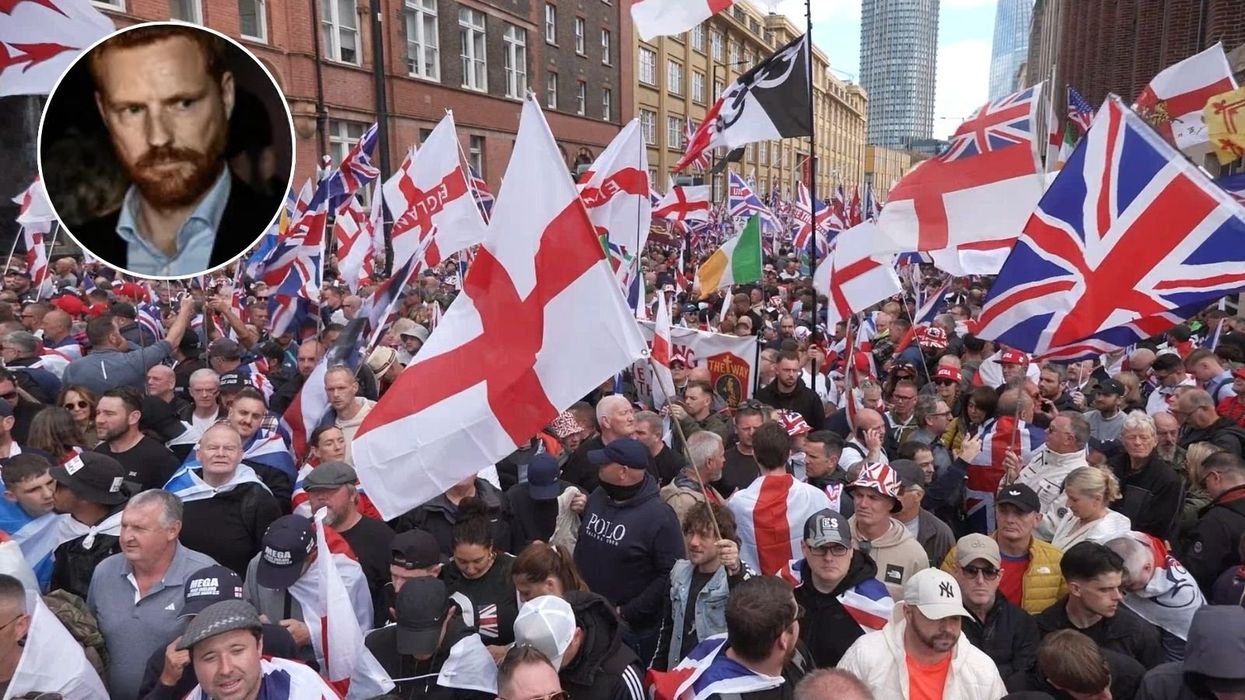
Trade unionist and author Paul Embery warns against ignoring the emerging protest movement as white reactionaries
|PA



Trade unionist and author Paul Embery warns against ignoring the emerging protest movement as white reactionaries
Don't Miss



Most Read


Trending on GB News
For most of my 30 years of activity as a foot soldier of the British Left, the topic of white identity politics has been considered taboo. You just didn’t mention it in polite company – unless it was to lambast those who peddled it.
No longer is this the case. White identity politics has become a fixed feature of our political landscape – and with each passing day is becoming more mainstream.
In truth, that saddens me. I have no interest in ‘blood and soil’ nationalism and have in the past marched against groups such as the National Front and British National Party. Skin colour should not be a faultline in our society, and nobody will persuade me that the likes of Rishi Sunak and Frank Bruno are not Englishmen.
But the gradual creep of white identity politics from the outer fringes to the frontline will surprise nobody who has been following events in our country closely.
Crucially, and thankfully, the white identity politics finding expression today – and currently being manifested in, for example, the “Raise the Colours” campaign, street protests over immigration and the surge of Reform UK – bears little resemblance to the skinhead-and-swastika “white power” movements of the past, with their poisonous notions of racial supremacy.
Instead, it derives from a growing sense among many ordinary white Britons – especially those of working-class stock – that they have become the embarrassing elderly relatives of the nation, held in contempt by the progressive establishment for their “outdated” attitudes and refusal to embrace the ideology of radical progressivism that has come to dominate within the commanding heights of our political and cultural institutions.
Usually, these are folk who have worked hard, paid their taxes and obeyed the law. They are good patriotic citizens who love these islands and can trace their roots in them back through many generations. In their personal lives, they are decent and tolerant.
But because they don’t subscribe to the kind of fashionable political opinions – for instance, on questions such as globalisation, immigration and multiculturalism – held by influential metropolitan liberals, and because, worst of all, they voted for Brexit, they are seen as a tribe of reactionary ignoramuses who are holding the nation back. And so they are subjected to a level of prejudice and abuse that would horrify us if it were directed at any other group.
Few within the establishment parties had any desire to speak for this body of voters, lest they be “contaminated” by the brand. Politicians are like that. They crave the approval of their peers and of “progressive” opinion. Even those who make their name as a “populist” or “voice of the people” will, in many cases, end up seeking the metropolitan embrace.
And so, with powerful allies in short supply, white working-class Britons began to cluster together, albeit in an inchoate and unorganised manner, in an attempt to challenge the prejudice directed towards them, and to force their political leaders to treat their concerns with the seriousness they merit.
Who can deny that they are having an impact? Questions of national identity, place, belonging and cultural attachment are now at the forefront of political debate in Britain in a way that would have seemed unimaginable a few years ago. Such questions always take on increased relevance in a society whose economy is, like ours, busted, and whose people do not therefore have the consolation that the transformation of their communities is a price worth paying for greater prosperity.
No serious person should want their nation to be cut off from the rest of the world or refuse to do business with overseas economies or experience foreign cultures. But there is, at last, a growing recognition that, even in the good times, a society cannot embrace untrammelled global markets, open borders and hyper-diversity without eroding the levels of cohesion and social solidarity within it. When even a Labour government tables radical immigration proposal because it has begun to understand this inescapable truth, it tells us that the message is hitting home.
It would be easy to dismiss the emerging protest movement as white reactionaries who despise anyone or anything not like them. But that would be a grotesque misreading of the situation.
Some toxic rabble-rousers, such as Tommy Robinson, have, of course, latched on to it and sought to make it in their own image. But most involved are decent everyday people who see a country they love being subjected to rapid and far-reaching change, often not for the better. At the same time, they feel that they are losing their status in society and that, if they don’t stand up and resist now, it may prove too late.
The era of liberal globalisation, which led to this eruption and has wreaked so much economic and social havoc in our nation, may, at last, be on its last legs. If that proves to be the case, nobody should mourn its passing.