









Vice President JD Vance has once again expressed publicly what millions of Britons have concluded privately: that a nation unwilling to control its borders will eventually lose public trust, social cohesion, and democratic legitimacy.
Why on earth does it take a non-British leader to make these observations? At the White House on 20 May, discussing the Unite the Kingdom rally, he encouraged critics of mass immigration to "just keep on going".
He added: "It’s OK to want to defend your culture. It’s OK to want to live in a safe neighbourhood.”
Britain’s closest ally has once again spoken more candidly about the country’s trajectory than Britain’s own leadership. The contrast is revealing. In Washington, the Trump administration treats border enforcement as a non-negotiable component of sovereignty.
In London, Keir Starmer’s Labour government continues to treat public concern over immigration as a communications problem to be managed through announcements, reviews, and carefully calibrated language.
The result is a governing class increasingly disconnected from the electorate it governs, and it must be acknowledged that it is not only Labour that deserves blame for this approach.
The Tories performed abysmally on this charge and find themselves seemingly irredeemable as a result. Vance’s remarks arrived at a politically combustible moment.
Last week’s Unite the Kingdom rally, associated with Tommy Robinson, drew tens of thousands of people to central London. Whatever Westminster may think of the demonstration itself, the underlying message was unmistakable: a growing share of the public no longer accepts that secure borders, national identity, and cultural cohesion are fringe concerns beyond legitimate debate.
The May local elections reinforced the point. Labour lost more than 1,300 council seats across England, while Reform UK made sweeping gains in former political battlegrounds from Sunderland to Essex.
Starmer acknowledged the losses but doesn't possess the dignity to resign. The small-boat crossings have surged under his government, while net migration continues at historically elevated levels.
Starmer dismantled key deterrence measures inherited from the previous government, prioritised legal pathways and international obligations, and left taxpayers confronting mounting pressure on housing, GP surgeries, and public services. For millions of Britons, these pressures are no longer abstract policy disputes but lived experience.
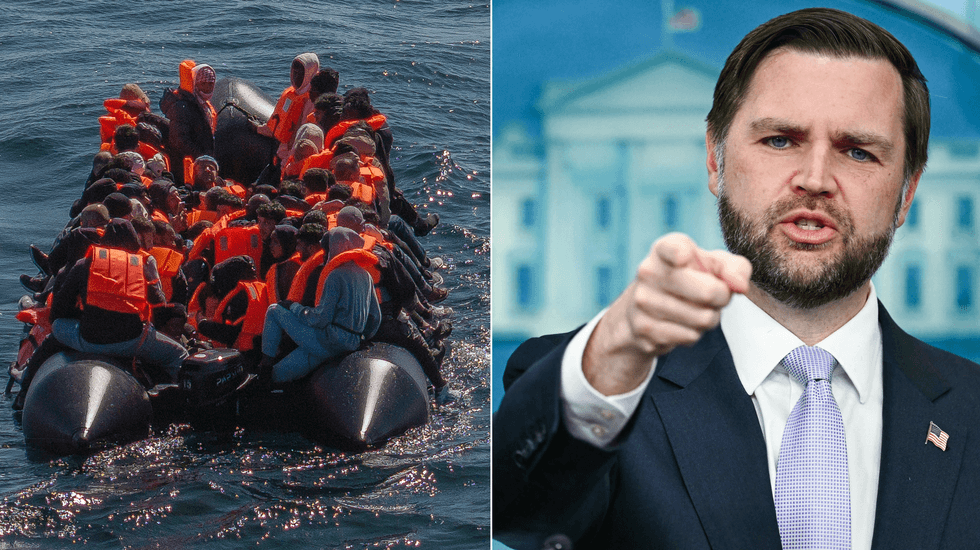 JD Vance's emergency intervention just blew the lid off Britain's small boats crisis |
 Getty Images
This approach reflects a broader ideological instinct within modern progressive politics: the belief that national borders are morally suspect, that sovereignty should yield to international frameworks, and that public anxiety over immigration is best explained as misunderstanding rather than legitimate democratic concern.
The same political movement that dismissed Brexit as an act of national self-harm now frequently treats calls for border enforcement as evidence of intolerance.
Public concerns over grooming gangs, perceived two-tier policing, and social fragmentation are ignored, redirected, or discussed only in the most cautious institutional language.
Too often, the electorate’s anxieties are treated as the problem rather than the policies that produced them. This weakness carries strategic consequences beyond domestic politics.
Post-Brexit Britain possesses the legal authority to determine its own immigration policy and the geopolitical flexibility to deepen ties with allies that still prioritise national sovereignty.
The Special Relationship with the United States now links Britain to an administration that rightfully regards border security as essential to economic stability, democratic legitimacy, and national resilience.
Labour’s instincts pull in the opposite direction: closer alignment with Brussels-style regulatory norms, greater deference to multilateral institutions, and persistent reluctance to prioritise British interests in immigration enforcement, energy security, and industrial strategy. In an era of rising geopolitical competition, border control is not a peripheral issue. It is inseparable from state capacity and national cohesion.
The United States has demonstrated what political resolve can achieve. Trump and Vance have reframed immigration as a central question of prosperity, security, and sovereignty rather than merely administrative management.
Britain’s government, by contrast, continues to offer incremental adjustments and rhetorical reassurance while public confidence deteriorates.
The gap between official rhetoric and lived reality widens with every crossing, every strained local service, and every election result that Westminster dismisses as a temporary protest.
The choice now facing Britain is becoming increasingly stark. The country can no longer continue with a political model in which voters are expected to absorb the consequences of policies they repeatedly reject.
It must instead insist that democratic accountability extend to the most fundamental responsibility of any state: deciding who enters, who remains, and whose interests government exists to serve.
The local elections and the London rally were not isolated events. They were signals of a broader political realignment already underway across Britain and the wider West.
Sovereignty is no longer an abstract constitutional concept. For growing numbers of voters, it has become inseparable from public order, economic stability, cultural confidence, and democratic trust.
The trajectory Vance identified is real. Mercifully for Britain, political correctness now appears inevitable.