

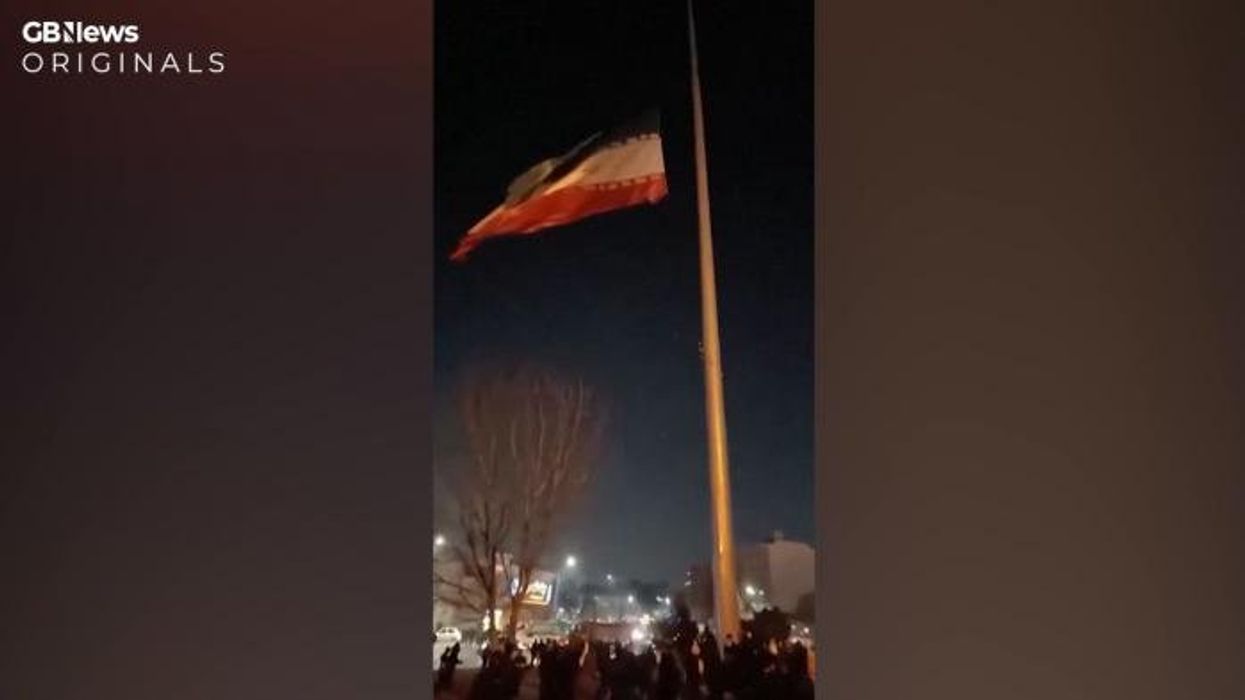



With millions of citizens uniting against the Islamic Republic of Iran’s clerical rulership, the regime is facing the most serious threat to its position of power and authority since the 1979 overthrow of the Pahlavi dynasty.
One should not underestimate the gravity of the events currently unfolding in Iran – these are extraordinary developments. In more than 100 cities and towns across the country’s provinces, demonstrators have taken to the streets to express their anger towards Iran’s Shi’ite Islamic theocracy, with several reports suggesting that hundreds of protesters have been killed by security forces in the country since late December.
BBC News has reported on footage emerging of a makeshift open-air morgue just outside Iran’s capital city of Tehran, counting at least 180 white shrouds as refrigerated trucks kept pulling up with more bodies.
Iran's attorney general - Mohammad Movahedi Azad - has said anyone protesting would be considered an "enemy of God" (an offence that carries the death penalty). While the regime appears to be ramping up its effort to quell the nationwide protests, it seems many are defying the government crackdown in a mass uprising, which follows the 2022 Mahsa Amini protests.
A United Nations fact-finding mission held Iran responsible for the “physical violence” that led to Mahsa Amini's death, with the 22-year-old dying in police custody after being arrested for allegedly violating rules requiring women to wear a headscarf.
So, what are the reasons behind the nationwide demonstrations in Iran? Soaring inflation is certainly a factor. In fact, Iran is suffering its deepest and longest economic crisis in modern times, with inflation skyrocketing to nearly 50 per cent last autumn.
As a result of international sanctions, high inflation, domestic mismanagement, rampant corruption, and other structural inefficiencies, some local reports from Iran suggest that nearly three in four people live below the poverty line.
In addition to this, public frustration over the repressive rule of Iran’s leaders – with the current ‘Supreme Leader’ being Ali Khamenei – has well and truly reached boiling point.
 The West risks blowing this golden opportunity to end globalist Islamic extremism - Rakib Ehan |
 Getty Images
Alongside the widespread economic hardship, there are long-standing restrictions on political and social freedoms, with the current regime now orchestrating internet blackouts.
Plenty of Iran’s young yearn for the economic opportunities, social rights, and political freedoms their peers in other countries enjoy, if not take for granted.
Anger over a significant economic decline, mixed with a deep-seated desire for greater socio-political freedoms, can explain the nationwide uprising in Iran. The country’s clerical rulership looks somewhat shaken, and there appear to be few limits on the brutality it is willing to inflict on its own people.
There is no denying that the downfall of the theocratic leadership in Iran would be a massive blow to global Islamist extremism as well as the anti-Western radical Left. US President Donald Trump, who was responsible for the forcible removal of Nicolás Maduro from presidential power, warned Iran that he would intervene if demonstrators were killed.
However, it is important to acknowledge that Venezuela is not Iran. Since 1979, the original theocracy has evolved and developed a complex and sophisticated security-ideological power machine, with the Islamic Revolutionary Guard Corps (IRGC) and its affiliated networks at its core.
The IRGC, the Quds Force, parallel intelligence bodies, and a web of armed groups across the region are better understood as a single, tight-knit superstructure – one which has cooperated operationally with aligned forces in other countries in the region.
As Mehdi Parpanchi, the executive editor of Iran International, has observed, other organs within this very apparatus have spent much time “developing missile and nuclear programs - accumulating expertise, institutional memory, and vested interests”. The United States intervening into the politics of Venezuela is one thing – attempting to do something similar in Iran is an entirely different kettle of fish.
While President Trump has said he is considering taking military action and looking at ‘very strong options’, it would be a mistake to think a Venezuela-style intervention would be as easy to carry out in Iran.
It is a fundamentally different environment, and there is the possibility that while many Iranians may be unhappy with their clerical regime, they would neither welcome American military action in their country with open arms.
More From GB News