






From an American vantage point, Britain’s latest visa bans present a genuinely complex problem.
On the one hand, Home Secretary Shabana Mahmood’s instinct to block inciters of hate has clear merit. Cenk Uygur and his nephew Hasan Piker are vile, nasty flamethrowers who have spent years pumping toxic rhetoric into millions of impressionable young minds.
Yet in the end consistency matters above all. Labour has now banned these two left-wing broadcasters from entering the United Kingdom.
I do not believe they should have been barred – any more than the right-wing speakers invited to the Unite the Kingdom Rally should have been. Banning them does not defeat their ideas. It simply turns them into martyrs.
Let us be unflinching about the men themselves. Uygur, founder of The Young Turks, has trafficked in classic antisemitic tropes, claiming Israel “controls America” and that the Israeli lobby buys Congress.
He has called Israel’s actions “genocide”, “barbaric” and “savage” and dismissed the Rotherham grooming gangs scandal – where 1,400 victims were identified – as mere “Islamophobia”.
His nephew Piker is even more brazen: he has said he would “vote for Hamas over Israel”, described Orthodox Jews as “inbreds” and claimed America “deserved 9/11”.
These are not robust contributions to debate. They are the daily diet Piker serves to an audience of impressionable teenagers who treat his YouTube channel as gospel.
Their presence on British soil is not neutral. It carries risk. Antisemitism is already at record levels. Public order and community cohesion are under strain.
Ms Mahmood’s decision to cancel their Electronic Travel Authorisations on the grounds that their presence “may not be conducive to the public good” therefore has surface logic.
She has shown the kind of decisiveness in desperately short supply on the Labour benches. The same Home Secretary blocked far-right agitators ahead of the Unite the Kingdom Rally and Islamist preachers who preach hatred. That even-handedness is to her credit.
If the party applied the same cold-eyed assessment to the hundreds arriving illegally in small boats every week, Britain might begin to look like a sovereign nation again rather than an open-door hotel with no one at reception.
Yet the moment a government starts pre-emptively cancelling visas on such vague grounds, it has entered dangerous territory. Free speech is not a luxury for pleasant opinions; it is the currency of any free society.
The proper response to obnoxious speech is not to ban the speaker before he lands. It is to let him speak – and ensure he is met with robust, unapologetic challenge.
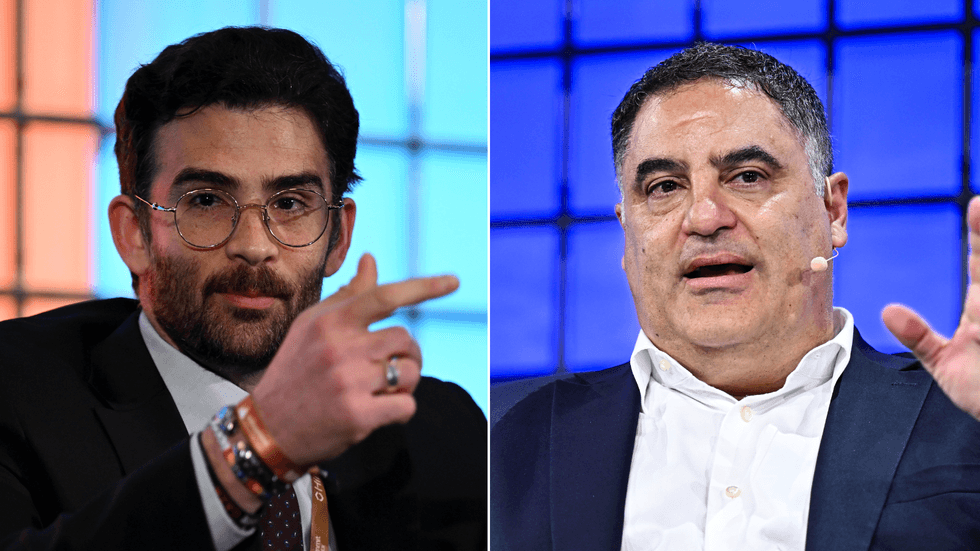
PICTURED: Banned YouTubers Hasan Piker (left) and Cenk Uygur (right). The proper response to obnoxious speech is not to ban the speaker before he lands. It is to let him speak, says Lee Cohen
|GETTY
SXSW London and the Oxford event had booked these men. The British public, the press, and dissenting voices on the right and centre should have been given the chance to dismantle their arguments in plain sight.
Instead, the Home Office has handed them the perfect script: “See? The West is betraying its liberal values on behalf of Israel.” Uygur and Piker are already shouting this from the rooftops on X. The ban simply amplifies it. Martyrs are more dangerous than mere cranks.
This is the hypocrisy Americans notice. Under President Trump the United States has not banned British left-wingers for criticising America. Britain has now banned left-wing Americans for criticising Israel.
The commentariat that lectures us about “cracking down on the media” suddenly falls silent when Labour wields the same power against its own ideological allies. From across the Atlantic, under Labour, Britain looks like a country that has lost confidence in its own ability to absorb disagreement without reaching for the ban hammer.
We should also be asking hard questions of the hosts who invited them. Why did SXSW London and an Oxford lecture theatre roll out the red carpet for men with this track record?
What does it say about institutional judgement when prestige British platforms platform voices that downplay industrial-scale child grooming and traffic in blood libels? The cultural capture of these institutions is the deeper problem, not border paperwork.
Modern societies are trapped in a genuine dilemma: how do you defend freedom – especially free speech – without ultimately undermining it?
For generations, Britain and the United States relied on an informal immune system: shared social norms, a strong national identity, and a cultural consensus that certain expressions were simply beyond the pale.
Mass immigration, social media echo chambers, and the deliberate erosion of that national identity have shredded those restraints. Governments are therefore stepping in with bans, laws, and enforcement. The intervention is understandable – it is an attempt to fill the vacuum.
But it is also a double-edged sword. It can check genuine extremism, yet it risks being weaponised against anyone who offends the current consensus.
We are balanced precariously between two real dangers: unchecked hatred that self-replicates and exploits our freedoms, and heavy-handed state control that diminishes those same freedoms.
Banning individuals like Uygur and Piker may feel satisfying in the moment, especially to those tired of their daily poison. But it does not restore the underlying immune system. It merely proves the system is broken.
From an American perspective, Britain still matters profoundly. It was historically our closest ally in the defence of liberty. We respect decisiveness. What we worry about is selective decisiveness dressed up as principle.
Free speech is messy, uncomfortable, and occasionally ugly.
But the alternative – turning every controversial voice into a banned martyr – is worse.
Consistency is not weakness. It is the only thing that keeps a free society free.