

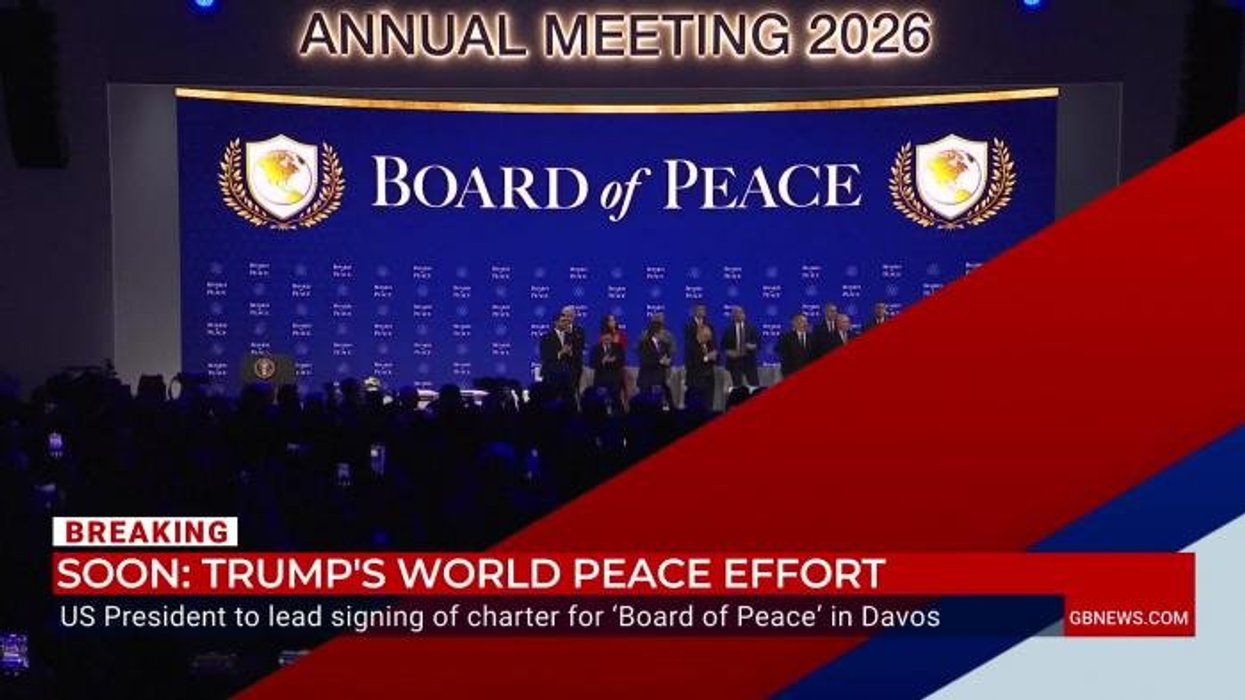


I never thought I’d live to see Keir Starmer becoming a Brexiteer. Yet that is exactly what has happened: when the opportunity arose to join Donald Trump’s “Board of Peace” and influence the direction of a flawed institution from the inside, he ran for the exit without even subjecting the question to a referendum.
The comparison is a little tongue-in-cheek, of course – this is hardly the European Union – but in many ways, the comparison holds.
From now on, Britain's level of influence over the development of Gaza will be limited to the work of Tony Blair, who no longer formally represents the country. For a government that has obsessed over Gaza, this is quite the withdrawal.
To be fair to the Prime Minister, you can understand why. The headlines have left us in no doubt: how can a “Board of Peace” possibly include tyrants such as Xi Jinping and Vladimir Putin?
How can it sensibly comprise both Israel and the United States alongside Turkey, Egypt and Qatar? What about the Saudis and Emiratis?
In this three-dimensional maze of competing agendas, alliances and hostilities, it is difficult to see how any sensible decision-making can take place. Few people would argue against that conclusion, but the finer detail, perhaps, makes for a more complex picture.
Firstly, we must look a bit deeper into the architecture of the Board. At the top of the tree sits Trump, who will in perpetuity chair a body of invited officials tasked with resolving global conflicts. These include Tony Blair, Secretary of State Marco Rubio, Jared Kushner, Steve Witkoff and others.
Then there is the General Executive Committee, a regional coordination group led by veteran Bulgarian diplomat Nikolay Mladenov, who has close ties to the United Arab Emirates, where he runs a diplomatic academy.
Formerly an envoy for the Quartet – remember them – his committee will include representatives from Qatar, Turkey, Egypt and the UAE.
 I never thought I'd live to see Keir Starmer become a Brexiteer. We are in a new era - Jake Wallis Simons |
 Getty Images
Finally, there’s a technocrat committee, composed of Palestinian administrators who have been vetted by the Israelis for any connection to Hamas (but who are mostly deeply linked to the Palestinian Authority); they will actually run the Strip.
In their support will be the muscle from the International Stabilisation Force, troops of which are already on the ground close to the Gaza border.
That military grouping is made up of a bewildering range of different nationalities, from Americans to Indonesians, Pakistanis to Hungarians, Poles to Greeks; it also includes Qatar and Turkey, which have strong ties to Hamas, a fact that has not gone unremarked upon by the Israelis.
Overall, 35 world leaders have agreed to join the project. Therefore, although a certain number of them are undemocratic at best and tyrannical at worst, and many harbour agendas that are hostile to the West, democratic nations are also amply represented. Indeed, the absence of Britain, France, Sweden and others will only tip the balance towards authoritarianism.
Don’t get me wrong, the project is so fraught with difficulties that success looks all but impossible. Aside from the coordination problem among so many competing nations, the facts on the ground remain the same: even after two-and-a-half years of war, Hamas retains a monopoly on violence in the Strip, and the Palestinian administrators due to take over are drawn from the ranks of the Palestinian Authority.
The new head of security, for example, will be General Sami Nasman, a PA intelligence official who has long been on the Hamas wanted list. Don’t forget, Hamas and the PA fought a bloody civil war back in 2007, which resulted in victory for the jihadis.
Within this ecosystem, introducing a new dynamic will be extremely challenging. Will Indonesian troops really risk their lives to disarm Hamas?
Will soldiers from Greece, Pakistan or Singapore? There is a high risk of a kind of chaotic and bloody Babel, in the centre of which the old Palestinian rivalries will play out as usual.
This is not, however, the reason that Starmer and the other liberal Western European countries have decided to sit this one out. Rather, that is more closely linked to their fears that Trump is planning to replace the United Nations.
In many ways, the UN is a failure. From the Cold War onwards, it has become slowly dominated by the anti-Western agenda of emerging Third World countries, under the leadership of the Kremlin and, to a lesser extent, the Chinese.
That is why we see such travesties as Iran chairing human rights groups; that is why Israel has come in for monumental condemnation, both before October 7 and since, while we heard barely a squeak during the recent mass murder in the Islamic Republic.
In the naive eyes of Starmer and his cronies, however, the UN is a bastion of globalised liberal ideology, the totem of the “rules-based international order”, which has increasingly come to represent the ideological centre-of-gravity of the Islington dinner party, haloed by international status and enforced with binding resolutions.
It is this fundamental moral relativism, which often allows tyrannical states an equal place at the table to the democracies, that makes the UN so ripe for manipulation by rogue states.
Starmer, Macron and the rest, however, cannot recognise this, as it goes against their deeply-held dogma of liberalism, multiculturalism and diversity, applied on the world stage.
Under the leadership of Trump, it seems unlikely that the Board will suffer the same problems as the UN. Rather, its challenges will be of a different order, becoming the UN’s evil twin, perhaps.
What it does represent, however, is an assertion that the rules-based international order, which has become so corrupted on account of its capture by the cosseted elites and their exploitation by tyrants, is firmly a thing of the past.
In truth, we are in a new era. Trump does not operate his alliances and rivalries based on the old cant of “shared values” but on strength and the projection of strength.
When questioned about the inclusion of Putin, he revealingly remarked: “If I put all babies on the Board, it wouldn’t be very much”. On those terms, Starmer and Macron are babies. No wonder they’re throwing their toys out of the pram.
More From GB News