




Every four years, football does what politics no longer can: it brings the world together without first demanding ideological purity - which is precisely why some people now seem to want to destroy it.
“We are less than two weeks into 2026,” writes Katy Gordon in Scottish paper, The Courier, “the US President has kidnapped the leader of Venezuela and set his sights on Greenland, while his Immigration and Customs Enforcement (ICE) agents have killed a US citizen. Enough is enough”.
Katy would perhaps benefit from seeing in greater depth the complex geopolitical issues that she reduces to good versus evil.
She goes on: “I think the Scotland men’s football team – and its supporters – should boycott the 2026 World Cup in North America. Yes, we have waited 28 years to return to the biggest of football stages. Yes, we earned our place in the tournament through sheer grit, determination and a bit of luck. And yes, much of the Tartan Army has already booked its travel to Boston and Miami for the group games…But we need to send a message to Trump and his far-right cohort that Scotland does not agree with or condone what they are doing in the USA. Imagine the impact that would have on him. The homeland of his beloved mother shunning 'his tournament'.”
She may be the first, but she won’t be the last journalist to make this call. It is bubbling away in activist circles and gaining traction among the permanently outraged with a libidinous take on admonishing Trump.
This is empty, moral vanity dressed up as principle.
Let’s be clear: a boycott would not hurt Trump. It would not humble America. It would make us more of a laughing stock than we already are. It would not advance human rights, heal divisions or improve the world in any measurable way.
It would, however, punish fans, players, communities and one of the last global institutions not yet fully captured by ideological warfare. Yet again, some of the Left believe that the solution to what they see as authoritarianism is…er…more authoritarianism, only this time aimed at British people who just want to watch a match and drink a pint.
Once again, some people in Britain want to saw off the branch we are sitting on.
When all else fails, petty dictators sit behind keyboards and conscript sport into political causes. Football becomes a proxy battlefield for grievances that have nothing to do with the game itself — and everything to do with signalling virtue to one’s own tribe.
The irony, of course, is that many of these same voices spent years insisting that football should “bring people together”. Now it must first pass a political purity test.
Donald Trump is many things, but he is not the first controversial leader to preside over a major sporting event, nor will he be the last. If we are to boycott tournaments hosted by countries whose governments offend British political sensibilities, we’d better cancel the next few decades of international sport and make sure all those budding athletes take off their sports kit and sit idly at a screen.
 Why Britain must resist calls to boycott the World Cup over Trump at all costs — Bev Turner |
 Getty Images
If Labour and left-wing journalists have their way, it seems it will only be a matter of time before we boycott sports events in countries with energy policies we disagree with.
The truth is uncomfortable for some: democracy means other people get to choose leaders you dislike.
What’s particularly galling is the assumption that Britain, of all countries, should once again sit in judgement — wagging a finger from the sidelines while insisting we are morally superior. This posture hasn’t worn well in recent years. Nor has it improved cohesion at home.
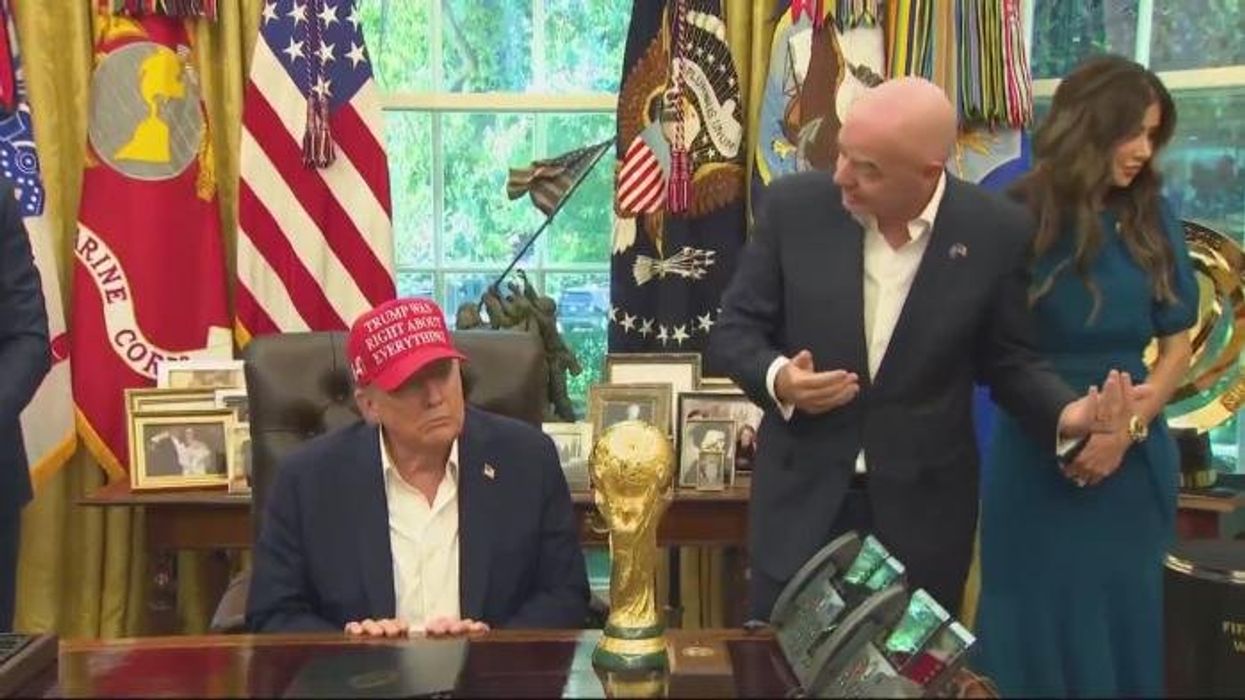
Football is not a Trump rally. A World Cup is not a MAGA hat. It is a tournament played by athletes from dozens of nations, watched by billions of people, many of whom disagree profoundly with their own governments, let alone America’s.
To reduce all of that to “Trump bad, therefore boycott” is intellectually lazy and culturally destructive.
What Gordon and her ilk don’t seem to understand is that ‘soccer’ in the USA sits very comfortably on the DEI spectrum and is particularly popular with the LGBT crowd.
The Pride flag pops up routinely at football matches, and let’s just say that the fans are more Mardi Gras than pie-and-a-pint. It’s a warm, welcoming and gentle sport here in the USA with families attending en masse.
I watched a match at the stadium in Washington, DC, recently, where the harshest heckle from the fans was directed at a player reluctant to tackle. “Don’t be afraid!” shouted one bloke behind me, who received a ripple of applause for such inspiring words.
Compare that to the chanting on British terraces. “I can’t eat popcorn at a football match," responded our cameraman, Ben, a regular Premier League match-goer, to my offer of popcorn as he sank into his seat. “I’d never forgive myself.”
There is also something deeply elitist about this British boycott instinct. It’s always the same people calling for it — those for whom missing a World Cup is an abstract inconvenience, not a once-in-a-lifetime joy. It’s easy to sacrifice other people’s pleasures on the altar of your own righteousness as you dip biscuits in tea from behind your laptop.
Ask the fans who’ve saved for years. Ask the kids watching their heroes. Ask the players whose careers hinge on moments like this. None of them voted for Trump because none of them got a vote in the US elections.
Yet they’re the ones expected to pay the price!
More broadly, boycotts feed the very escalation we claim to oppose. They harden identities, entrench resentment and confirm the suspicion — widespread in America — that cultural elites abroad despise ordinary voters. If the aim is to cool tensions and encourage dialogue, withdrawal and condemnation are the worst possible tools.
Engagement is much harder. It requires confidence. It requires trusting that our values can survive contact with people who don’t share them.
Our political class used to understand that. I’d argue that anyone calling for us to sit this one out is no lover of Britain.
More From GB News