









Sometimes it takes outsiders to say what a country no longer dares to say about itself.
This week, the White House publicly criticised Britain for refusing to ban first-cousin marriage, describing the Labour government’s opposition to a bill that would ban the practice as not just disagreement about policy but a matter of “civilisational concern”.
And the Americans are right to say so.
When Keir Starmer was recently asked in Parliament whether he would allow legislation banning cousin marriage to proceed, he declined to give support.
Consistently, Labour has pushed against a private member’s bill introduced by the Conservative Party MP Richard Holden to ban the practice.
This is not an accident; it is a very deliberate choice.
For most of British history, cousin marriage was restricted or discouraged. It became taboo as family sizes shrank, knowledge of the genetic risks that accompany incest grew, and Britain evolved into a modern, open, civilised society.
For decades, it was a non-issue — because it was rare.
But this is no longer the case. Far from it. As mass immigration has continued to reshape British society, the practice has become more visible.
As even The Economist acknowledges, cousin marriage is now concentrated in specific communities within Britain.
Precise figures are elusive — not least because few people want to collect them. But what information we have is truly shocking.
Cousin marriage is the missing link in Britain's darkest scandals. We must ban it - Matt Goodwin
|Getty Images
For instance, one recent study, the Born in Bradford project, found that nearly half of all mothers from the Pakistani community in three inner-city wards —46 per cent —were married to their first or second cousin, compared to 1% among White British couples.
Defenders of the practice will say the health risks are often exaggerated.
But as Times columnist Matthew Syed has repeatedly noted, the real danger lies not only in isolated cousin marriages, but in repeating the practice across generations — cousins marrying cousins whose parents were also themselves cousins.
In such cases, the risks compound dramatically.
This explains why small communities, mainly of Pakistani origin, account for a vastly disproportionate share of recessive genetic disorders, and why parts of the NHS now employ specialist staff to manage the consequences.
As the courageous academic Patrick Nash summarised in a recent paper, children of cousin-marriage are about twice as likely to inherit a serious genetic disorder (which rises significantly in communities with multi-generational cousin-parents), and are far more likely to suffer from cerebral palsy, cystic fibrosis, various cancers, birth defects, cardiovascular conditions, mood disorders, schizophrenia, Alzheimer’s, higher infant mortality rates, and depressed I.Q. scores.
“In short”, notes Nash, “the adverse biological consequences of cousin marriage are legion, severe, and long-lasting”.
Yet the issue also goes far beyond medicine. Cousin marriage is not just a lifestyle choice —it is also a social system with profound consequences for our society.
By marrying within their extended families, communities sustain biradari clan networks that concentrate loyalty, property, power, and secrecy within the group.
These structures isolate communities from wider British society, weaken women’s autonomy, suppress dissent, and incentivise silence in the face of wrongdoing.
This is not abstract theory. It is the missing link in some of Britain’s gravest integration failures, including the Pakistani Muslim rape gang scandal.
According to official reports, two-thirds of offenders acted in networks that were based on pre-existing relationships — often brothers and cousins. And yet these ties were dismissed by authorities as “informal” and “unsophisticated”.
They were neither.
As Matthew Syed and Patrick Nash point out, this is the unmistakable signature of clan-based crime. Loyalty is owed to kin, not victims. Outsiders are dehumanised. Crimes are concealed to protect family ‘honour’ and the network.
In some cases, perpetrators are shielded by relatives, while the networks themselves often neither respect nor recognise UK law and established authority.
This is why analysing the grooming gangs scandal in the UK without understanding cousin marriage is like analysing the power grid without mentioning electricity.
Supporters of cousin marriage will tell you that legislating against it risks fuelling racism, ‘Islamophobia’, pushing weddings underground, or alienating communities.
The Economist quotes officials warning that Muslims may become “reluctant to talk about it” if the issue is politicised. But this argument collapses on contact with reality.
Britain already bans forced marriage and female genital mutilation — once defended by misguided liberals in exactly the same language of ‘cultural sensitivity’.
The state intervened, rightly, because harm matters more than offence. Cousin marriage should be no different —it should be banned.
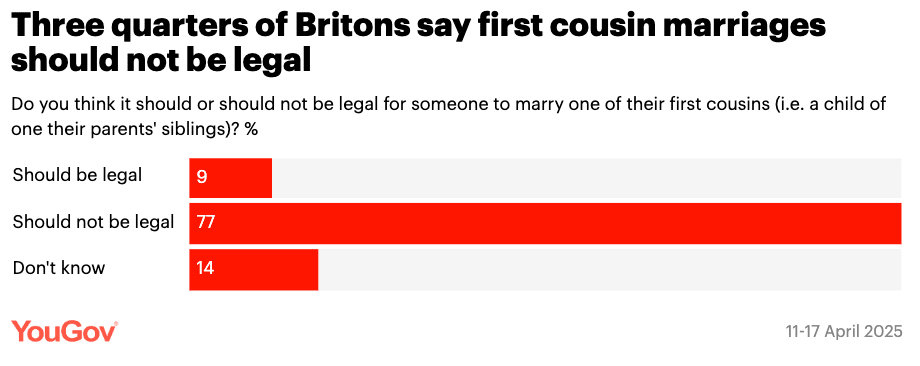
Nor is this a fringe position. Nearly 80 per cent of the British public, according to recent polling by YouGov, say they support a ban on cousin marriage.
Once again, Keir Starmer and Labour are hopefully out-of-touch with the country.
And if you want another example of these negative effects then look, too, at what we recently witnessed in the House of Commons.
An independent Muslim MP elected on sectarian, pro-Gaza lines, using parliamentary proceedings to defend cousin marriage, presenting it as a legitimate cultural practice.
When MPs use Western political institutions to normalise practices that most Britons regard as harmful and archaic, it underlines a deeper issue — the rise of identity-based politics that prioritise communal norms over our shared civic standards, and that clash with the cultural expectations of the country as a whole.
Western civilisation did not emerge by accident. It was built by breaking from these clan loyalties and inherited obligation, and by insisting that individuals matter more than bloodlines.
Centuries ago, the Church banned cousin marriage for precisely this reason, forcing people to marry beyond their kin groups and helping dissolve tribal divisions. That decision laid the groundwork for civic trust, national identity, and the rule of law.
This is why Keir Starmer’s and the Labour Government’s refusal to engage with this issue has nothing to do with evidence. Labour has read the data. Labour knows the arguments. The government’s total silence on this issue is political.
Labour’s fear is not of being wrong, but of being accused — of racism, Islamophobia, insensitivity, violating the dogma that ‘all cultures are equal’, and, perhaps most of all, being accused of these things by Labour’s Muslim voters.
This is another clear example of what the Canadian psychologist Gad Saad has called ‘suicidal empathy’ —displaying endless to ‘empathy’ and ‘compassion’ to minorities, no matter where they are from, while destroying your own civilisation from within.
We should all recognise that fear, by now. After all, it is the same fear that paralysed politics, police and social services in the face of industrial-scale child abuse of white working-class children across these islands.
And it is paralysing the Labour government once again —a government, a political party, that has clearly not changed its underlying view. When Labour is presented with a choice between encouraging segregation and sectarianism or promoting a shared national community and common culture it will always choose the former.
The philosopher John Gray once observed that what he calls ‘hyper-liberalism’, or ‘woke’ politics, is the most illiberal ideology of our time.
He was right.
In its obsession with not offending, in its obsession with displaying suicidal empathy, it abandons the vulnerable — especially women and children — to patriarchal systems it dares not challenge. Liberals did this to the victims of the rape gangs, and now they are doing it to the victims of cousin marriage.
So the question is simple.
Does Britain still believe that some values are worth defending — or will it continue to sacrifice the vulnerable on the altar of moral relativism?
If liberalism cannot say no to practices that very clearly damage health, suppress women, and fracture society, then it has ceased to be liberal at all. And that — not American criticism — is the real civilisational concern.
This article first appeared on Matt Godwin’s Substack
Our Standards: The GB News Editorial Charter
More From GB News