








The US and Iran have both received a ceasefire plan that could last 45 days, as Donald Trump's deadline looms.
Pakistan has put forward a peace framework to Washington and Tehran aimed at halting hostilities between the two, with the proposal exchanged overnight through diplomatic channels.
The plan follows a two-stage approach, beginning with an immediate cessation of fighting that would restore shipping access through the Strait of Hormuz.
A broader settlement would then be finalised within a fortnight to 20 days, according to a source familiar with the discussions.
According to reports from Axios, the ceasefire's length being discussed is as long as 45 days.
Field Marshal Asim Munir, Pakistan's army chief, spent the night in communication with US Vice President JD Vance, special envoy Steve Witkoff and Iranian Foreign Minister Abbas Araghchi.
The source indicated that all components of the deal needed agreement on Monday, with the initial understanding to be formalised electronically via Pakistan.
However, Tehran has rejected the proposal to immediately reopen the strategic waterway as part of any temporary truce.
A senior Iranian official said that Iran would not accept deadlines while reviewing the framework, adding that Washington lacked the readiness for a permanent cessation of hostilities.
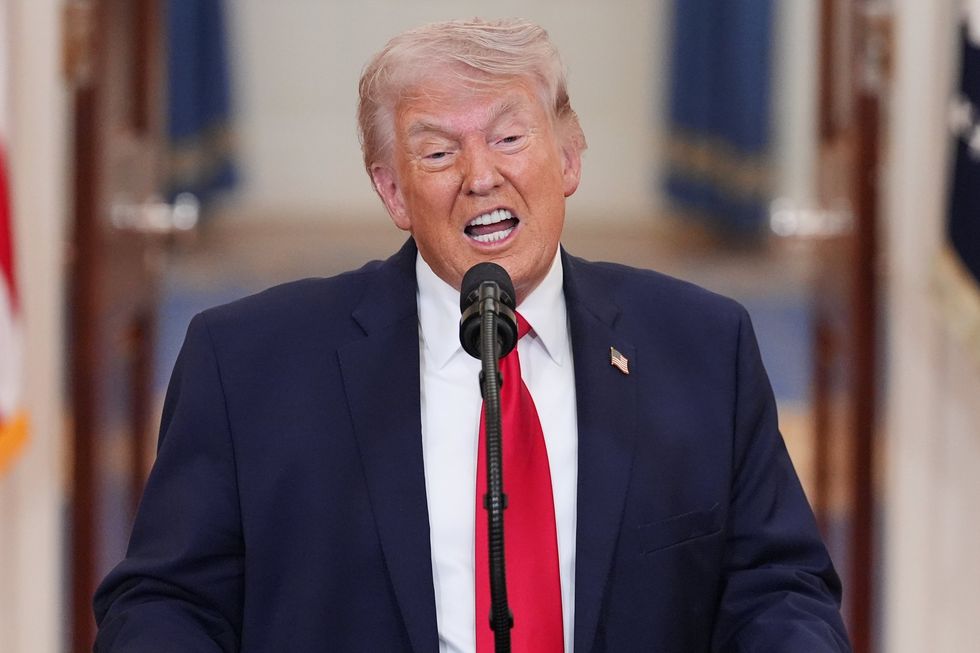
Donald Trump had initially given Tehran 48 hours to comply on Saturday before extending his ultimatum to Tuesday evening
|GETTY
Iranian authorities have previously indicated they are seeking lasting guarantees that neither the US nor Israel will launch further attacks.
The Islamic Revolutionary Guard Corps (IRGC) declared on Monday that the strait "will never return to its former status, especially for the US and Israel", stating that preparations were under way to enforce new operating conditions in the waterway.
President Trump had initially given Tehran 48 hours to comply on Saturday before extending his ultimatum to Tuesday evening.
In an expletive-laden outburst on his Truth Social platform on Sunday, the US president threatened devastating strikes on Iranian energy and transport infrastructure should Tehran fail to reach an agreement.
Mojtaba Khamenei has not been seen in public since succeeding his father as Supreme Leader of Iran
|GETTY
LATEST DEVELOPMENTS
- Wreckage of US aircraft in Iran pictured for first time following dramatic rescue mission
- US special forces rescue team faces 'harrowing and dangerous' search for crew member downed over Iran
- Donald Trump warns 'time is running out' for Iran as he threatens to 'rain down all Hell' in 48-hour ultimatum
He wrote: "Tuesday will be Power Plant Day, and Bridge Day, all wrapped up in one, in Iran.
"Open the F****n' Strait, you crazy b*****d, or you'll be living in Hell — JUST WATCH! Praise be to Allah."
The Potus subsequently specified his deadline as Tuesday at 8pm Eastern Time, equivalent to 1am UK time on Wednesday.
Iran's deputy foreign minister, Kazem Gharibabadi, responded by accusing Mr Trump of threatening war crimes, citing provisions of the Rome Statute that prohibit attacks on civilian infrastructure such as power stations and bridges.
The conflict, which erupted on February 28 when US and Israeli forces began striking Iran, has claimed approximately 3,540 lives in the country, including at least 244 children, according to the US-based rights organisation HRANA.
US-Israeli attacks have killed at least 34 people across Iran in recent days, among them six children, while strikes have also eliminated several senior regime figures including the intelligence chief of the Revolutionary Guards, Major General Majid Khademi.
The Strait of Hormuz carries roughly a fifth of global oil and natural gas supplies, and its effective closure by Iran has disrupted energy markets worldwide.
Under the proposed settlement, tentatively named the Islamabad Accord, Tehran would commit to abandoning nuclear weapons development in exchange for sanctions relief and the release of frozen assets.