










Hundreds of birdwatchers have flocked to Wales after a "mega rare" bird appeared in the UK for the first time.
Ornithologist Simon Hugheston-Roberts made the historic identification of the western reef heron, a species normally found along coastal areas from West Africa through to India, at Y Foryd in Caernarfon, North Wales.
He made the discovery at approximately 10am on Saturday morning while doing his routine bird monitoring activities.
The grey-blue visitor represents a significant moment for British ornithology, as the species has never previously been documented within the United Kingdom.
The tropical bird's appearance in Welsh waters has generated considerable excitement within the birdwatching community.
Mr Hugheston-Roberts, drawing on extensive field experience from West Africa and the Middle East, recognised the distinctive features of the species, scientifically designated as Egretta gularis.
He conducted a side-by-side comparison with a nearby little egret to verify the heron's size and physical structure before confirming his observation.
"After getting a better look, I thought 'this is a rare thing'," he said.
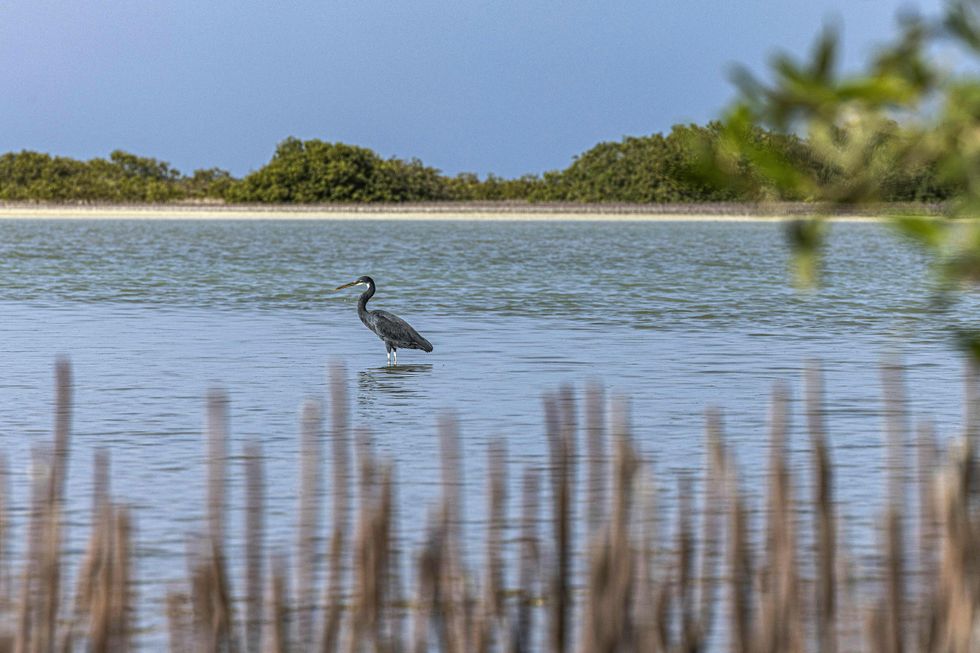
The western reef heron was spotted at Y Foryd in Caernarfon, North Wales
|GETTY
The species typically inhabits coastal zones across a broad geographical range from West Africa eastward to India, as well as parts of southern Europe and Asia.
Naturalist and broadcaster Iolo Williams, who was filming locally when news emerged, characterised the visitor as a "smart bird" with a "lovely grey-blue" appearance.
Following Mr Hugheston-Roberts's sharing of the discovery with a local birdwatching group, word spread rapidly across the ornithological community.
By Saturday afternoon, around 300 enthusiasts had converged on the town, eager to witness the unprecedented visitor.
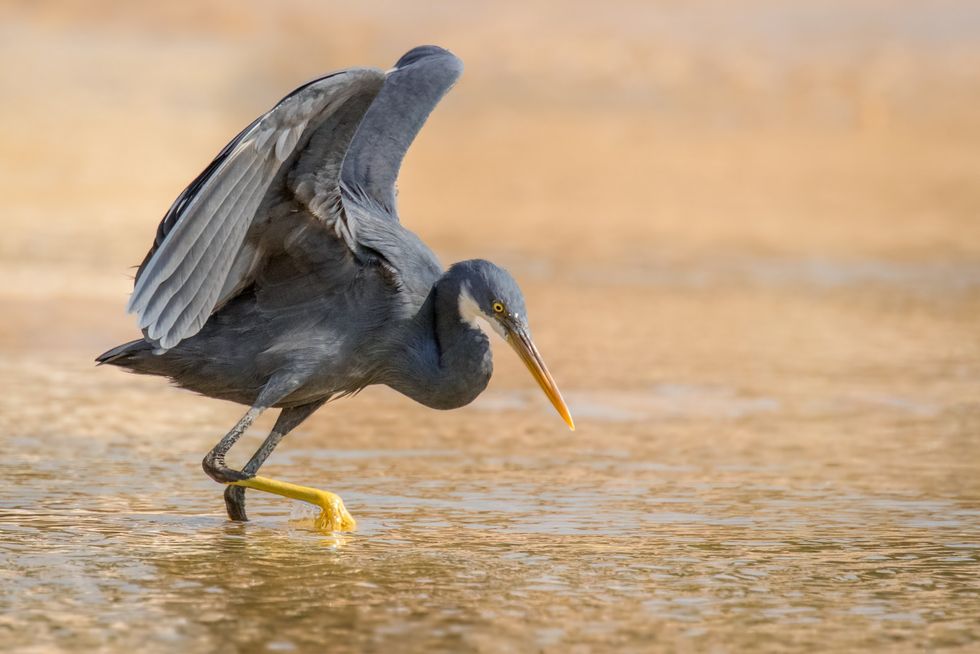
The heron has been observed in multiple locations throughout Caernarfon over the weekend
|GETTY
The heron has been observed in multiple locations throughout Caernarfon over the weekend.
Birdwatchers tracked its movements as it foraged near Cei Llechi in the harbour, rested in trees beside the Aber Bridge, and flew over Morfa Dinlle fields, the Foryd, and even Caernarfon Castle.
Among the visitors was ornithologist and artist Richard Partis, who dedicated nearly 12 hours to documenting the bird in his sketchbook.
He noted that observers maintained respectful distances to avoid disturbing the heron whilst it fed.
Some enthusiasts travelled from as far as Essex, with others arranging overnight accommodation to continue their observations.
Macclesfield resident Mike Barth said he "dropped everything" after hearing the "mega rare" bird had been sighted in the UK.
Mr Barth continued: "It was a very satisfying trip, more often than not birds are found on work days and usually gone by the time the weekend comes around!
"So to get a mega rarity on a Saturday morning within two hours was very unusual in itself let alone a first for Britain."
Mr Williams said despite the sighting occurring after record-breaking temperatures in Wales, experts do not link the event to climate change.
Instead, powerful southerly winds during migration likely carried the heron out to sea, causing it to become disoriented and ultimately reach the Welsh coastline.
He remarked that whilst such weather-driven occurrences are infrequent, it is particularly unusual for an inaugural national record to appear in Wales.
The estuary environments at Y Foryd and the Afon Seiont offer appropriate feeding areas, where the bird hunts small fish in a fashion comparable to the little egret.
Mr Hugheston-Roberts is preparing comprehensive documentation for submission to the British Birds Rarities Committee.
This formal assessment process is required to officially validate the sighting for inclusion in the national database.