









England’s school uniforms are under threat as one in eight ditch ties for tracksuits and hoodies with parents left fearful over girls’ safety, a GB News audit has revealed.
One in eight (12.4 per cent) schools in England permit at least one item of sportswear - joggers, leggings or hoodies - as part of their standard daily uniform.
One school audited even permits all three items - a full tracksuit as a uniform.
Suella Braverman, Reform UK’s spokeswoman for Education, Skills and Equality slammed the findings, exclaiming that schools are not "extensions of the living room".
TRENDING
Stories
Videos
Your Say
Speaking to the People’s Channel, the MP for Fareham and Waterlooville, said: "Our classrooms are places of learning and ambition not extensions of the living room.
"The moment we blur that line, we do our children a disservice."
The GB News audit, which analysed the uniform policies of 508 primary and 645 secondary schools across England, found jogging bottoms as standard daily school uniform - not just part of PE kit - are now permitted in one in 14 primary schools (7.1 per cent).
The regional breakdown shows wide-ranging figures, with 12.2 per cent of schools in the East of England allowing casual legwear, compared to only 2.2 per cent in Yorkshire and Humber.
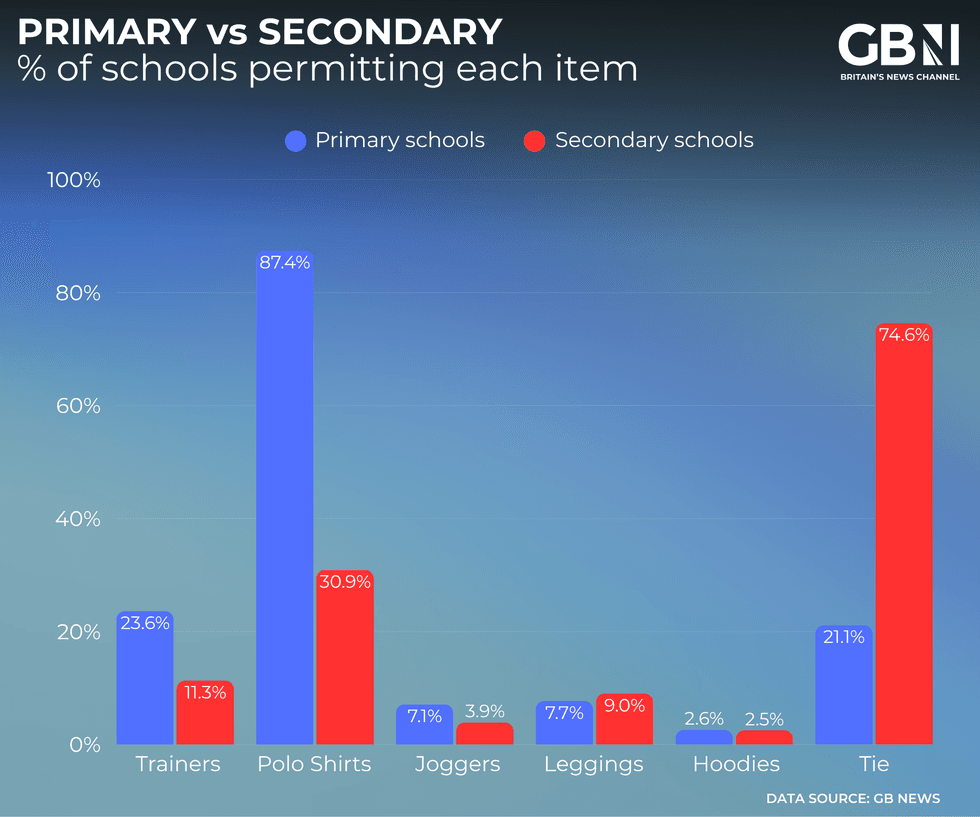
Primary vs secondary schools: uniform items permitted
|GB NEWS
Leggings - a form-fitting garment - are allowed in eight per cent of schools nationally, though Yorkshire and Humber stands apart, with 15.2 per cent of schools permitting them as daily wear - double the national average.
For secondary schools, this figure is even higher, with nine percent allowing the legwear - with this figure shooting up to 16.7 per cent in the north west.
Christine Cunniffee, executive principal at LVS Ascot, told the People’s Channel: "Wearing a distinctive uniform enables a sense of belonging and pride in school.
"Belonging and pride will lead to respect for the school’s fabric and the community."
LATEST DEVELOPMENTS:
Suella Braverman, Reform UK’s spokeswoman for Education, Skills and Equality said that schools are not 'extensions of the living room'
|GETTY
Hoodies, a defining part of a tracksuit, also makes an appearance on some daily uniform policies - albeit only 2.6 per cent have gone that far.
However, this number virtually triples for schools in the east Midlands and south east of England, with 7.4 and 7.1 per cent of schools allowing the hooded jumper in daily uniform respectively.
GB News also found that one primary school in Rotherham is planning to introduce all three of these items to its uniform policy.
Pupils at Our Lady and St Joseph's Catholic Primary School will be able to wear plain black joggers, leggings, sport shorts or a skort in September 2026.
The school’s headteacher, Louise Illien, said: "We’ve found that when children are wearing more comfortable clothes, they make the most out of their learning and are able to be more active in and out of the classroom."
However, a Freedom of Information request by GB News revealed the school previously included hoodies before removing them.
Rotherham Borough Council confirmed the hoodies had been "causing difficulties in class".
The skort, meanwhile, was added after parents raised concerns that girls would not be able to dress "as girls", the council added.
Miss Illien said: "Parents asked for a skirt option for girls which is why we added a skort to our uniform policy."
The British school uniform is embedded in the nation’s DNA, finding its roots in 16th century charity schools - not elite public institutions such as Eton and Harrow - originally providing clothes to poorer children to give them a sense of belonging and dignity.
That founding principle, seeing uniform as a force for equality and cohesion, is precisely what defenders of traditional dress codes still argue for today.
Serge Cefai, executive head at St Thomas The Apostle College, told GB News: "A good uniform policy is a great leveller.
"It stops less wealthy children feeling hard done by, and that in itself reduces bullying.
"It allows children to concentrate on their education without distraction, and in the long run it is easier and cheaper for parents."
Over the centuries, the attire has evolved greatly - from caps, capes and bonnets, to blazers and ties, all donning specific colours unique to your place of study.
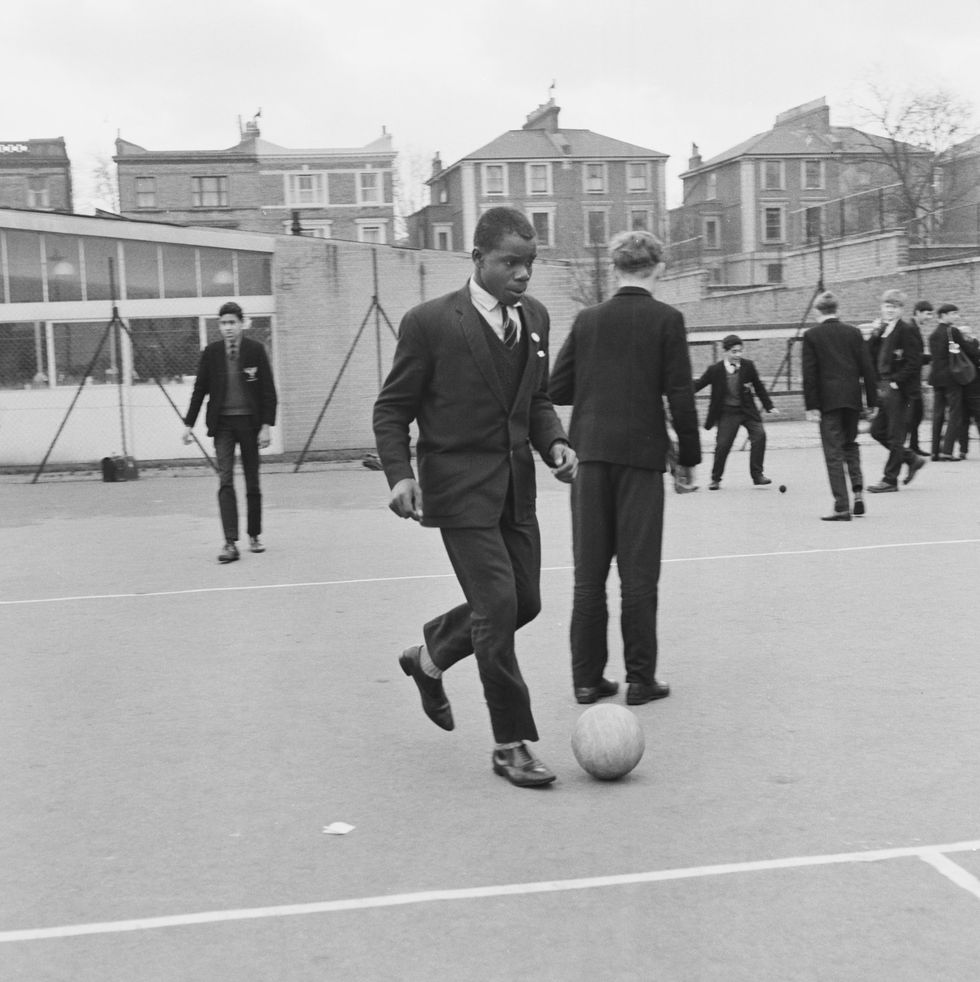
Schoolboys in the playing at Holloway Comprehensive School on Hilldrop Road, in London in 1963
|GETTY
However, the British school uniform seems to be entering its latest transition: relaxation.
Another nail in the coffin for the traditional school uniform is footwear - one in four primary schools allow trainers daily, with this figure increasing to nearly one in three in the east and south east of England.
Esther McVey, MP for Tatton, told GB News it was "sad" that school uniforms are "being dumbed down", emphasising the importance of smartness.
She said: "Smart uniforms are extremely important in schools, and it is sad to see them being dumbed down in so many."
She went further to make the connection between a lack of smart standards in the classroom to the casualisation of workwear.
"Sadly it mirrors the lack of smart attire in many offices and workplaces currently, but I am sure most parents would like to see schools pursue a uniform policy which maintains traditional high standards," she said.
If the shirt and tie was an animal, it would be critically endangered in primary schools - just six out of 508 establishments audited make it compulsory to wear the combination on a daily basis.
Nearly two-in-three primary schools have dropped the tie completely.
In its replacement, 87 per cent of schools permit pupils to wear polo shirts throughout the academic year, rather than being kept as an option in the summer months.
However, GB News's extensive audit also revealed a stark contrast in England's secondary schools.
Three-quarters of secondary schools still require a tie.
A significant majority (75 per cent) of primary school teachers would prefer children to wear a "practical" uniform of jogging bottoms and a polo shirt, according to research by Teacher Tapp.
Fewer than one-in-four favour a smart uniform of a tie, trousers and a blazer.
Phil (not his real name), a primary school teacher in the south east, is one of them.
He told GB News he was "in favour of a more relaxed uniform", pointing to the realities of working in a disadvantaged area.
"I work in a school in quite a deprived area and we often give out uniforms to children who don’t have any or whose families are struggling," he said.
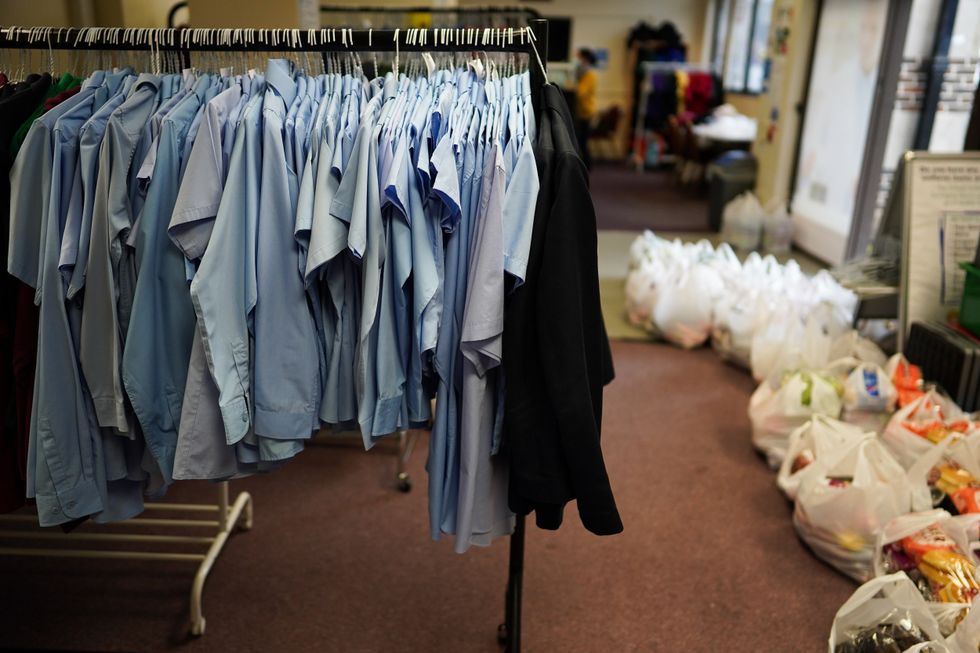
Twenty-eight per cent of parents in 2024 were finding it hard to afford uniforms and school supplies
|GETTY
"Having a simple uniform makes this easy to provide - it is cheap to buy from most big stores at good prices."
This sentiment is backed by data - 28 per cent of parents in 2024 were finding it hard to afford uniforms and school supplies, a YouGov poll showed.
In a bid to tackle this, the UK Government from September will mandate that schools limit compulsory branded items to three or fewer (plus a tie for secondary/middle schools) to reduce costs for parents.
But Phil was careful to stress he backs uniform in principle - without it, children from families who cannot afford whatever is the current fashion trend risk feeling "left out".
He said if schools had a no uniform policy, it would be "added hassle or stress for teachers to worry about".
Simone Brown, a 44-year-old life coach and youth mentor from London, went viral earlier this year after posting a video from her car outside a local secondary school, expressing her alarm at a teenage girl arriving in what she described as "super, super, short hot pants".
Having worked in youth mentoring and as a parent facilitator with the Race Equality Foundation, she told GB News that she had previously raised uniform concerns with the school - only to receive a generic response.
This time, Ms Brown said she felt a "righteous anger" and decided to take to social media about the inappropriate uniform.
She said: "A righteous anger just came up inside of me. I think it's about time we begin to have a conversation about how we can make our uniform more modest - how can we bring up the self-esteem of our young women.
"I don't just look at the girls - I look at who's looking at the girls. I look at who's looking. And there are a lot of men who are looking. Old men, young men, workmen - they're all looking."
The video received over 300,000 views, but divided opinion sharply.
However, the London-based life coach remained undeterred and contacted the school to share her concerns and was invited for a meeting with senior management during February half term.
For Ms Brown, this incident lends itself to a bigger issue - the unravelling of the standards, boundaries and expectation that uniform, at its best, is supposed to represent.
"There has been a decline in social values", she said.
"I think there’s a decline in our faith values as well, which I think plays a huge part in all of that.
"I love the blazer - I love the way it looks with the tie and your skirt. I think it comes across as presentable."
She concluded: "School uniform is beautiful."
The question is whether the creeping casualisation of the school uniform is a symptom of something far deeper.
Fresh data from the National Education Union (NEU) offers a troubling backdrop.
Simone Brown, a 44-year-old life coach from London, said it is time to talk about how we can 'bring up the self-esteem of our young women' '
|GETTY
Two-thirds (66 per cent) of state school teachers say pupil behaviour negatively impacts learning regularly or all the time.
This figure was just 46 per cent in 2020, then 48 per cent in 2022, rising sharply to 66 per cent in 2024 and has remained ever since.
In primary schools, seven in 10 teachers report behaviour disrupting their lessons regularly or all the time.
The NEU stops short of drawing a line between what children wear and how they behave.
Mrs Braverman said: "Britain became great because we held the line on values that matter; hard work, discipline and pride in who you are and where you come from.
"That starts at school and it starts with getting the basics right."
A Department for Education spokeswoman said: "We strongly encourage schools to have a uniform as it can play a key role in promoting the ethos of the school, providing a sense of belonging and identity and setting an appropriate tone for education."
They added that revised statutory guidance published in October 2025 makes clear that "schools can require that all uniform items, whether branded or generic, meet standards of modesty and appropriateness".
Proportional stratified random sample drawn from 16,462 open primary schools in England, plus 2,996 open secondary schools. 508 primary and 645 secondary school uniform policies audited.