











Church organs across Britain “will fall silent within 50 years”, a new study has warned.
Pipe organs in churches across Britain could be lost to ordinary communities within a generation, according to a stark new report from a leading heritage charity, Pipe Up for Pipe Organs.
Father Tim Handley, vicar of St James's Church in Paddington, London said this issue is a "crisis of faith".
Speaking to GB News, he said: "It's actually much more of a crisis of faith than it is a crisis of music.
TRENDING
Stories
Videos
Your Say
"When you think about most churches - small or rural with not many people going - it just doesn't surprise me, I'm afraid.
"It comes back to that fundamental issue that people aren't going to church, then the organ won't be used and it will fall into disrepair."
The charity has warned that by 2070, playable instruments will exist only in elite cathedrals, Oxbridge colleges, concert halls and a handful of well-funded churches, with the vast majority of parish churches left in silence.
Pipe Up described the situation as a full-blown national crisis and said it was sounding the alarm before it was too late to act.
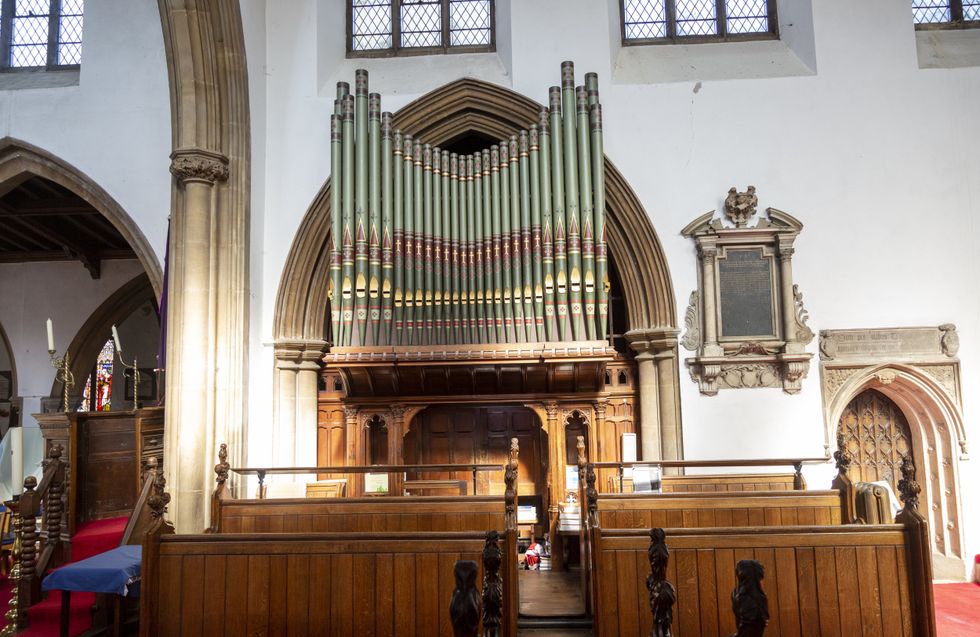
A charity chief said the beloved church instrument is 'dying out everywhere'
|GETTY
Of the roughly 15,000 organs still surviving across the country, only half are currently in working order.
The number is expected to halve again over the next decade alone, as funding dries up and church closures accelerate across England and Wales.
Around five organs a week are being dumped in landfill or scrapped, with a further four falling silent each week through lack of repair, the Telegraph reports.
Father Handley told the People's Channel that the issue is likely to be impacting churches outside of the capital, as in London there are institutions such as the Royal School of Music and the Royal Academy which means there is a secure pipeline of organists, "learning the trade".
LATEST DEVELOPMENTS

St Mary's Church in Beverley, east Yorkshire gave their organ away to a Norweigan counterpart as it could not cover the multimillion repair costs
|GOOGLE STREET VIEW
He further explained that as you move out of the capital, less people are attending church meaning the organ won't be used as much.
Father Handley said: "Therefore, the organ will go into disrepair and it will cost a lot of money to mend.
"If people aren't going to church, who's going to provide the money to mend it? The organ will gradually become unworkable and unusable and it will be lost because these things aren't cheap.
He explained his church, located in central London, had refurbished its organ roughly four years ago, which came at a six-figure cost.
George Allan, chairman of Pipe Up, described the trajectory as shocking, warning the instruments were on a path to extinction that few people seemed aware of.
He said: "Village organs are dying out everywhere.
“Every morning, I look at my emails and there's a couple more notifying us that they are at imminent risk or unwanted.”
Mr Allan said it was inconceivable that such culturally significant instruments were disappearing through neglect, adding that the country was "sleepwalking into the mass extinction of these national assets”.
He pointed out that organ music had long been the soundtrack to some of life's most profound moments, weddings, funerals, christenings, and that its loss would be felt far beyond the walls of the church.
Earlier this year, a 100-year-old organ at St Mary's Church in Beverley, east Yorkshire was given away to a church in Norway after the congregation was unable to fund repairs estimated at up to £2.3 million.
Holy Trinity Church in Oslo not only agreed to fund the renovation but covered the considerable cost of dismantling the vast structure, which contains around 6,000 pipes reaching up to 32 feet in height.
St Mary's said that raising such a sum on top of the £10 million still needed to restore its crumbling stonework would have been virtually impossible and that the Norwegian offer at least ensured the pipes were spared from landfill.
Rural churches in France, Portugal and as far afield as the Philippines among those snapping up instruments that British congregations can no longer afford to maintain.
One rural department in south-west France alone is now home to around 40 village church organs that were unwanted in Britain.
Historically, Britain was a world leader in organ building, with instruments found in churches of every denomination right across the country.
Numbers peaked at around 40,000 instruments in 1915, but more than half have since disappeared, with the rate of loss now accelerating sharply.
Church closures are estimated at around 400 a year, and those organs left behind in closing buildings fare particularly badly.
Many churches are sold for redevelopment, and the instruments are simply discarded.
The lead pipes occasionally fetch token sums as scrap, while wooden components go straight to landfill.
Music expert, Norman Lebrecht, wrote that, at the very moment a new Archbishop of Canterbury was being installed, the fate of St Mary's organ stood as a troubling symbol of the Church's neglect of its own heritage.
Stephen Lomas, who became custodian of the organ at the long-closed St Leonard's Church in Bridgnorth, Shropshire, described finding an instrument in a poor state, with half of it having been dismantled and removed by an unqualified joiner rather than a professional organ builder - the removed section later sent to landfill by the church that received it.
He argued that digital replacements, increasingly used by parishes trying to maintain their choral traditions on a budget, were a poor substitute - particularly in smaller buildings where the sound came across as thin and artificial.
Mr Lomas added that pipe organs, with regular maintenance, would outlast their digital counterparts, and that the real failure lay in years of churches neglecting basic servicing, treating their instruments far worse than they would their own vehicles.
Experts have stressed that many of the organs currently at risk could be saved with just a couple of days of skilled work and that irreparable damage is far less common than simple, prolonged neglect.