








A Christian saint has been depicted as an Asian trans man in a National Gallery exhibit.
Saint Sebastian who was an early Christian martyr, has been portrayed in a new art installation by an Asian transgender man in London’s National Gallery.
To retell the story of St Sebastian, who was believed to have been killed during the Diocletianic Persecution of Christians, transgender models have been used by Ming Wong, a Singaporean artist.
The new installation involves different videos depicting the trans models playing the Christian saint, where they can be seen to be listening to a seashell, dancing and doing martial arts movements.
According to Christian belief, St Sebastian survived an initial execution attempt in which he was bound and shot with arrows, before being nursed back to health by Irene of Rome - a scene that became a popular subject for 17th-century artists.
He is said to have then confronted Emperor Diocletian directly over his sins, a decision that ultimately cost him his life when he was beaten to death.
The saint is venerated in both the Catholic and Eastern Orthodox churches as the patron saint of athletics, archery and plagues.
Mr Wong’s transgender models are barely clothed - like a lot of the depictions of St Sebastian in paintings - and are play-fighting and touching each other, the Telegraph reports.
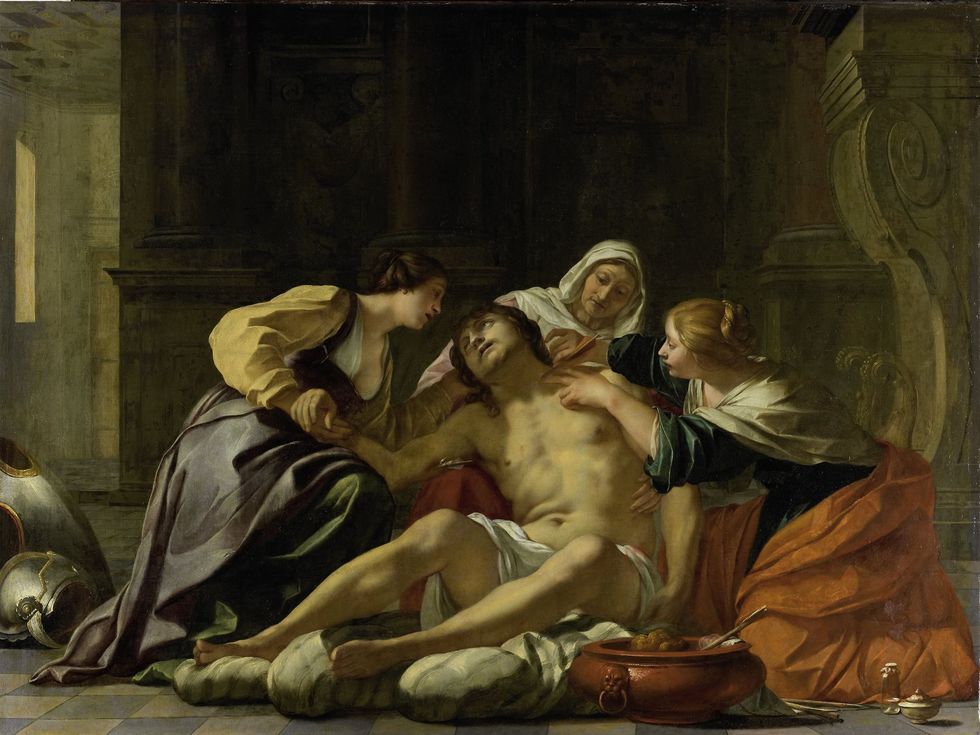
St Sebastian nursed by Irene and her Helpers by Jacques Blanchard (c. 1630-38)
|GETTY
Paired with the video is audio of a Latin translation of the final monologue from Kenneth Clark’s 1969 BBC art series, civilisation.
The videos conclude generally with the trans models being injured by arrows, with stills of other religious imagery from the National Gallery’s collection.
In more modern depictions of the saint, his image has often been interpreted as homoerotic.
In medieval art the martyr appeared as an older, mature figure.
LATEST DEVELOPMENTS
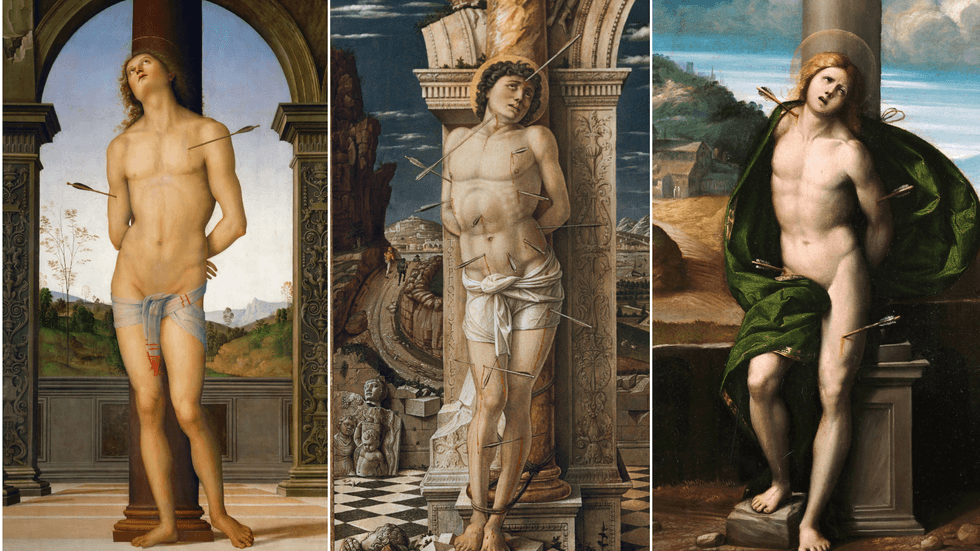
Left to right: By Perugino c. 1495, by Andrea Mantegna c.1457, by Garofalo c. 1520
|GETTY
However, after the Black Death of 1347, his image softened into something younger and healthier.
Renaissance artists then reimagined him entirely, drawing on ancient Greek ideals of male beauty to present him as a handsome, near-naked young man.
Since then, artists have imagined the saint in different ways, with Mr Wong’s installation being the latest in a string of homoerotic interpretations of the martyr.
Derek Jarman's 1976 film Sebastiane explicitly sexualised the saint’s torture, while British painter, Keith Vaughan, used the story throughout his work to explore homosexual desire.
Signage for the artwork states: “Wong’s film reimagines the martyr’s narrative within the gallery.
“Latin-speaking Roman soldiers are performed by Asian actors of different genders, alongside the artist himself, staging a dialogue between an ancient past and a global present.”
Mr Wong has been artist in residence at the National Gallery in 2025, as part of an initiative to shine a light on contemporary art.
He is the fifth artist to be appointed since the launch of the Gallery's Modern and Contemporary Programme
His residency follows artists Rosalind Nashashibi, Ali Cherri, Céline Condorelli and Katrina Palmer.
Mr Wong said of the appointment: "There isn't a better time to reimagine the stories that these characters and creatures inhabiting these worlds can tell one another, and their exchanges that cross centuries and civilisations beyond the frames."
Daniel F. Herrmann, Curator of Modern and Contemporary Projects, at the national gallery said: "With genuine compassion, curiosity and grace, Ming Wong’s work asks how the images and culture around us create notions of ourselves and others.
"We are excited to be working with him during his residency at the National Gallery, particularly as we reflect on the Gallery’s 200-year history."