







Britain's state pension now covers more than basic living costs, but the UK is still lagging behind much of the world.
Despite the triple lock boost, it ranks just 20th globally for pension power.
New analysis shows that, following the increase taking effect on 6 April 2026, the UK state pension now covers 126.08 per cent of average living costs, up from 120.31 per cent before the rise.
This places Britain just ahead of Ireland at 125.74 per cent, but still well behind many other developed economies.
To make the comparison, Moorepay sourced data from reputable reports on average state pension rates in each country, based on a single, recently retired person living in an urban area without additional income.
The company then used Numbeo cost-of-living data to calculate the percentage of local living costs covered by each pension on average.
Despite exceeding basic living costs, the UK continues to trail several countries.
Cybill Watkins, Product Legislation Manager at Moorepay spoke exclusively with GB News about the data and warned retirees that they shouldn't rely on the state pension despite the findings showing there is a £2,000 surplus.
She said: "The state pension is not enough to cover living costs for a typical individual, so without any private savings these retired workers will be pushed into poverty."
In the data the United States ranks 13th, with pensions covering 163.46 per cent of living expenses. Ireland sits just below Britain at 125.74 per cent while the Gulf state of Kuwait leads the world by a substantial margin.
Its pension system is valued at 16,308 Kuwaiti dinars annually, equivalent to approximately £39,170.84.
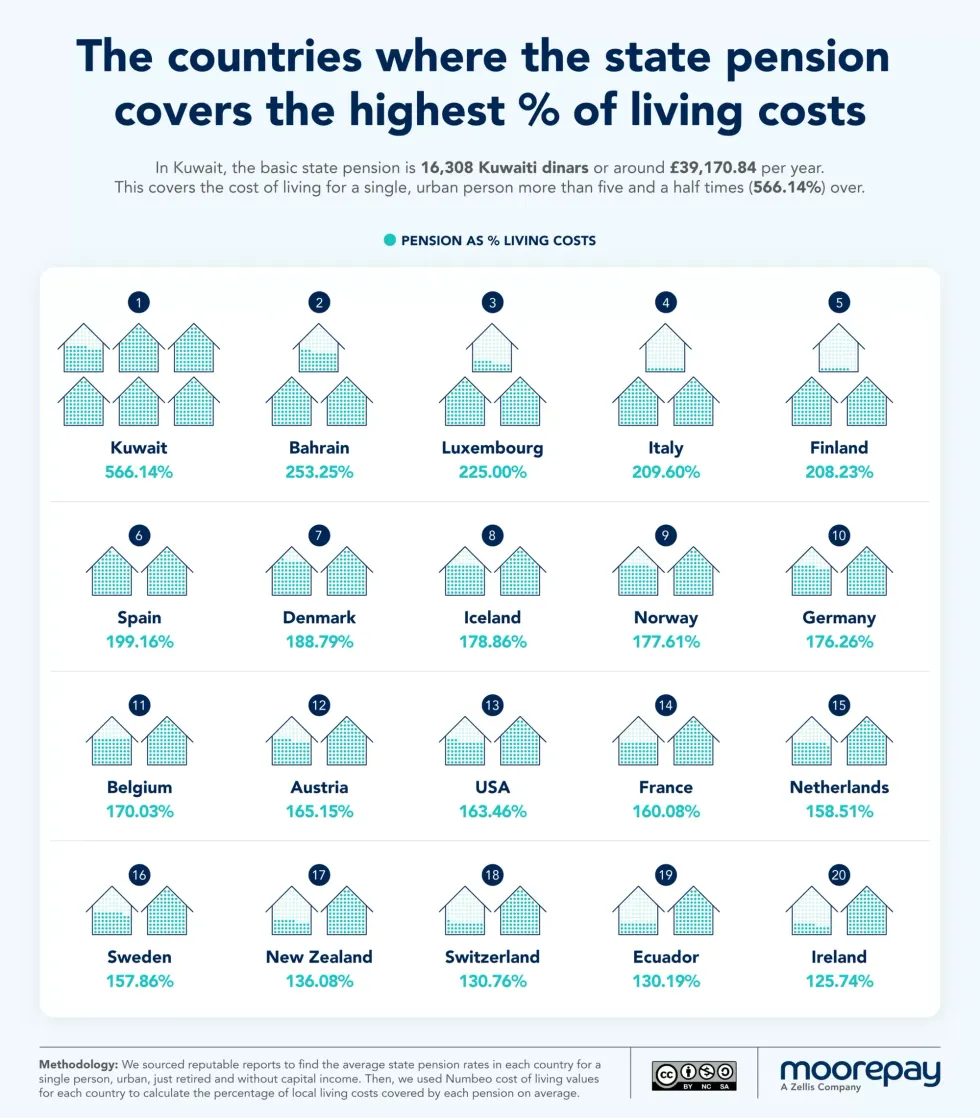
State pension living costs ranked
|MOOREPAY
Bahrain claims second spot at 253.25 per cent, followed by Luxembourg in third position at 225.00 per cent.
European nations dominate much of the upper rankings, with Italy achieving 209.60 per cent coverage, Finland reaching 208.23 per cent, and Spain recording 199.16 per cent.
New Zealand, Switzerland and Ecuador all outperform Britain, covering between 130 and 136 per cent of living expenses.
State pensions in some countries now cover far more than basic living costs, with major differences across the globe. Full list:
- Kuwait – 566.14 per cent
- Bahrain – 253.25 per cent
- Luxembourg – 225.00 per cent
- Italy – 209.60 per cent
- Finland – 208.23 per cent
- Spain – 199.16 per cent
- Denmark – 188.79 per cent
- Iceland – 178.86 per cent
- Norway – 177.61 per cent
- Germany – 176.26 per cent
- Belgium – 170.03 per cent
- Austria – 165.15 per cent
- United States of America – 163.46 per cent
- France – 160.08 per cent
- Netherlands – 158.51 per cent
- Sweden – 157.86 per cent
- New Zealand – 136.08 per cent
- Switzerland – 130.76 per cent
- Ecuador – 130.19 per cent
- United Kingdom – 126.08 per cent
- Ireland – 125.74 per cent
State pensions in some countries cover only a small fraction of basic living costs, highlighting major gaps in support for retirees.
- Nepal – 7.84 per cent
- Tajikistan – 8.03 per cent
- Jamaica – 13.44 per cent
- Armenia – 17.62 per cent
- Botswana – 18.23 per cent
- Fiji – 19.22 per cent
- Guyana – 21.65 per cent
- Georgia – 21.79 per cent
- Uzbekistan – 23.72 per cent
- Kyrgyzstan – 25.74 per cent
- Ghana – 26.32 per cent
- Albania – 28.72 per cent
- Ukraine – 28.87 per cent
- Egypt – 28.94 per cent
- Mongolia – 33.92 per cent
- Maldives – 38.04 per cent
- Oman – 39.62 per cent
- Moldova – 41.70 per cent
- Israel – 44.97 per cent
- Morocco – 45.51 per cent
Those receiving the new State Pension will see their weekly payments increase to £241.30 for the 2026/27 tax year, compared with £230.25 in the previous year. Recipients of the basic State Pension will receive £184.90 weekly, rising from £176.45.
The new State Pension applies to men born on or after 6th April 1951 and women born on or after 6th April 1953, while those born earlier qualify for the basic rate.
The triple lock mechanism, introduced by the Government, ensures pension values keep pace with either inflation measured by the Consumer Prices Index, average wage growth, or 2.5 per cent, whichever proves highest.
Labour has committed to maintaining this policy, though it faces ongoing scrutiny as pension costs have diverged from initial projections.

The gap between state pensions and living costs varies sharply across countries
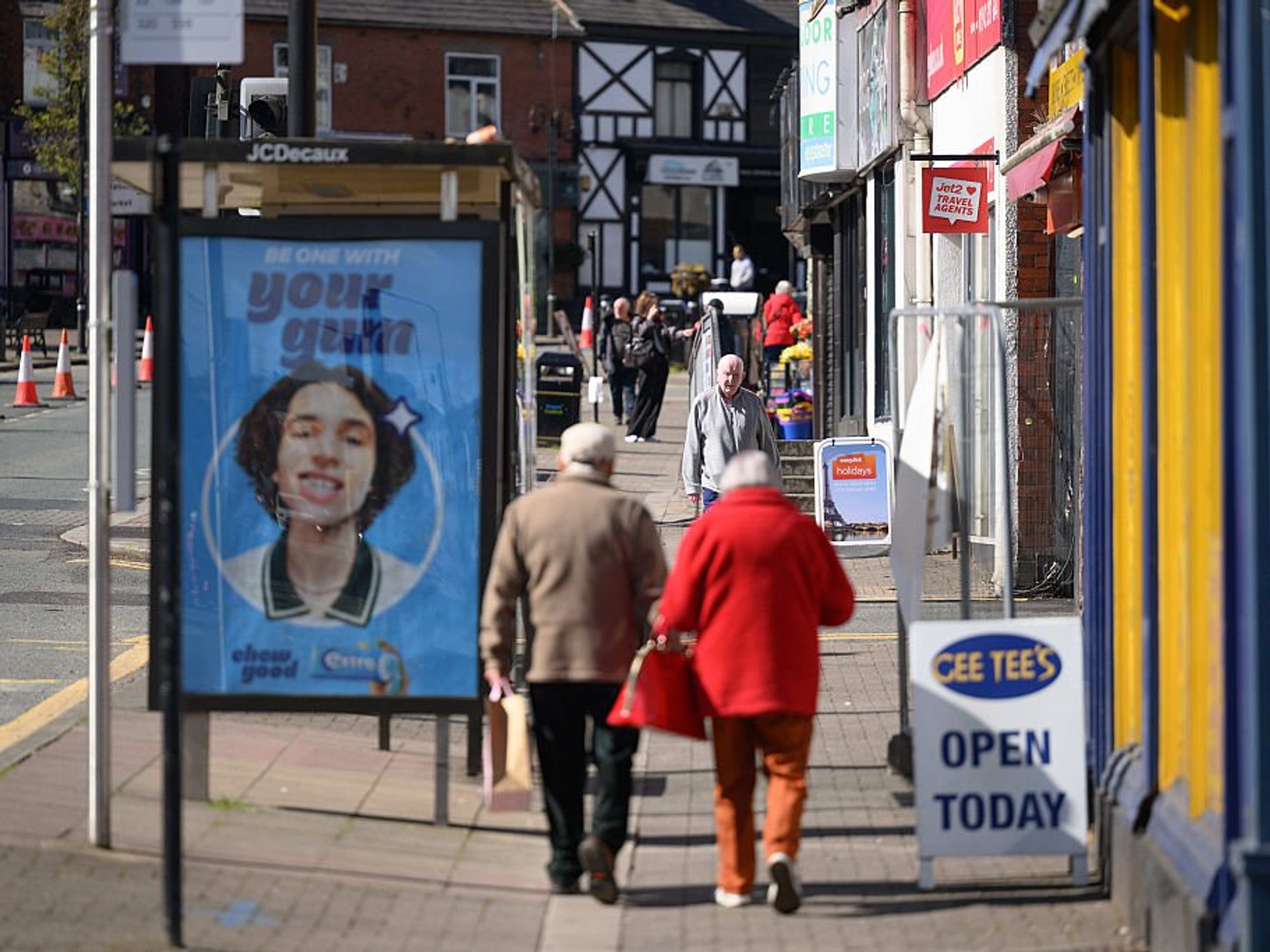
| GETTYThe gap between state pensions and living costs varies sharply across countries, with some retirees left with thousands in surplus while others face significant shortfalls.
Countries with the biggest pension surplus:
- Kuwait – £32,251.90 ($43,999.87)
- Luxembourg – £13,822.80 ($18,857.84)
- Bahrain – £11,547.07 ($15,753.17)
- Iceland – £11,067.65 ($15,099.12)
- Finland – £10,649.53 ($14,528.68)
- Denmark – £10,149.86 ($13,847.01)
- Italy – £10,094.86 ($13,771.98)
- Norway – £9,380.77 ($12,797.78)
- Germany – £7,942.15 ($10,835.13)
- Spain – £7,565.94 ($10,133.48)
- United Kingdom – £2,608.12 ($3,537.05)
At the other end of the scale, pensioners in several countries face large deficits after covering basic living costs:
- Jamaica – -£7,062.25 (-$9,634.72)
- Guyana – -£6,239.56 (-$8,512.36)
- Israel – -£5,763.96 (-$7,863.52)
- Armenia – -£5,367.25 (-$7,322.31)
- South Korea – -£5,056.06 (-$6,897.76)
- Albania – -£4,761.99 (-$6,496.57)
- Maldives – -£4,683.01 (-$6,388.83)
- Fiji – -£4,251.11 (-$5,799.60)
- Georgia – -£4,094.14 (-$5,585.45)
- Ghana – -£4,018.29 (-$5,481.98)
Ms Watkins questioned whether the £2,600 surplus in the UK reflects reality for typical pensioners.
"It depends on the person's wage and saving plan, but I don't think this is at all realistic for the average pensioner," she told GB News.
According to Money Helper data, someone in their late forties earning £50,000 annually would need to invest roughly 21 per cent of their salary into a private pension to achieve a comfortable retirement income of £18,300 yearly alongside the state pension.
Ms Watkins warned that rising living costs since 2020 mean savings may now be redirected towards fuel, energy bills and food.
"The state pension is not enough to cover living costs for a typical individual, so without any private savings these retired workers will be pushed into poverty," she added.
Those receiving the new State Pension will see their weekly payments increase to £241.30 for the 2026/27 tax year
| PAMs Watkins emphasised that the state pension would be considerably lower without the triple lock protection.
"If this was to return to the old rules, pensioners would see lower increase each year on an already low annual pension," she explained.
She warned that slower pension growth failing to match living costs would push more retirees towards government assistance.
"More pensioners could end up needing additional government support - for example, benefits like Pension Credit - because their basic pension wouldn't be enough to cover essentials," Watkins said.
Those falling between benefit eligibility thresholds and comfortable living standards face particular vulnerability.
"There would also be a greater risk of pension poverty for those who were in-between the benefit support, and basic comfortable living who would miss out on support," she added.