









Oil prices dropped by more than 10 per cent on Friday, building on earlier declines after Iran confirmed the Strait of Hormuz would stay open to commercial shipping during the ceasefire.
The move eased concerns over potential supply disruptions, helping drive a sharp pullback in prices.
Brent crude dropped by around 10 per cent to roughly $89 per barrel, while crude oil fell more than 11 per cent in a single session.
Market data from Trading Economics, recorded at around 14:32, showed the rapid sell-off unfolding shortly after confirmation that the strategic waterway had reopened.
Iran’s foreign minister Abbas Araqchi said the strait is "completely open" for all commercial vessels, with ships travelling along coordinated routes set by the Ports and Maritime Organisation of Iran.
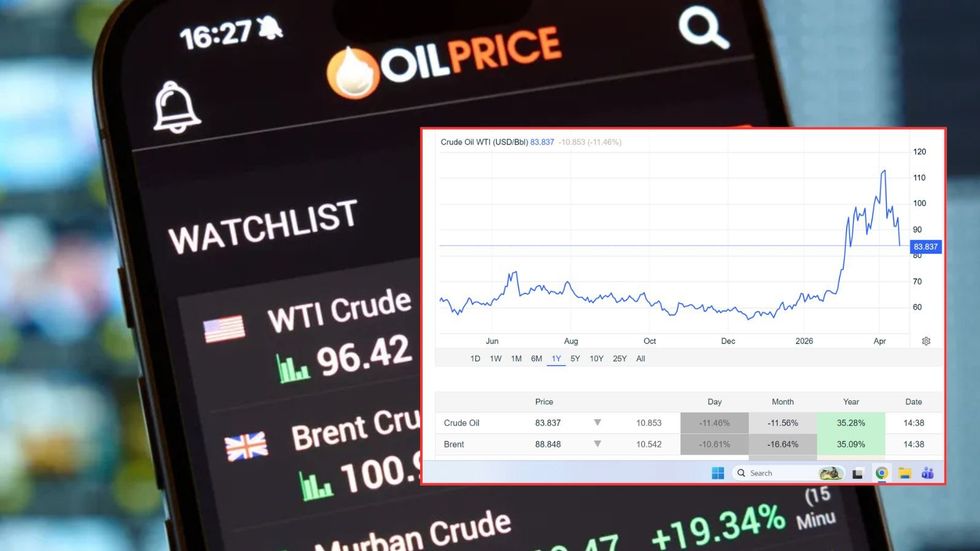
Heating oil fell more than 13 per cent, while petrol prices dropped over seven per cent.
|GETTY/TRADINGECONOMICS
He wrote on X: "In line with the ceasefire in Lebanon, the passage for all commercial vessels through Strait of Hormuz is declared completely open for the remaining period of ceasefire, on the coordinated route as already announced by Ports and Maritime Organisation of the Islamic Rep. of Iran."
President Donald Trump also said the passage is "fully open and ready for full passage."
On Truth Social he wrote: "Iran has just announced that the Strait of Iran is fully open and ready for full passage! Thank you!"
Wall Street responded positively after Iran confirmed the Strait of Hormuz is fully open. The Dow Jones Industrial Average jumped by around 578 points, or 1.2 per cent, to roughly 49,157, while the S&P 500 rose by about 0.7 per cent in early trading.
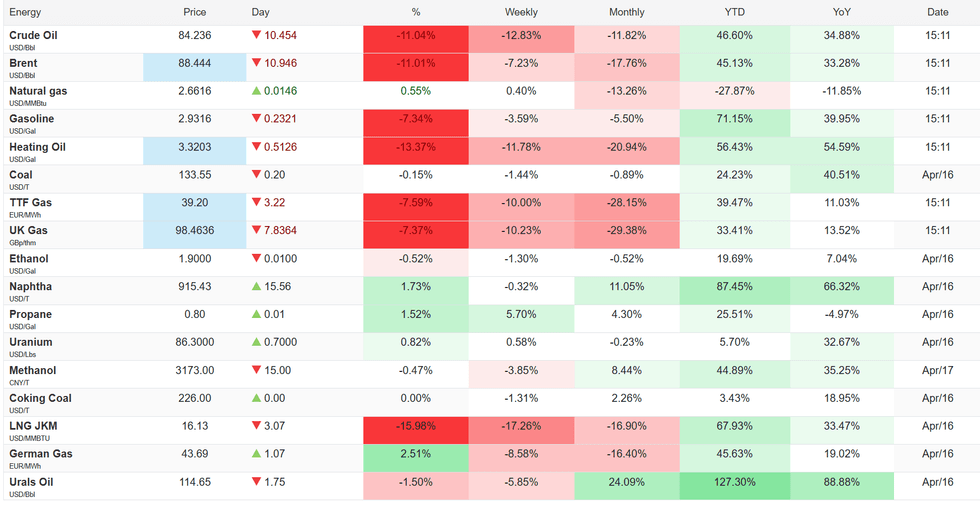
Prices had already started to fall earlier in the day as signs of easing tensions lifted market confidence
|TRADINGECONOMICS
The Strait of Hormuz carries roughly one fifth of the world's oil and liquefied natural gas, meaning any disruption poses a serious threat to global energy supplies.
Other energy markets also saw sharp declines. Heating oil fell more than 13 per cent, while petrol prices dropped over seven per cent.
Prices had already started to fall earlier in the day as signs of easing tensions lifted market confidence.
Hopes of fresh talks between the United States and Iran, alongside a 10-day ceasefire between Lebanon and Israel, raised expectations that the wider Middle East conflict could be de-escalating, prompting traders to pull back from earlier risk-driven buying.
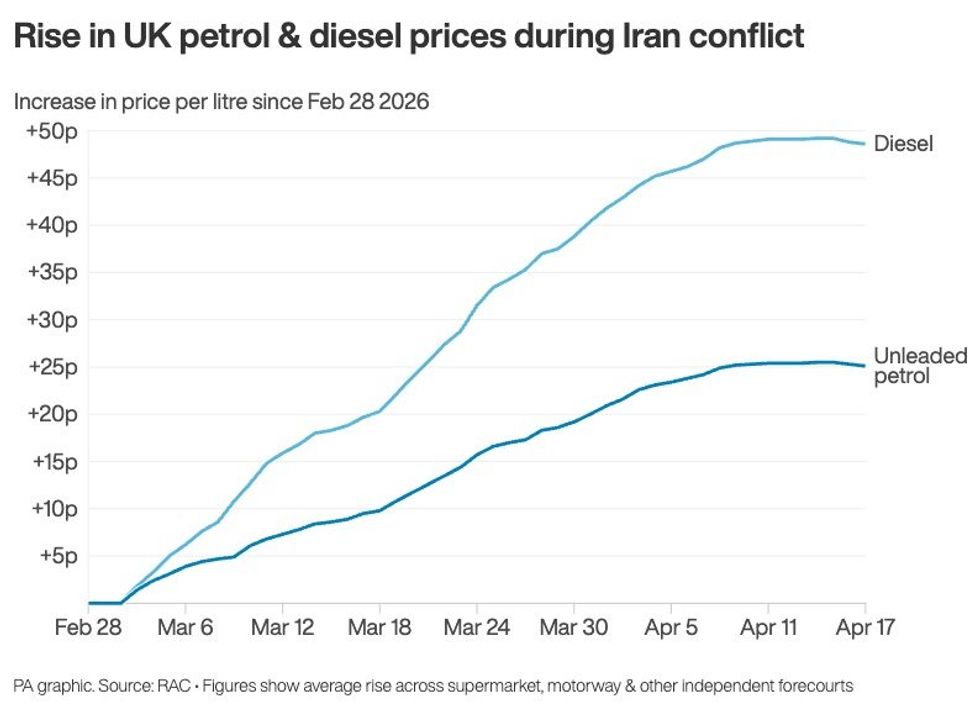
Fuel prices have fallen for the first time since the start of the Middle East conflict
|PA
The swift reaction suggests investors moved quickly to unwind positions taken during earlier panic-driven price surges.
As a result fuel prices have fallen for the first time since the start of the Middle East conflict.
The RAC said "drivers will be relieved" as the average price of a litre of petrol at UK forecourts was 158.1p on Thursday, down from 158.3p a day earlier.
Diesel saw a drop from 191.5p to 191.2p over the same period. This followed 46 days in a row when fuel prices rose.
A litre of petrol and diesel remains 25p and 49p respectively more expensive than when the war began on February 28.
Despite the significant drops, prices remain higher than they were a year ago, highlighting continued uncertainty in energy markets.

Cornwall Insight now forecasts the energy price cap will rise by 12 per cent to £1,837 annually from July
| GETTYFor British households, the easing of wholesale energy costs can bring a little relief.
Cornwall Insight now forecasts the energy price cap will rise by 12 per cent to £1,837 annually from July, an increase of £196 per year for typical dual fuel customers.
This represents a smaller jump than the £332 surge predicted in early March, when wholesale markets were reeling from the initial shock of the conflict.
However, analysts warn that a July increase remains unavoidable, with elevated wholesale prices already factored into Ofgem's calculations.