








Britain's energy debate has been reignited by the Middle East conflict, with fresh questions over whether North Sea drilling can shield households from rising bills.
But Octopus Energy boss Greg Jackson has warned that while extracting UK gas may have some benefits, it will not bring down energy costs for consumers.
In a move that may surprise some, the Octopus Energy boss said he supports extracting all remaining North Sea oil and gas.
Mr Jackson explained he is "perfectly relaxed" about continuing to tap domestic hydrocarbons.
"For as long as we're using a lot of gas, I personally am perfectly relaxed. I prefer it to come from the North Sea than the other side of the world," he told The Times.
However, the green energy boss firmly rejects arguments made by Kemi Badenoch and Nigel Farage that increased drilling represents a solution to Britain's energy woes.
"It ain't going to make a difference on the price. It's not going to make a difference on the security of supply," Mr Jackson argued.
Mr Jackson outlined two principal reasons for his scepticism about North Sea extraction as an economic remedy.
Britain's gas system is fully linked to European and global markets through pipelines and shipping routes, meaning any gas produced in the UK would still be sold at global prices.
If the Government tried to cap prices for UK consumers, producers would "just sell it to another country," he explained.
Analysis from the University of Oxford has described the idea that using up North Sea reserves would significantly cut household bills as "sheer fantasy."
 Greg Jackson urges Labour to allow new North Sea drilling | GETTY
There is also limited supply left. Mr Jackson said Britain’s potential output is a "drop in the ocean" compared with global demand.
Production began in the 1960s and peaked in 1999. The North Sea regulator estimates 2.9 billion barrels of oil equivalent remain, compared with 47.7 billion already extracted.
For Mr Jackson, the real route to energy independence is not more drilling, but switching to widespread electrification of the economy.
"The biggest solution is electrification," he stated, pointing to electric vehicles and heat pumps as replacements for petrol cars and gas boilers.
Consumer behaviour suggests the public is already responding to this message. During the first three weeks of March, Octopus recorded a 51 per cent surge in heat pump sales and a 20 per cent rise in EV charger purchases compared with February, as households sought protection from volatile energy prices.

the Octopus Energy boss said he supports extracting all remaining North Sea oil and gas
| PAMr Jackson warned of severe consequences for nations that fail to embrace this transition.
"If you don't take an approach of electrification and wherever possible from renewables, in ten years' time you're going to look like a middle-income country," he argued.
The Octopus boss also called for a dramatic rethink of planned grid infrastructure spending, drawing parallels with the government's decision to scale back HS2.
He argued that the potential £90billion earmarked for upgrading Britain's electricity network in coming years rests on outdated assumptions. The planned expansion would exceed even that undertaken during the 1960s.
Grid-scale batteries have become cheaper than planners anticipated, Mr Jackson contended. When combined with EV batteries, these could serve as a buffer for supply and demand, potentially reducing the approximately 1,000 miles of new pylons projected between 2030 and the 2040s.
"We need a huge rethink. Until you've built something, you can always cancel it. Look at what we've done with HS2," he said.
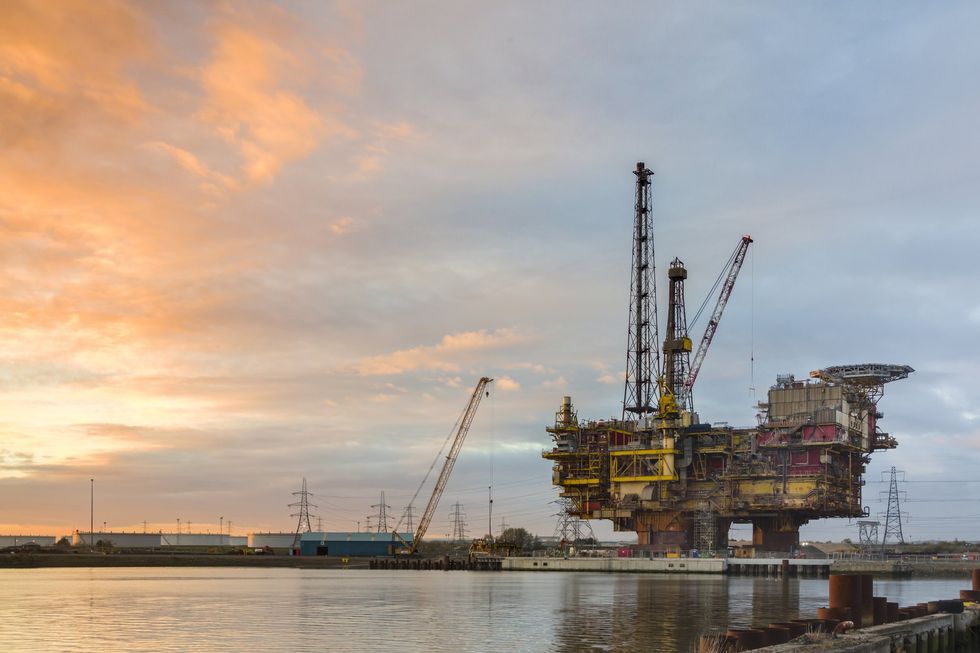
Mr Jackson outlined two principal reasons for his scepticism about North Sea extraction as an economic remedy
| GETTYMr Jackson also advocated scrapping the £22billion allocated for carbon capture and storage projects, which would be funded through energy bills.
His reasoning was blunt: "it really doesn't work." Research indicates that major CCS schemes worldwide have significantly underperformed expectations.
On nuclear power, he acknowledged it has merit but noted it has proved "disastrously" slow to construct.
Fracking, championed by Lord Cameron and supported by Farage despite stalling in 2018, would not make a "meaningful contribution" to gas demand and remains unpopular, he said.
Mr Jackson pointed to countries with substantial renewable capacity as models for Britain.
"The UK is seeing a 50 per cent increase in wholesale electricity prices due to Iran. Spain, virtually nothing. Norway, a 10 per cent increase in electricity prices because of Iran," he observed.