







Tom Blomfield, the entrepreneur behind digital bank Monzo, has declared income tax will become obsolete within the next five years as artificial intelligence (AI) displaces human workers en mass.
The fintech pioneer made the forecast during an appearance on a podcast, arguing that governments must fundamentally rethink how they fund public services.
Rather than taxing wages, Mr Blomfield suggested authorities should impose levies on the computational infrastructure powering AI systems.
"I don't think we'll tax human labour, we'll tax compute, [meaning systems like] data centres, and then we will use the proceeds to pay for Government," he said.
TRENDING
Stories
Videos
Your Say
His comments reflect growing concern across the financial sector about AI's potential to reshape the British economy.
Mr Blomfield said AI systems are already outperforming academics in specific areas of expertise, highlighting the pace of technological advancement.
"These tools are performing beyond university professor level they are actually beating humans in narrow domains," he told The Rest is Money podcast.
While acknowledging that AI remains limited to specialised tasks, he predicted this would change rapidly.

Tom Blomfield warns income tax could become obsolete as AI replaces jobs
|Rest is Money
"They're not yet generalisable, so they're very narrow geniuses, but by the end of 2026 they will be generalisable," Mr Blomfield said.
The Monzo founder singled out tax accounting as one profession facing near-total automation, suggesting it could soon require virtually no human involvement.
Such predictions carry particular significance given Britain’s heavy reliance on professional services, which represent a cornerstone of the national economy.
Evidence of this labour market transformation is already emerging.
LATEST DEVELOPMENTS
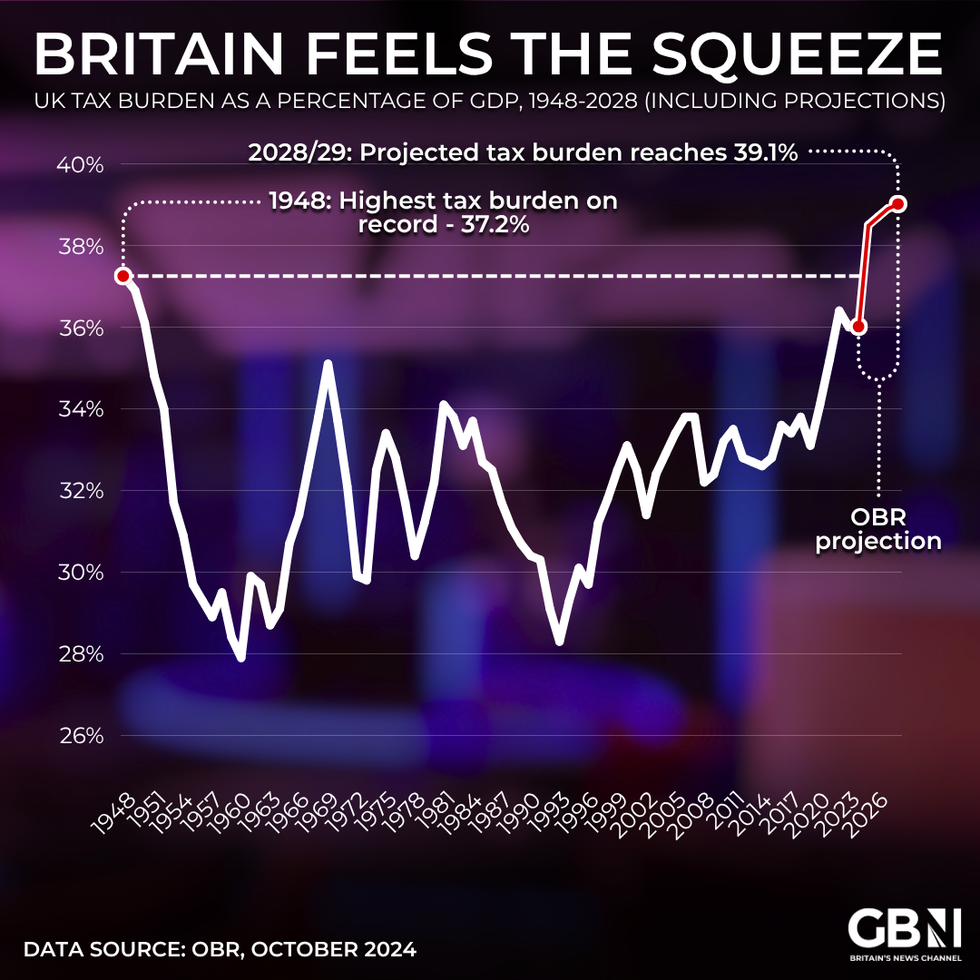 UK tax burden as a percentage of GDP | GB News
Data from recruitment platform Adzuna shows advertisements for entry-level positions have fallen by 35 per cent when comparing figures from last December with November 2022, the month ChatGPT first launched.
Britain appears particularly exposed to this technological shift.
Morgan Stanley warned earlier this year that the United Kingdom would bear the brunt of an AI-driven employment crisis more acutely than other nations.
The investment bank attributed this vulnerability to the country’s dependence on professional services, a sector that contributed 81 per cent of total economic output last year.
This concentration leaves British workers at heightened risk as AI systems become increasingly capable of performing knowledge-based tasks.
The question of how governments would replace lost revenue has prompted proposals from within the AI industry.
OpenAI, the creator of ChatGPT, last week advocated for a "robot tax" on automated labour alongside increased taxation of the wealthy.
In a policy paper, the company said: "Policymakers could rebalance the tax base by increasing reliance on capital-based revenues such as higher taxes on capital gains at the top, corporate income or targeted measures on sustained AI-driven returns."

ChatGPT have advocated for a "robot tax"
| GETTY IMAGESThe firm also suggested Governments could expand levies on share sales, property transactions and corporate profits as traditional income-based revenues decline.
However, implementing such measures presents considerable difficulties.
Income tax and National Insurance currently comprise 42 per cent of UK Government revenue, while capital-based taxes account for four per cent.
Previous attempts to tax technology companies have faced resistance, with Donald Trump repeatedly challenging levies on American tech giants.