







Global financial markets fell sharply on Monday after President Donald Trump issued a 48-hour deadline for Iran to reopen the Strait of Hormuz, triggering volatility across equities, oil and bond markets.
The strait handles roughly a fifth of global oil supplies, heightening concerns about energy disruption and inflation.
European stock markets dropped into correction territory, with the Stoxx Europe 600 falling 1.7 per cent to sit more than 10 per cent below pre-conflict levels.
TRENDING
Stories
Videos
Your Say
London’s Ftse 100 declined 1.5 per cent while Germany’s Dax fell 1.9 per cent.
Asian markets recorded steeper losses, with Japan’s Topix down 3.4 per cent, South Korea’s Kospi falling 6.5 per cent and Hong Kong’s Hang Seng losing 3.8 per cent.
Neil Wilson, investor strategist at Saxo Markets, said: "Developments over the weekend mean we are entering a new and very dangerous phase for financial markets."
UK Government borrowing costs rose above five per cent for the first time since the 2008 financial crisis as investors reacted to the escalation in the Middle East.
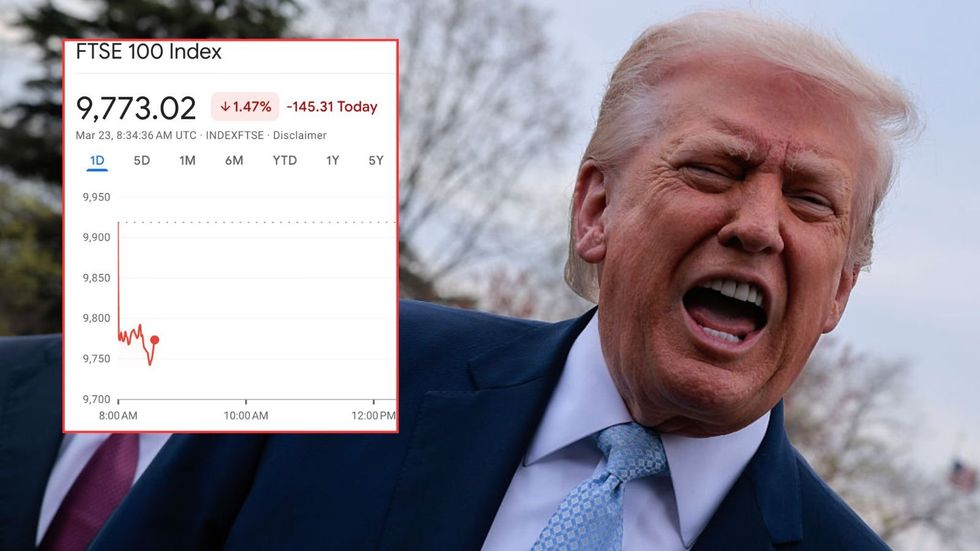
Global stocks fall sharply while borrowing costs rise as Middle East tensions escalate
|GETTY
The benchmark 10-year gilt yield increased by 0.06 percentage points to 5.05 per cent amid heavy selling across European debt markets.
Britain’s exposure to imported energy has left its bonds particularly vulnerable to rising oil and gas prices feeding into inflation.
Shorter-term borrowing costs also climbed, with the two-year gilt yield rising 0.05 percentage points to 4.63 per cent, its highest level since February 2024.
European natural gas prices increased by three per cent, adding to inflation concerns.
LATEST DEVELOPMENTS
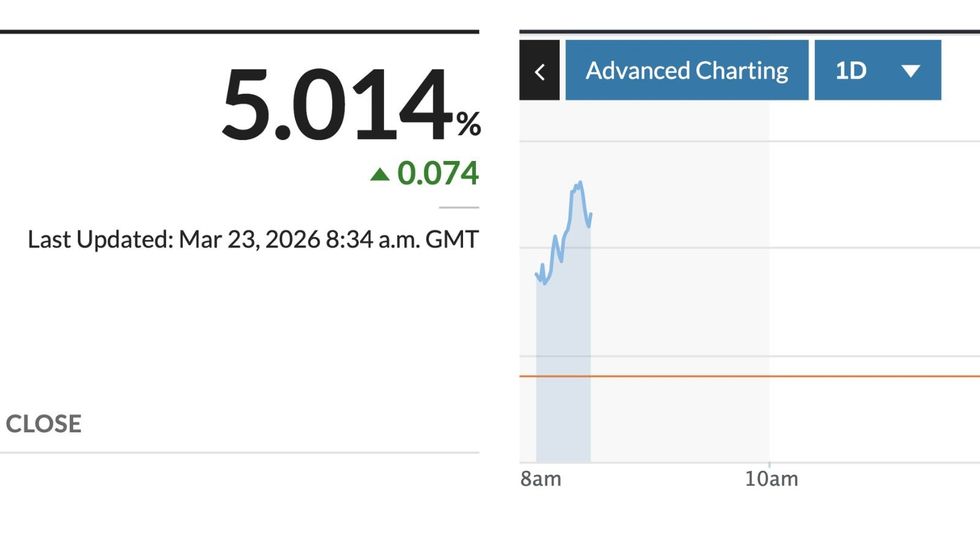
10-year Gilt yields shot through the five per cent threshold
|Marketwatch
Financial markets have shifted expectations for interest rates sharply, with traders now pricing in four quarter-point increases from the Bank of England this year.
Before the conflict, investors had expected two rate cuts.
The shift has raised concerns about a period of stagflation in the UK economy, where high inflation limits the Bank’s ability to support growth.
Sterling fell 0.4 per cent against the dollar to $1.328, while the euro also dropped 0.4 per cent to $1.152.
The dollar strengthened 0.2 per cent against a basket of major currencies.
Gold dropped more than 8 per cent, wiping out its gains for 2025, as expectations of higher US interest rates weighed on prices.
Sir Keir Starmer is due to chair an emergency meeting with Chancellor Rachel Reeves and Bank of England Governor Andrew Bailey to assess the economic impact of the crisis.
The meeting comes as tensions continue to rise in the region.
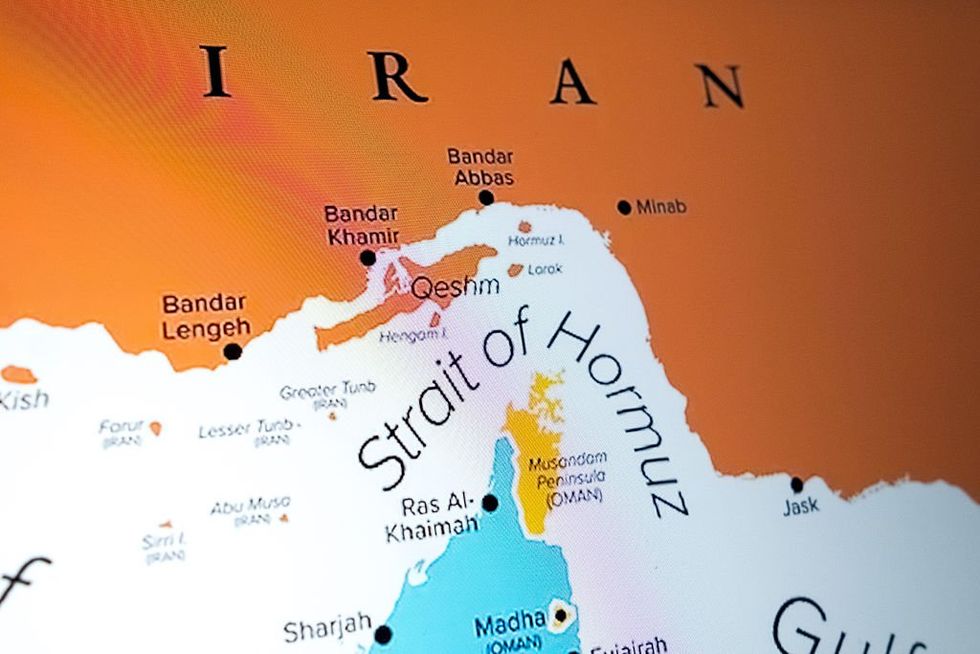 The Strait of Hormuz is a key shipping lane | GETTY
Mr Trump said the United States would "hit and obliterate" Iranian power plants if the strait was not reopened by 23:44 GMT on Monday.
Iran’s Revolutionary Guards responded by warning the waterway would "be completely closed and will not be opened until our destroyed power plants are rebuilt" if further strikes take place.
The ultimatum followed comments from Mr Trump a day earlier suggesting he was considering scaling back military operations after three weeks of conflict.
Explosions were reported in Tehran on Monday as Iran launched missiles towards Israel and Gulf states.
More From GB News