









British stargazers have a rare opportunity to witness a spectacular celestial display this weekend when six planets will appear together in the evening sky.
The astronomical phenomenon, commonly referred to as a planetary parade, occurs when multiple planets become visible simultaneously from Earth's perspective.
On February 28, Mercury, Venus, Jupiter, Saturn, Uranus and Neptune will all be observable shortly after dusk, weather permitting.
Such gatherings of four or five planets visible without optical aids typically happen only every few years, according to Nasa.
TRENDING
Stories
Videos
Your Say
Those keen to see the incredible display but miss Saturday’s showing will have to wait till October 2028 for another chance, though that parade will feature only five planets.
However, the following alignment after that is not expected until February 2034.
Last year saw alignments featuring six and even all seven planets, making these events relatively uncommon but not once-in-a-lifetime occurrences.
Four of these celestial bodies—Venus, Jupiter, Saturn and Mercury—can be spotted with the naked eye alone, though clear skies are essential.
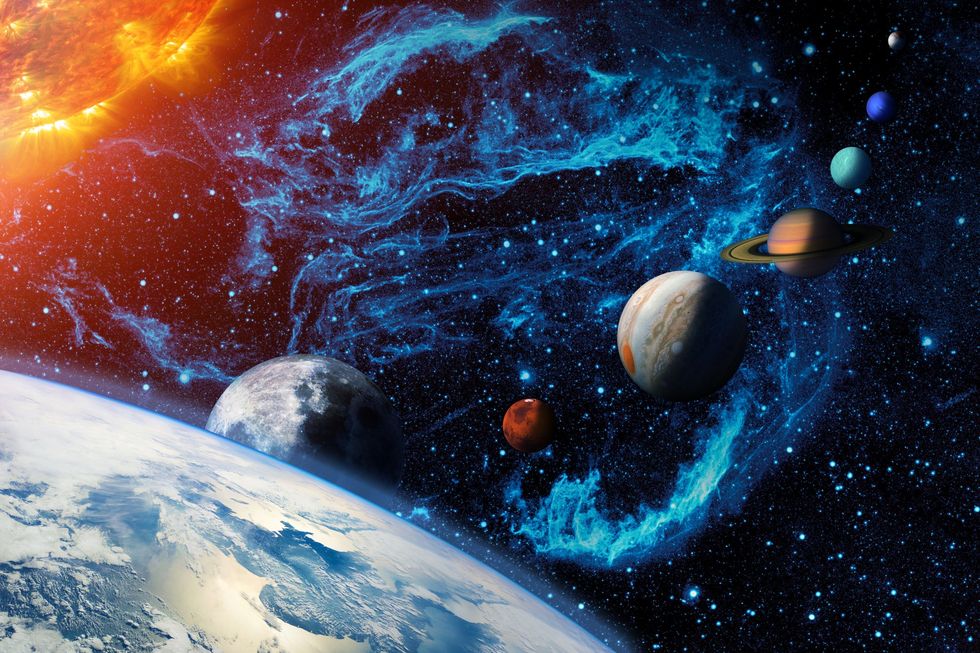
Britons will have a chance to see a rare space phenomenon where six planets align in the sky
|GETTY
Venus will prove the easiest to locate, being the brightest object in the night sky after the Moon.
The remaining two planets in the parade, Uranus and Neptune, will require binoculars or a telescope to observe.
Mercury may also present some difficulty for viewers, as it sits low near the horizon and can occasionally be challenging to discern without optical equipment.
The planets will appear grouped together because their orbits currently place them on the same side of the Sun during this period.
LATEST DEVELOPMENTS
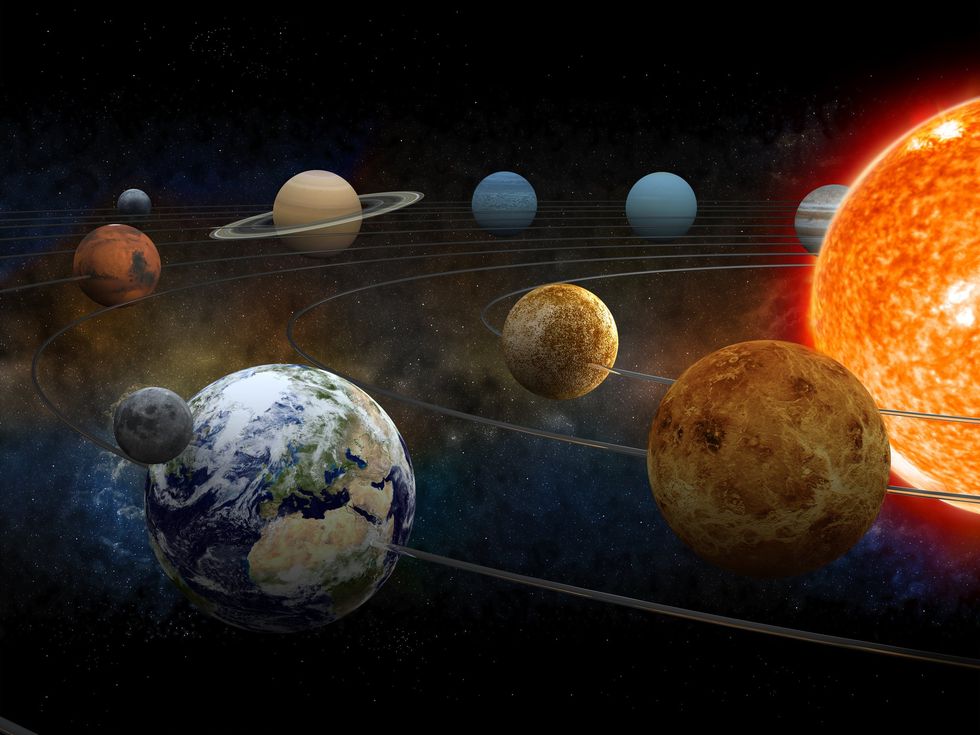
A repeat of this full alignment is not expected until February 2034
|GETTY
For optimal viewing, head outside approximately 30 minutes to an hour after sunset and direct your gaze towards the western sky.
Venus, Saturn and Mercury will appear close to the horizon, whilst Jupiter sits higher in the sky alongside Uranus and Neptune.
Choosing a location away from tall buildings, trees and artificial lighting will significantly improve visibility.
National Geographic recommends seeking out spots far from urban areas, such as moorlands or remote locations with unobstructed views of the horizon.
The parade should remain visible throughout the weekend and into the following days, though Mercury will eventually drop below the horizon.
Planetary scientist Sara Mazrouei from Humber Polytechnic in Canada offers a simple tip for identifying the celestial bodies.
"If it's twinkling, it's a star. If it is not twinkling, it's a planet,” she advised.
Dr Shyam Balaji, a researcher in astroparticle physics and cosmology at King's College London, explained that: “These alignments have no gravitational effects on Earth.”
“Their combined gravitational pull of the planets on Earth is negligible compared to that of the Moon or the Sun.
The academic explained that: “Planetary alignments have often inspired cultural or astrological interpretations, but scientifically they are predictable geometrical coincidences with no known physical influence.”
Our Standards: The GB News Editorial Charter