










British scientists have unveiled the most comprehensive three-dimensional map of the cosmos ever assembled, marking the conclusion of a five-year observational campaign.
The Dark Energy Spectroscopic Instrument (DESI) completed its final observations this week, targeting a region of sky close to the Little Dipper constellation.
Since 2021, researchers have been piecing together what they describe as an extraordinary "CT scan" of the universe.
The completed survey encompasses more than 47 million galaxies, alongside 20 million stars – representing six times the number of galaxies and quasars documented by all previous surveys combined.
The international collaboration brought together more than 900 researchers from 70 institutions worldwide, united in their quest to understand dark energy.
Among them were researchers from Durham University, University College London (UCL), University of Portsmouth, University of Cambridge, University of Saint Andrews, University of Sussex, and University of Warwick.
Light captured from the most remote galaxies travelled for more than 11 billion years before reaching the instrument, offering a glimpse into conditions near the universe's earliest epochs.
Throughout the five-year campaign, DESI's 5,000 fibre-optic sensors each focused on individual points of light across the night sky.
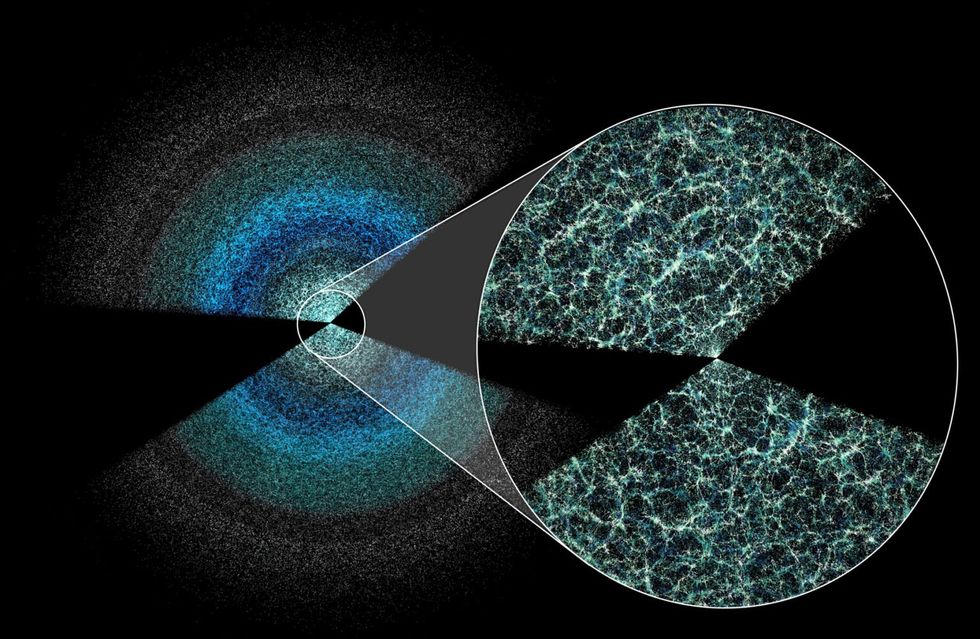
The Dark Energy Spectroscopic Instrument completed its final observations this week
|CLAIRE LAMMAN/THE DESI COLLABORATION
Robotic mechanisms positioned every lens with remarkable accuracy, achieving precision within 10 microns – finer than a human hair – and shifting to fresh targets every 20 minutes.
Ten spectrographs analysed the collected light, separating it into component wavelengths to determine each celestial object's location, speed, and chemical makeup.
The resulting map offers unprecedented detail and scale of the cosmos surrounding Earth.
Only regions obscured by the dense edge of our own galaxy remain unmapped, appearing as dark segments in the final image.
This invisible force constitutes approximately 70 per cent of the universe, and drives its accelerating expansion.
LATEST DEVELOPMENTS
Analysis of data from the survey's initial three years suggested that dark energy, previously thought to remain constant, might actually be evolving over time.
Such a discovery could fundamentally reshape scientific understanding of the cosmos, given the universe's origin and ultimate fate hinge on the interplay between matter and dark energy.
With the complete dataset now available, researchers hope to determine whether this apparent variation is more or less pronounced than initial findings indicated.
The collaboration will begin processing the full five-year survey immediately, with definitive results on dark energy anticipated in 2027.
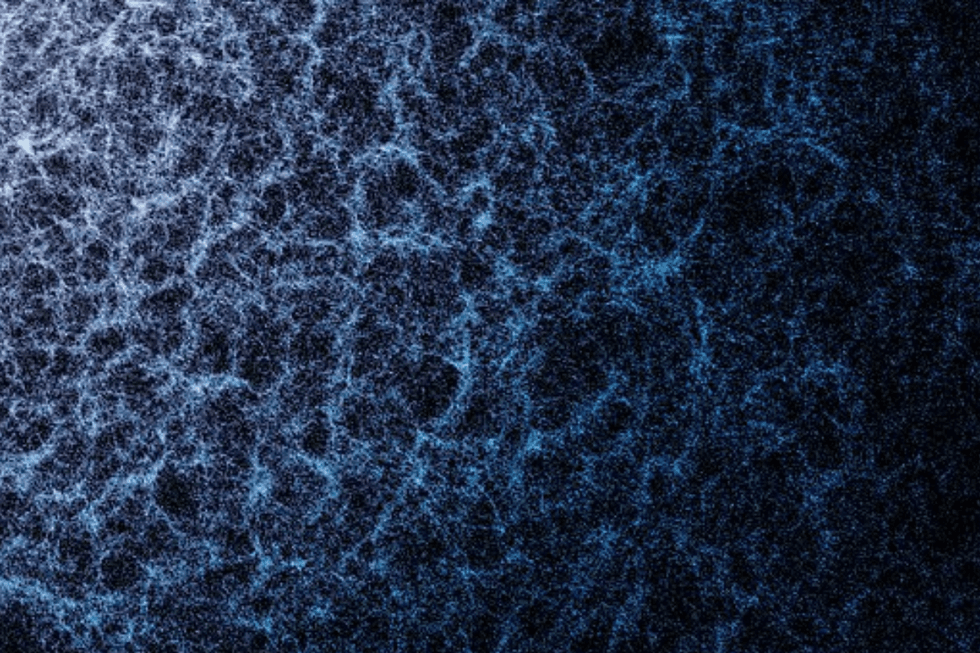
Each dot represents an individual galaxy
|CLAIRE LAMMAN/THE DESI COLLABORATION
Remarkably, DESI exceeded expectations, completing observations ahead of schedule and capturing far more data than the original target of 34 million galaxies and quasars.
From 2028, the team intends to expand the survey's coverage by roughly 20 per cent, reaching 17,000 square degrees of sky.
To put this in perspective, the moon occupies merely 0.2 square degrees, whilst the entire sky spans over 41,000 square degrees.
This expansion will require observations closer to the Milky Way's crowded central plane and further southward, where atmospheric interference poses greater challenges.
Researchers also plan to revisit previously mapped regions to identify luminous red galaxies and examine dwarf galaxies along with stellar streams, ribbons of stars stripped from smaller galaxies by our galaxy's gravitational pull.
Stephanie Juneau, associate astronomer and NSF NOIRLab representative, said: "Ultimately, we are doing this for all humanity, to better understand our universe and its eventual fate."
Our Standards: The GB News Editorial Charter