










Nasa has officially declared a Mars probe "unrecoverable" after it scanned a mysterious interstellar object.
The first mission devoted to observe the Martian atmosphere, The Mars Atmosphere and Volatile Evolution (Maven) lasted a decade beyond its intended one-year mission.
It was last heard on December 6, when the spacecraft "experienced an unexpected loss of signal after it passed behind the Red Planet".
Nasa has now determined Maven to be unrecoverable and incapable of performing its science and data relay mission.
Outside of its primary Martian observance mission, Maven examined 3I/ATLAS, a comet which is only the third interstellar object discovered in our solar system.
The probe moved behind Mars while tracking the comet, before suddenly stopping transmission and rotating unusually fast.
At the time, Shane Byrne, HiRISE principal investigator at the University of Arizona in Tucson, said: "Observations of interstellar objects are still rare enough that we learn something new on every occasion.
"We’re fortunate that 3I/ATLAS passed this close to Mars."
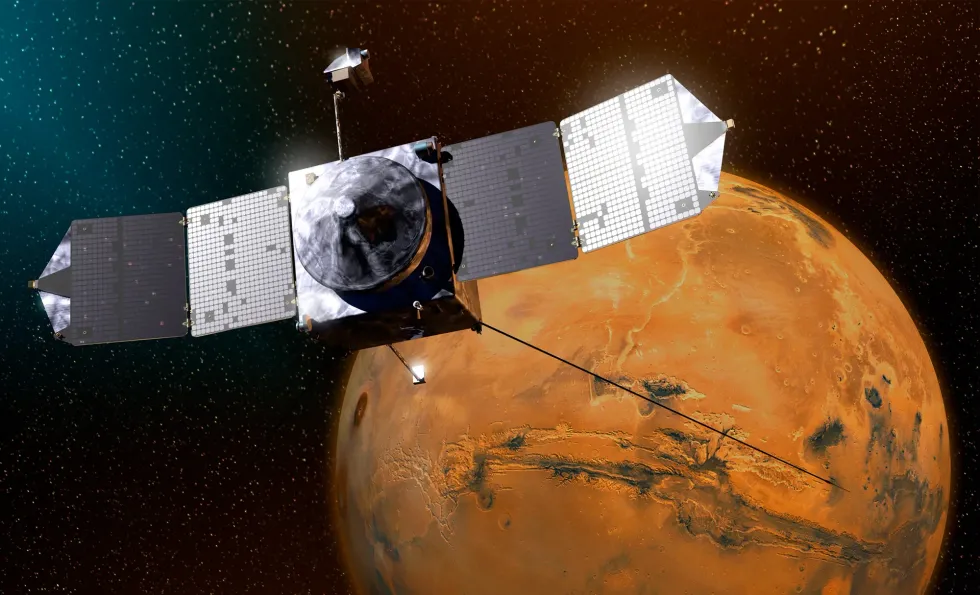
An artists' rendition of Maven at Mars, which has now been declared 'unrecoverable' by Nasa
|NASA
Nasa remains uncertain why the $583million probe began to spin rapidly, which it believes cause d the batteries to drain and communications system to die.
The space agency said: "These preliminary findings do not address a potential root cause for the anomaly, which still is being investigated."
When Maven initially went offline in December, many believed it was tied to 3I/ATLAS, which made its closest pass by Earth that same week.
Nasa faced criticism for the images it took of the interstellar object - which were blurry, and fuelled theories 3I/Atlas was harbouring alien life in some way
LATEST SPACE NEWS:

An ultraviolet image taken by Maven which shows the halo of dust around the comet
|NASA
Earth-bound amateurs were also able to take photographs of comet through telescopes and pictured jest of gas flowing from it.
Harvard Professor Avi Loeb has claimed 3I/ATLAS was sent by a form of unknown intelligence.
The comet was found to be releasing a surprising amount of methane, a byproduct of living organisms, in May last year by Dr Loeb, the director of the Galileo Project.
He said in a statement: "In the atmospheres of exoplanets, methane is considered a prominent biosignature."
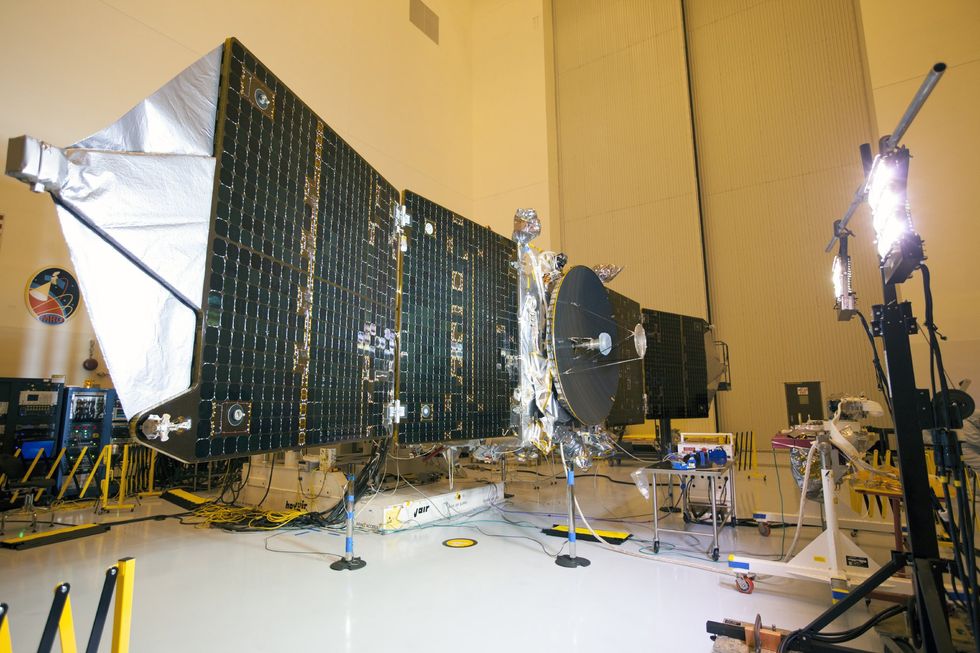
PITCURED: Maven in Earthbound testing before its launch
|NASA
Other scientists have argued methane is the first detectable indication of life beyond Earth, Dr Loeb added.
The Galileo Project is one of the largest university-backed projects dedicated to the search of extraterrestrial life, describing itself as where "accidental or anecdotal observations and legends" meet with "the mainstream of transparent, validated and systematic scientific research".
Shannon Curry, Maven's principal investigator said: "The Maven mission has truly advanced our understanding of the Martian atmosphere and evolution. This dataset has had a tremendous impact on the field."
Louise Prockter, director of the Planetary Science Division at NASA Headquarters in Washington, added: "The data collected from MAVEN will continue to provide valuable insight into Mars for decades to come."
Our Standards: The GB News Editorial Charter