










Nasa officials have warned there is "no plan B" during the most perilous part of the upcoming mission before the Artemis II crew gave an update on the groundbreaking Moon mission.
Artemis II has spent its eighth day in space and is currently preparing for atmospheric re-entry and splash down in the Pacific at about 8.07pm EDT on April 10 (12.07am GMT April 11).
Nasa administrator Jared Isaacman admitted this was the riskiest phase of the mission.
He said: "In terms of what keeps me up at night, my blood pressure will be elevated until they're under parachutes in the water off the West Coast.
TRENDING
Stories
Videos
Your Say
"There's no plan B there. That is the thermal protection system. The heat shield has to work."
The crew of four, comprising Nasa's Reid Wiseman, Victor Glover, Christina Koch, and Canadian astronaut Jeremy Hansen gave an update on the mission on Thursday.
Mr Glover, the pilot of Artemis II, admitted he had not "begun to process" the experience of the mission after being asked about how the crew was mentally preparing for reentry.
He said: "I'll be honest and say I've actually been thinking about entry since April 3, 2023, when we got assigned to this mission.

The Artemis 2 crew is now preparing for their return to Earth alongside mascot and zero gravity indicator 'Rise'
|NASA
"And one of the first press conferences we were asked, 'what are we looking forward to?', and I said splashdown.
"And it's kind of humorous, but it's literal as well that we have to get back."
He described the experience of re-entry as "riding a fireball through the atmosphere" and said it also was "profound".
Artemis II's Orion spacecraft, named Integrity, will experience temperatures of up to 7,000 Fahrenheit (3871 Celsius).
LATEST ON ARTEMIS II:

Jared Isaacman admitted the re-entry plan had been adjusted to make up for 'shortcomings' of the Orion heat shield
|GETTY
The crew capsule will experience speeds of 25,000 miles per hour, causing gas and air particles in front of the spacecraft to compress.
In 2022, during the unmanned Artemis I mission, the Orion spacecraft experienced unexpected char loss - which reduces protective insulation.
This was caused when gases generated inside the outer material called Avcoat were not able to properly vent and dissipate.
Mr Isaacman, a former commercial astronaut, said the mission has been adjusted since Artemis I to adjust for "the current shortcomings" of the heat shield.
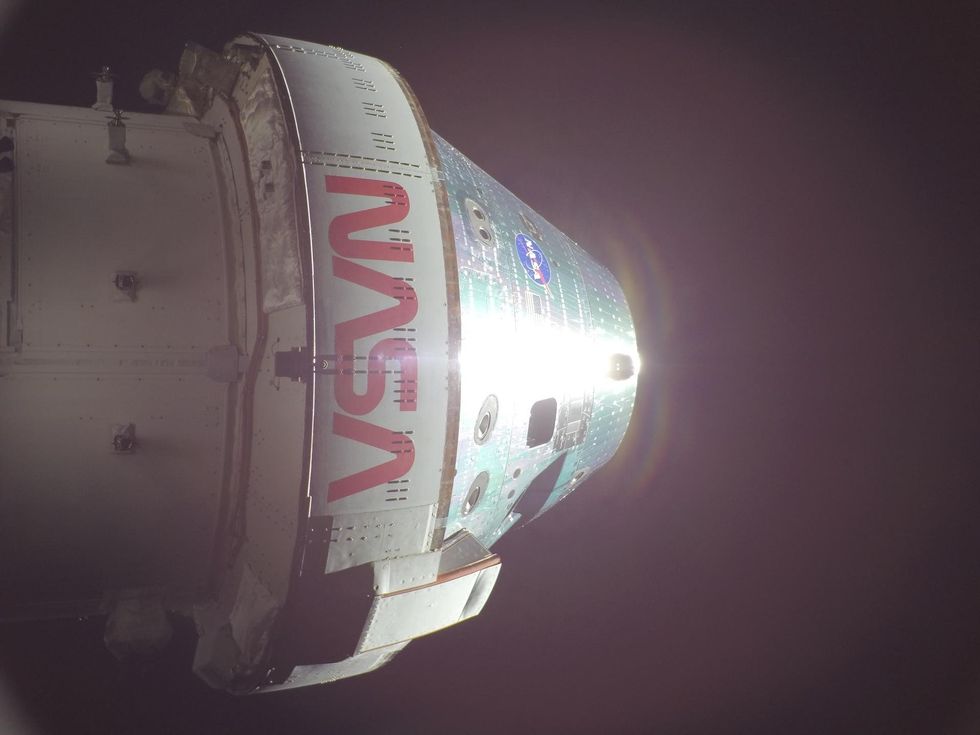
PICTURED: A view of the Orion spacecraft from its solar array wings as the Artemis II crew slept
|NASA
Comparing the current era of space exploration to the 1960s, he admitted Nasa was not currently manufacturing as many spare parts as it did during the Space Age.
After surviving the most intense period of heat, two parachutes are deployed from the spacecraft which will slow Orion to 300 miles per hour.
A set of pilot parachutes will be then deployed, followed by three large main parachutes which will bring the spacecraft to 17 miles per hour before splashdown in the Pacific Ocean, off the coast of San Diego, California.
The 2003 Space Shuttle Columbia disaster was caused by a failure in the thermal protection system, which has led to heat shields being a key point of research in the years since.