










A Labour MP has demanded Sir Keir Starmer sacks Ed Miliband as he branded latest Net Zero targets as “insane”.
On Tuesday, the Department of Energy Security and Net Zero (Desnz) announced the Government aims to reduce carbon emissions by 87 per cent between 2038 and 2042.
The announcement has drawn fierce criticism from those who argue it accelerates deindustrialisation at the worst possible time for British energy security.
Graham Stringer, MP for Blackley and Middleton South, called for the Energy Secretary’s sacking after calling it “insane”, because the Government is not issuing more licences for gas and exploration in the North Sea to generate jobs.
He told GB News: “Whilst further capitalisation of our own gas and oil fields will have a marginal impact on price, it will generate UK jobs.
“We are generating jobs in Norway and Qatar at the expense of our own.
“The policy, quite frankly, is insane."
Mr Stringer went further, telling the People’s Channel he did not understand why Miliband had "so much influence”.

Ed Miliband said the 'only way to protect families and businesses' was to produce 'clean homegrown power'
|GETTY
He added:"Our current Prime Minister is too weak to sack Ed Miliband - hopefully if we get a new one, he will be strong enough to sack him."
DESNZ said the “Net Zero economy supports over one million jobs in the UK”, which generated £105billion in gross value added in 2025.
It described the industry as “one of the UK’s fastest-growing economic sectors”.
Mr Stringer argued it was “perverse” the UK was “generating jobs in Norway and Qatar” to import oil.
LATEST DEVELOPMENTS
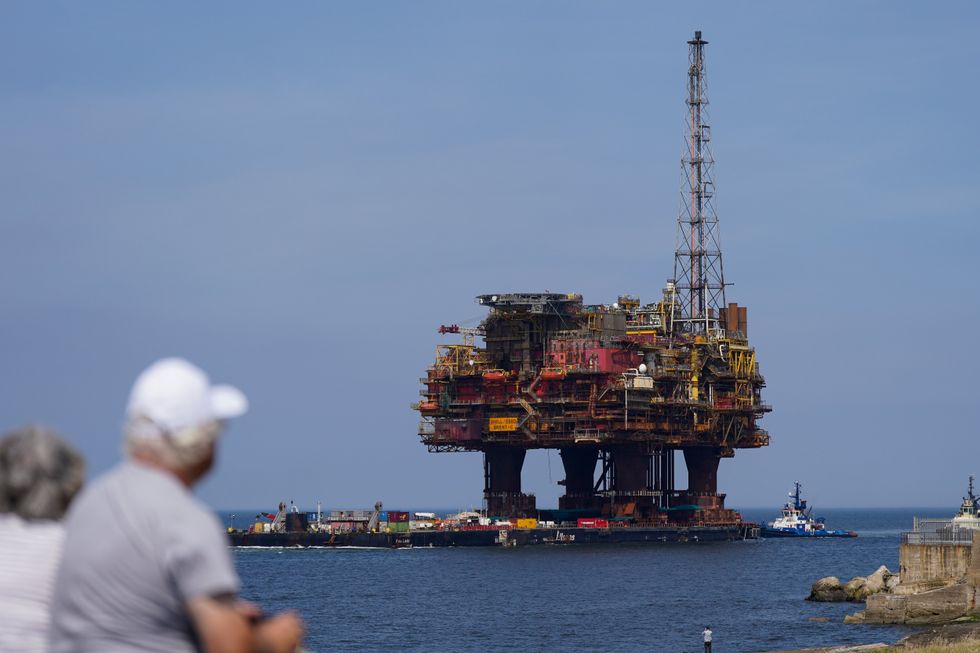
There is the equivalent of roughly 4.7 billion barrels of oil in the west of Scotland's Shetland basin alone
|GETTY
Beyond the Labour Party, Kemi Badenoch has also been vocal about the lack of domestic investment in the oil and gas industry in the UK.
Speaking from a business park in Aberdeen, the Conservative leader said the offshore sector was losing 1,000 jobs a month and accused both Labour and the SNP of waging a “war on oil and gas”.
Mr Stringer shared a similar sentiment, saying: "There is nothing in our policies which are affecting the climate.
“It is a deindustrialisation policy and speeding this process up is a bad move."
The dismantling of major crude oil refineries, including Grangemouth in Scotland, with 430 jobs lost, and Lindsey in Lincolnshire, has left the UK with just four operational oil production facilities, down from 18 in the 1970s.
Elizabeth de Jong, CEO of Fuels Industry UK, warned last year refineries were "strategic national assets" supplying 47 per cent of final energy demand, adding: "Refineries are vital for energy security, for jobs, for decarbonising well and for growth."
However, Desnz said by 2050, the UK could cut its reliance on fossil fuels from around three-quarters of energy consumption today to just 15 per cent, potentially avoiding around £445billion in fossil fuel spending over the next 25 years.
The announcement has roused criticism beyond Westminster.
Energy Strategist Chris Johnson warned the Government's approach amounted to "deindustrialisation by spreadsheet”.
The Washington-based energy guru told the People's Channel: "Net Zero without industrial strategy becomes deindustrialisation by spreadsheet. Prices rise, people suffer, and the only winner is China."
China dominates in renewable energy technology manufacturing – producing 80 per cent of the world’s solar panels and 60 per cent of the globe’s wind turbines.
It also refines roughly 90 per cent of rare earth minerals, which are used in the production of wind turbines and electric vehicles (EVs), as well as crucial metals for battery production, such as lithium and cobalt.
Mr Johnson said the UK could take a leaf out of America’s book when tackling the energy crisis.
He said: "Energy systems are global, but you can only control what happens within your borders. Act accordingly and seek to compete, not merely cooperate.
"The US embraced fracked shale, a "massive expansion of fossil fuels" and it led to the largest emissions reductions in history. Our emissions are now lower per capita than in 1940.
"If we had a scarcity mindset nationwide, not only would energy prices be higher, emissions would be as well."
Britain's News Channel has approached the Government for comment.
Our Standards: The GB News Editorial Charter