








Labour's insistence that a closer relationship with the EU is needed to unleash Britain's economy has been discredited in a new report.
Crunching the numbers on business, investment and trade, think tank Facts4EU finds Britain has performed well on each metric since leaving the bloc.
The report, which concludes a two-part series looking at Britain's economic performance since Brexit, comprises four charts.
The first chart (see below) deals with business investment.
Despite claims that business investment has fallen sharply since Britain left the EU’s customs union and single market at the end of the transition period on 31 December 2020, it has in fact risen by 19.5 per cent in real terms (after taking off the effects of inflation).
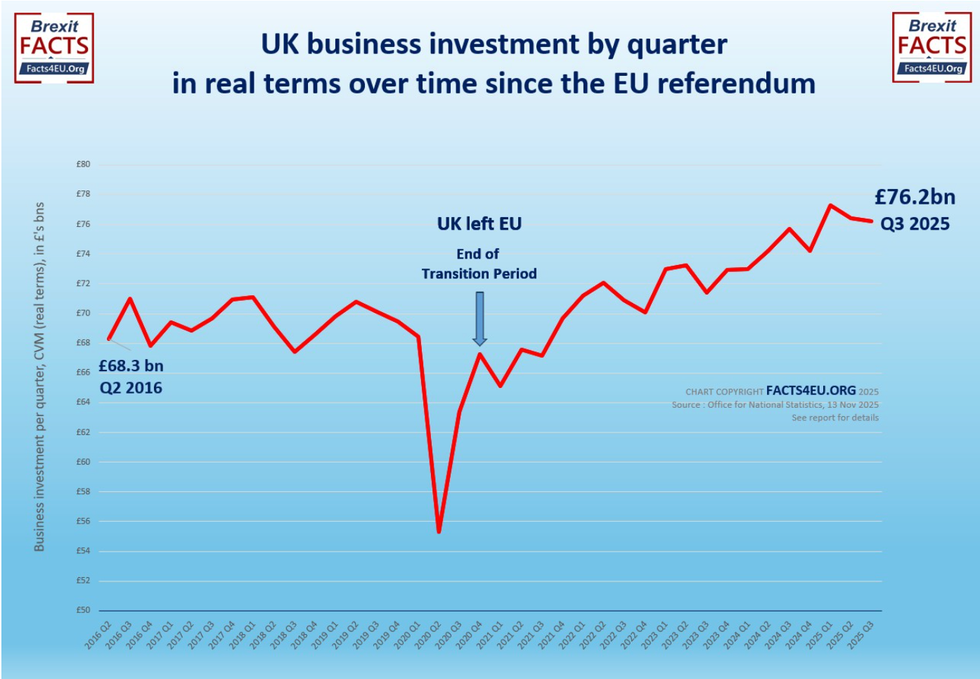
UK investment is up by 19.5 per cent in real terms since the UK left the EU's single market and customs union
|Facts4EU
Reform UK Deputy Leader Richard Tice dubs the findings an "excellent" rebuttal to Liberal Democrat Europe spokesman Al Pinkerton's claim that Britain's departure from the customs union has "choked" business investment.
He said: "Far from being 'choked', the excellent chart below by Facts4EU demonstrates that UK business investment has in fact risen since Brexit.
"Just as our Chancellor seems to have a problem recognising which way is up when it comes to her level of borrowing, so our LibDem friends have a similar problem when it comes to the mathematics of investment."
Former Conservative MP John Redwood, has also commented on the findings, saying: "Investment has grown well since we left the EU, contrary to gloomy Remain forecasts.
"Our history in the EU showed that the more we accepted EU laws, taxes and directions, the slower our growth and the more obstacles to successful investment. Now that we are out, we are avoiding some of the most damaging new laws they are adopting."
He cites former Italian Prime Minister Mario Draghi's damning report, which spells out the EU's economic woes in painstaking detail, such as losing out on massive digital investment.
"The EU held us back", Mr Redwood said, adding: "UK investment is doing a bit better, and can increase thanks to Brexit as we distance ourselves from the restrictive and costly rules crippling the EU's growth as identified by Mr Draghi. The UK has more digital investment than comparable EU countries, and needs to use its freedoms to expand it further."
Mr Tice added: "It should be remembered that Germany has its own troubles on investment and other issues, being in recession after its immigration policies have failed and after struggling with the EU’s Net Zero policies.
"Our private sector can do much, much better, of course, but this has far less to do with Brexit than with a tax code so long and complex it could consume the shelf-space of four copies of the entire wizardry output of J. K. Rowling. We shall, of course, be wielding the editor’s red pen on this code, making investment a great, great deal easier in the future.
"None of us wishes to see our businesses going abroad to seek further phases of funding for their investment needs."
Exports up
The second chart discredits Dr Pinkerton's claim that trade has been "strangled" by Brexit. Data from the Office for National Statistics actually show exports have risen.
The UK's exports of goods and services have grown by 19.2 per cent in real terms since Britain left the customs union and single market (see chart below).
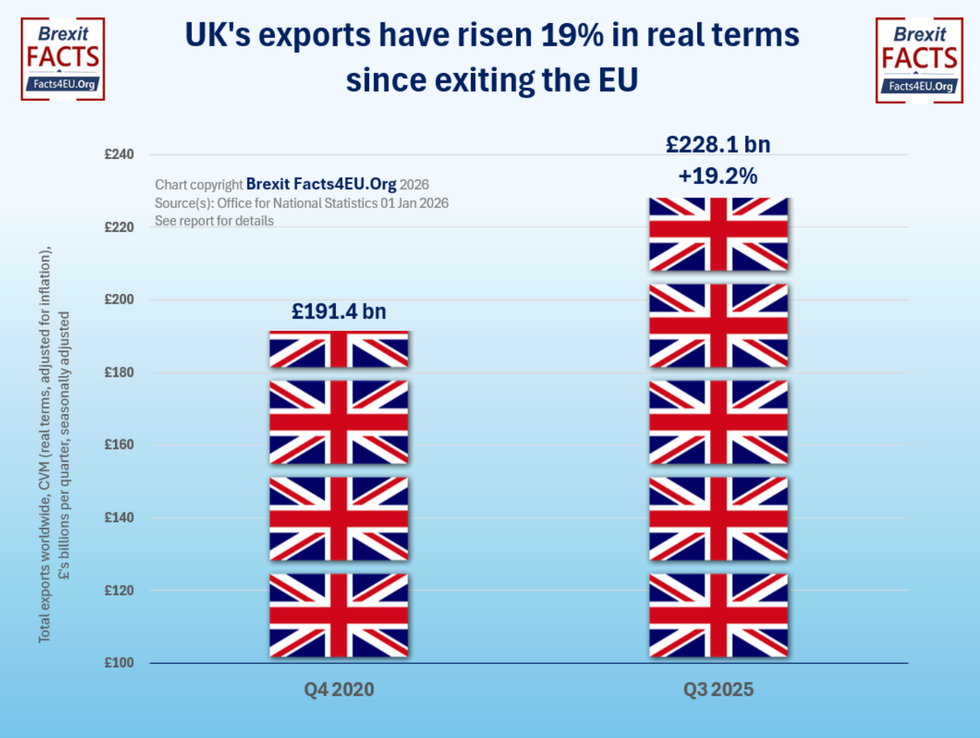
The UK's exports of goods and services have grown by 19.2 per cent in real terms since Britain left the customs union and single market
|Facts4EU
Commenting on the findings, Mr Redwood said: "Our trade has flourished since Brexit. There was no collapse as the Remainers had forecast before and after the event."
The former Conservative MP points out that Britain's exports of services, especially to non-EU destinations, have "soared" as a result of new trade agreements.
He told GB News: "2021, our first year out, brought 7.5 per cent GDP growth - largely owing to Covid lockdowns for much of the previous year - and good growth in trade. So there was no negative Brexit effect in 2021 and no late scramble in 2020 to carry out trade transactions ahead of Brexit. Once again, Remain forecasts were wrong.
"Inside the EU, our non-EU trade grew faster than our EU trade. By the time we left, well over half our trade was with non-EU countries. That was inevitable given the slow growth, high cost, over over-regulated nature of the EU getting in the way of business success."
Employment bonanza
The report also gives short shrift to the Remainer claim that Brexit has hammered the jobs market.
Speaking in the Commons, Dr Pinkerton expressed this view, saying: "At a time when Office for National Statistics data shows rising numbers of young Britons leaving to work overseas, we have a national duty to support growth, ease household pressure and give young people a compelling reason to build their futures here in the UK."
The Facts4EU authors do not dispute the number of young Britons leaving to work overseas - only the reasons for it.
As their findings show, this has nothing to do with the EU's customs union and more to do with Rachel Reeves' Budget measures.
The reality, as the chart below shows, is that employment has increased significantly since the Referendum and Britain's subsequent departure from the EU.
Far from hurting employment, the ONS data shows it has continued to rise since Brexit - except during the Covid-19 years - and stands significantly above its previous level.
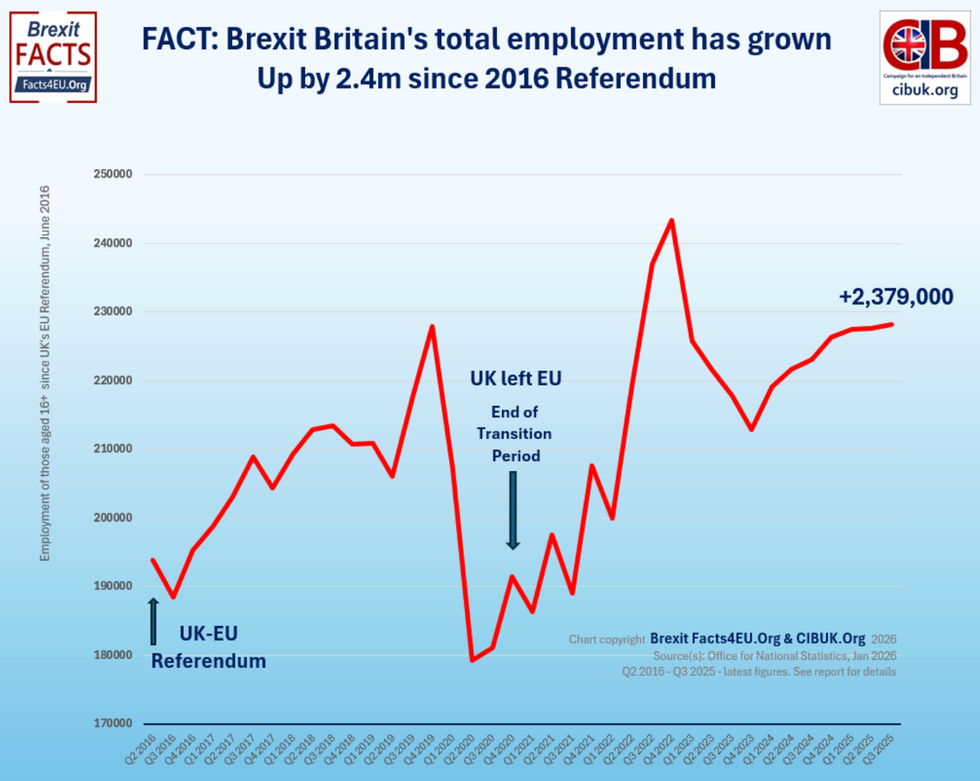
Employment has increased significantly since the Referendum and since the UK actually left the EU
|Facts4EU
A final chart shows the gap between the HM Treasury’s initial forecasts for job numbers (in grey) versus the reality (in red). It's based on employment numbers from the ONS.
The Treasury was unable to give quarterly estimates for the job falls of up to 820,000, which it had predicted. The chart below therefore spreads these over the two-year period, which they were forecasting for the immediate aftermath of a Leave vote.
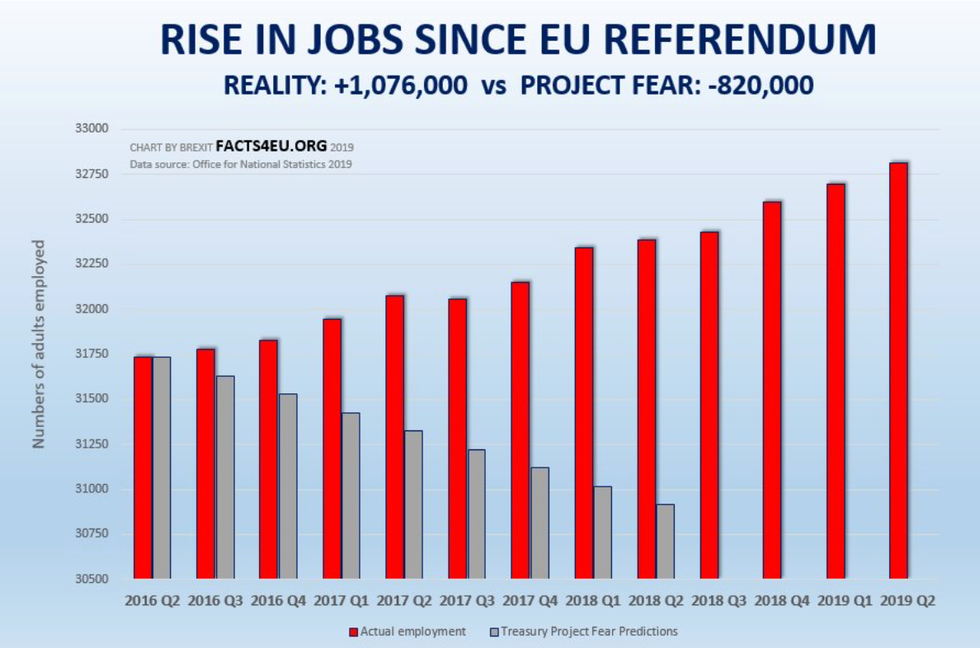
Chart showing the reality of jobs increases after the Referendum
|Facts4EU
Labour's 'Brexit betrayal bill'
The report challenges the argument underpinning Labour's proposed plans for "dynamic alignment", which could see Britain and Brussels tied together in various areas of regulation.
Under the arrangement, Britain would be bound to EU rules covering food standards, animal welfare and pesticide regulations permanently.
Keir Starmer claims the legislation, which critics have branded the "Brexit Betrayal Bill", will undo the economic harm wrought by Britain's historic departure from the bloc.
However, critics point out that it would hand power back to Brussels without needing a vote from MPs or the public. It could also lock Britain into EU net zero rules without a parliamentary vote.
Our Standards: The GB News Editorial Charter
More From GB News