

'MPs are going too far on abortion; we need the House of Lords to pull it back' – Maria Caulfield
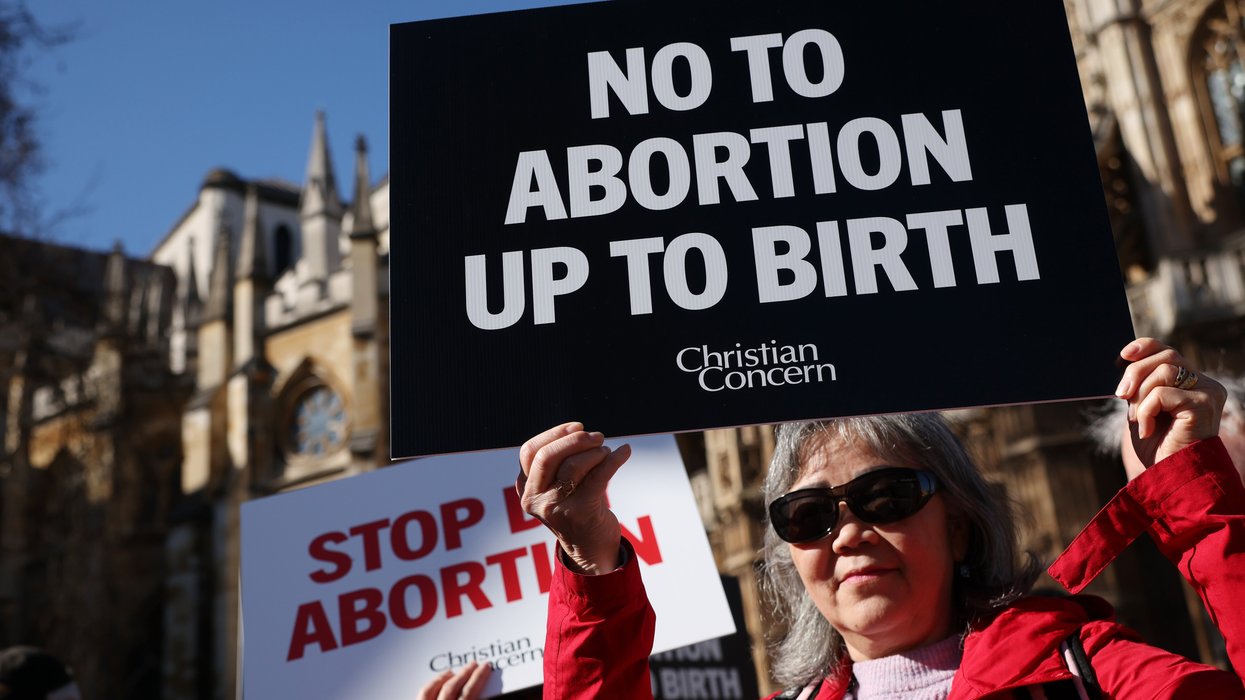
Ex-Health Minister Maria Caulfield lifts the lid on the latest push to liberalise abortion laws
|PA



Ex-Health Minister Maria Caulfield lifts the lid on the latest push to liberalise abortion laws
Don't Miss



Most Read


Trending on GB News
Despite already having abortion laws in England and Wales that are some of the most extreme in the western world, a highly controversial backbench amendment to the Crime & Policing Bill was passed by MPs last June that would "decriminalise" abortion up to birth for women in relation to their own pregnancies.
The bill, which was intended primarily to deal with tackling radicalisation, anti-social behaviour and sexual offences rather than abortion law, is approaching the end of its passage in the House of Lords.
The abortion amendment – now clause 208 of the bill – would change the law so that “no offence is committed by a woman acting in relation to her own pregnancy”, meaning it would no longer be a criminal offence for a woman to administer her own abortion, for any reason, at any stage of pregnancy, right up to birth.
This is no mere tweak to the law or simply a matter of bringing the law up-to-date. There is nothing progressive or modern about changing the law such that a viable baby can have its life ended beyond the legal time limit for abortion without any repercussions.
TRENDING
Stories
Videos
Your Say
Should the law change as proposed, what is currently unthinkable and subject to the full weight of the law – infanticide – would become possible with no legal consequence just a few minutes before birth if performed while a baby is still in the womb. Most people would struggle to see any significant moral distinction between such acts.
Abortion law is complex territory, and so it is right that parliamentarians take time to consider such matters carefully. Alas, that is not what happened in the House of Commons.
Instead, a seismic change to the law on abortion in England and Wales was voted through after only 46 minutes of contributions from backbench MPs, with no prior evidence sessions and no other form of scrutiny, such as that afforded by a full committee stage.
Tonia Antoniazzi, the Labour MP who introduced the amendment to the bill in the House of Commons, had stated before MPs debated her proposed law change that she is comfortable with the idea that her amendment would allow women to end the life of a viable unborn child as late as 37 weeks.
This is not a hypothetical scenario; though rare, abortions of healthy babies at term have happened. Clause 208 actually compounds an existing problem with our abortion laws rather than improving them.
The ‘pills by post’ scheme, first introduced during the pandemic in 2020 and made a permanent feature of the law in 2022, allows women to receive abortion pills by post without first having to attend an in-person medical consultation.
The result of this law change, which came in via a backbench amendment when I was a health minister and which I opposed, is the lack of any reliable assessment of a woman’s gestational age, meaning it is possible for a woman to obtain abortion pills to end a pregnancy beyond the legal limit, whether knowingly or otherwise.
Such late-stage abortions are incredibly risky, carrying inherent risks of harm for women, as well as ending the life of a viable baby.
LATEST DEVELOPMENTS
In some ways, clause 208 represents the worst of both worlds. It fails to address present inadequacies in the safeguarding of women by leaving the pills-by-post mechanism in place.
At the same time, it places women at further risk by removing any legal deterrent against the procurement of a later-term abortion.
As Baroness Monckton explained during the second reading of the bill in the House of Lords, if clause 208 makes it onto the statute book, we would be “creating a modern-day equivalent of backstreet abortion" – a stark but prescient observation that should be heeded by parliamentarians regardless of their views on the principle of abortion.
However, all is not lost, yet. Baroness Monckton has introduced an amendment which would remove clause 208 in its entirety.
In addition to this, a further amendment has been tabled by Baroness Stroud to reinstate the requirement for women to undergo an in-person medical consultation prior to proceeding with an at-home abortion. This is surely a sensible and reasonable approach.
These two amendments have significant public support. Polling in the summer found that two-thirds of women supported the return of in-person appointments, while just four per cent favoured the current system. Only one per cent of the public supports abortion up to birth.
This is an issue which is being pushed through via a ‘Christmas Tree’ Bill, with minimal public awareness, at the instigation of parliamentarians who have so convinced themselves of the righteousness of their position that they will accept no compromise and dismiss any criticism as regressive.
Yet, it is clear that the public does not support the radical, dangerous amendment to the law proposed by Tonia Antoniazzi. It simply goes too far and is not safe.
Elected representatives are entrusted to act in the best interests of the people they serve, and many do so brilliantly. However, this amendment furthers neither the will nor the well-being of the public.
I am troubled that its proponents appear unable to sufficiently detach themselves from their dogma to understand the de facto effect of their proposal: that a woman would be able to end the life of her own baby, for any reason, at any stage, including right up to birth, without legal consequence.
It does not matter that the time limits set out in the Abortion Act 1967 may remain unchanged on paper (which proponents trumpet ad nauseam): this amendment makes such limits redundant.
When they vote on Wednesday, peers should support the two amendments tabled by Baroness Monckton and Baroness Stroud, which will respectively unpick and mitigate the harmful effects of the proposed and past changes to abortion law.
If they fail to do so, or if the Commons does not subsequently support their decision, our society will be damaged and its moral credibility greatly diminished.
More From GB News