




Viktor Orban is Europe’s longest-serving – and most controversial – Prime Minister. The Hungarian leader is famed for his close relationship with President Donald Trump, his hardline approach to immigration, and, more recently, his stance on the war in Ukraine.
Perhaps less well known is the Orban administration’s novel approach to family policy. Since 2010, the Fidesz Party government has implemented an intensive series of tax and benefit incentives to encourage young Hungarians to get married and have children. It was these pro-natal policies that first piqued my interest in Hungarian politics when I was an MP.
I was delighted, therefore, in January to be invited alongside GB News National Reporter Charlie Peters on a British press tour to Budapest.
Over the course of a week, we met a number of government ministers to find out about Hungary’s approach to family policy, the war in Ukraine, the EU and of course immigration.
We also visited Hungary’s southern border with Serbia. GB News viewers will remember our live reports in deep snow next to the 175 km long and 4m high fence that the Hungarian government has built to prevent illegal migrants from crossing into the country.
To dig deeper into how Hungary’s ‘no migration’ policy has been achieved, Charlie conducted an extended interview with Balazs Orban, Viktor Orban’s political director. Balazs Orban told GB News that Britain and other European countries should pay more attention to the human rights of their own citizens rather than only considering the rights of migrants.
It was clear that Britain could have much to learn from Hungary’s no-nonsense approach to many of the challenges facing Europe today.
So GB News was pleased to be invited back to Budapest this week for an exclusive interview with Viktor Orban, his first with UK press for ten years and his first ever interview for British television.
The interview took place in the library of the Hungarian Prime Minister’s offices, a beautiful building in Budapest’s Castle District overlooking the famous Danube River.
Talented GB News camera operator Emil Kunda led the filming team and spent several hours setting up the room to optimise the lighting and camera angles.
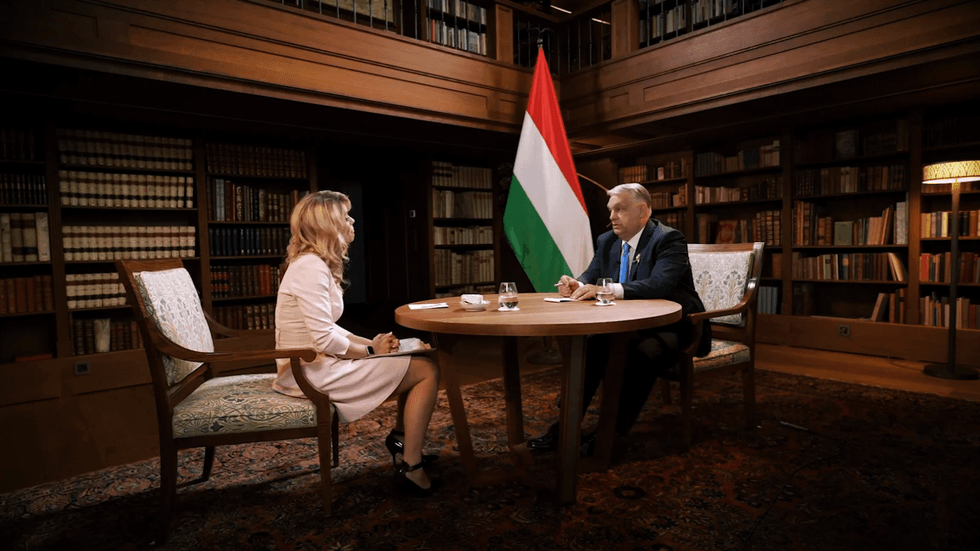
In his first ever interview for British TV, Victor Orban delivered a stark wake-up call - Miriam Cates
|GB
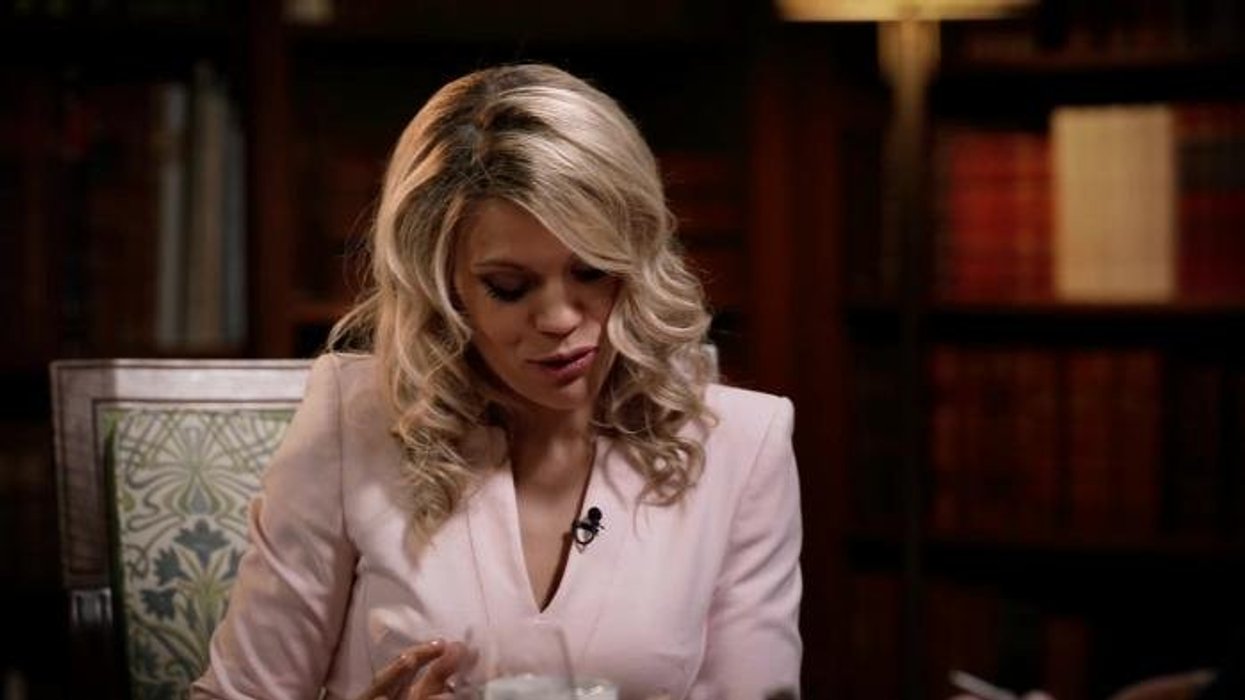
When Mr Orban arrived, he introduced himself to everyone in the room – including the technical team – and sat down for our hour-long discussion.
With the help of Charlie Peters and GB News reporter Steven Edginton, I had prepared and researched a series of questions to cover the main topics of interest to our viewers, including the war in Iran, Ukraine and Mr Orban’s views on the future of Europe.
We also covered the crucial Hungarian elections on April 12th, where Mr Orban is standing for a fifth consecutive term in office.
Despite his reputation as the ‘strong man’ of Europe, Mr Orban was warm, relaxed, humorous and easy to talk to.
Although, of course, English is not his first language, I was impressed at Mr Orban’s ability to discuss complex political and philosophical issues such as the problems with Western leadership and what it means to be a Christian country in 2026.
Orban was refreshingly direct; a British audience may strongly object to his statement that Ukraine is a “buffer zone” between Russia and Hungary and that Hungarians do not have a moral duty to help Zelensky. But Mr Orban cannot be accused of trying to obfuscate.
 Viktor Orban tells GB News that is it ‘not fair' for living standards to 'decline' if you have children | GB
For me, the most interesting part of the interview was our discussion about the importance of Hungary’s – and Europe’s – Christian heritage, and Mr Orban’s view that saving national identity is even more important than preserving our current democratic system. You can watch the segment here.
Viktor Orban has many detractors, not least EU officials in Brussels who accuse him of undermining democracy, freedom of the press and the rights of LGBTQ citizens. There are allegations of corruption against his government, and I challenged him on these during the interview.
Many Western Europeans also feel uncomfortable with Orban’s hardline stance on culture and immigration, particularly his view that there is a place for Islam in the world, "but this place is definitely not Hungary”.
Yet Hungary has a unique and fascinating past, caught between East and West and fighting many times for survival in the last few centuries.
I think it is important, before forming a judgement about a country or its leadership, to try to understand more about the context. I hope that this is what viewers will gain from watching the interview.
But whether or not you agree with Mr Orban’s philosophy of pragmatic patriotism, at least he has a consistent philosophy, one that he can eloquently explain and defend. Sadly, the same cannot be said for many of Britain’s recent Prime Ministers.
Looking on from our shores, Hungary might seem like a small, regional power in Central Europe with little impact on Britain’s political and cultural affairs.
But with our political system under immense strain, people are looking to newer and more unique corners of the globe for inspiration. Hungary is one such space.
We don’t need to copy and paste their system, but the Hungarians offer a lot that we can learn from. And if we don’t speak to Orban and his team, those lessons risk being neglected.
It was an honour and a privilege to be granted this exclusive interview on behalf of GB News, and I am grateful to the Hungarian Embassy in London for their crucial role in making it possible.
More From GB News