








Have you been to Addis Ababa, the capital of Ethiopia? When I was there 20 years ago, it didn’t seem the most promising place.
Rubbish-strewn, corrupt, benighted. In other words, much like any other African country.
And yet by the logic of Africa’s equivalent to the European Union, it ought to be booming. A sort of Abyssinian Dubai.
Because Ethiopia, a proud, predominantly Coptic Christian nation, is the only African country never to have been colonised by Europeans.
TRENDING
Stories
Videos
Your Say
The African Union says the transatlantic slave trade was a catastrophe for the African countries affected; keeping them in a semi-permanent state of underdevelopment.
Had the slave ships not extracted their best human capital, these nations would be thriving today.
But from what I saw in Ethiopia, the lack of African progress has many causes.
It may be convenient to blame Europeans. It may be expedient to argue that transatlantic slavery – uniquely – held back Africa. But the argument is full of holes.
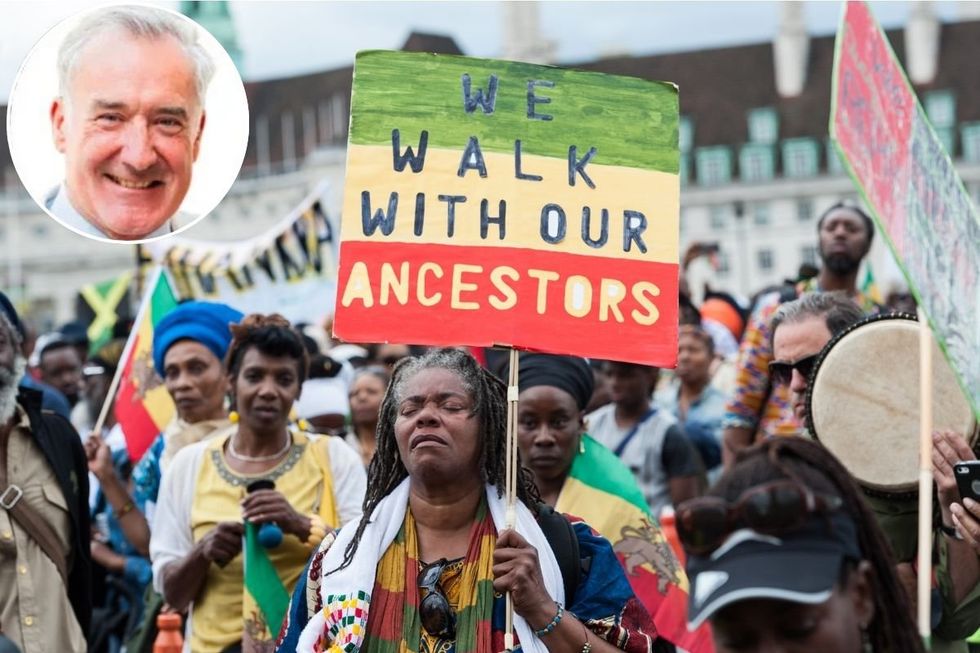
The idea that the transatlantic slavery has held back Africa is full of holes, Colin Brazier argues
|PA/GBNEWS
In fact, it’s worse than that. Yes, the case for compensation is animated by greed. Yes, it’s endorsed by an anti-Western coalition – this week a United Nations General Assembly resolution backing reparations was backed by China, Iran and Russia.
But, ultimately, the campaign for countries like Britain to forfeit billions would get nowhere if we had the spine to resist.
Instead, this wicked, demented and immoral campaign is slowly inching forward – aided and abetted by our craven elites.
Not just preening buffoons like David Lammy, but a whole host of NGOs and charities who share a worldview based on a kind of national cultural self-loathing and a willingness to expurgate their guilt with other people’s money – which invariably belongs to the British taxpayer.
Make no mistake, this week’s vote in New York was a low watermark for British diplomacy. The UK representative abstained when it came to voting on a proposal that Western nations, including Britain, ought to be on-the-hook for potentially limitless slavery reparations.
The resolution was non-binding. But it provides the legal foundations for future litigation. And we know from recent experience – most notably, our disgraceful surrender of the Chagos Islands – that our Labour Government will always put the good opinion of international courts ahead of the national interest.
LATEST DEVELOPMENTS
In other words, there is now an ever stronger possibility that Britain will pay vast amounts to African nations and, potentially, their descendants around the world.
The resolution itself was on behalf of all 55 members of the African Union, though specifically proposed by Ghana, a country which has enjoyed almost £3billion of bilateral aid from Britain over the last 30 years. Talk about biting the hand that feeds you.
The Ghanaian resolution demanded “a full and formal apology, measures of restitution, [and] compensation”. It called the transatlantic slave trade “the gravest crime against humanity”.
A pretty partial reading of history. It ignores the longer-lasting Ottoman-Barbary slave trade. It overlooks the fact that maritime slavery was abolished by Britain (and prosecuted on the high seas at a cost of many thousands of Royal Navy hands).
It overlooks the fact that slavery – sad to say – has been a human universal practised everywhere and always. It was only abolished in Saudi Arabia in 1962.
All these facts were recognised by the three nations which voted against the resolution: the USA, Israel and Argentina. But the EU, as well as Britain, abstained.
In addition to the usual suspects who will always side with any idea that weakens the West, the resolution also won backing from traditionally neutral states, like India. But it’s easy to see why. Countries which were once colonised, far away from the transatlantic slave trade, can still blame their nation’s current woes on historical Western imperialism.
And the African Union’s resolution, which makes no mention of all the Africans who rounded up slaves and sold them to European traders, doesn’t stop with compensation for slavery.
It also calls on Western states to begin “programmes and services to address racism and systemic discrimination”. In other words, we must see slavery as a form of original sin. It lies behind all white-on-black racism. What these “programmes” are isn’t clear.
However, you can be sure they will further entrench the idea that some communities can keep on blaming others for their own structural failings.
The transatlantic slave trade was morally indefensible. It is a stain on our reputation as a Christian nation. But with its iniquities came gifts.
Slavery was abhorrent, but British imperialism also brought the rule of law, a civil service, a lingua franca, railways and much more.
The life-enhancing infrastructural advances which we once took to Africa are now taken for granted, as if they might have happened anyway.
Now, of course, Beijing – happy to sign up to this week’s UN resolution – is the new imperial power; building roads and ports while condemning African governments to a Faustian bargain which amounts to its own kind of economic slavery.
Are we condemned to this slow march to reparations? Not necessarily. Let’s imagine a Reform Government takes charge here in 2029. It should consider three options.
First, leaving the Commonwealth. It is a fiction that this institution is a comity of nations acting as equals with mutual rights and obligations. African nations see us as a cash machine. Asian countries like India and Pakistan, ever-keen to demonise the legacy of empire, see us as an ideological punchbag. Abandoning the Commonwealth when the late Queen – to whom this institution mattered deeply – was unthinkable. Now it’s a no-brainer.
Second, we must realise that the UN is not an honest broker. Anyone who saw the juvenile attempts to humiliate Donald Trump last year, his autocue was sabotaged and escalator turned off when he came to address the UN General Assembly, must understand that this organisation is little more than an overblown students’ union.
By treating all nations as equals, it creates a kind of parity which is undeserved. North Korea is not Luxembourg. But the UN pretends they warrant the same respect and voting rights. We should follow the lead taken by the US and withdraw funding unless the UN reforms.
Third, the foreign aid budget is, finally, shrinking. But we still send billions abroad each year. Most countries, certainly China, would expect – if not diplomatic fealty – then at least some kind of quid pro quo in return for all that cash. As Ghana’s actions have reminded us, just because we have been generous to them in the past, it does not guarantee that a country will not act against our national interest in the future.
By all means, the African Union can make all the representations it likes in the court of global opinion. It can blame Britain as the root of all the continent’s evils. But don’t expect us to keep doling out the development aid. And don’t expect Britain to go along with the convenient fiction that slavery was a uniquely British enterprise, for which as yet unborn Britons must pay the price.