







The former US Defence Secretary Donald Rumsfeld was widely pilloried for a now infamous remark about “unknown unknowns”.
But if you read what he actually said, it was not only wise – it was an essential way of looking at the world, especially for a military strategist: “There are known knowns; there are things we know we know. We also know there are known unknowns; that is to say, we know there are some things we do not know. But there are also unknown unknowns—the ones we don't know we don't know. And if one looks throughout the history of our country and other free countries, it is the latter category that tends to be the difficult ones.”
Rumsfeld’s words come to mind when one learns of the RAF cadet who has been suspended from his officer training course after answering a question about what posed the greatest threat to Britain with the word ‘Islam’.
I have no idea what was going through the cadet’s mind. He may well have meant to say ‘Islamism’; he may indeed have meant Islam.
My guess is that if he had said Islamism, he would still be on the course – at least I would hope so, since on any objective criteria Islamism does indeed pose a grave threat to Britain, even if one could argue that the threat from Russia and China is even graver.
But the threat from Islamism, from Russia and from China is all known knowns. Whatever the relative strengths of those threats, I find it inconceivable that the RAF would be so in thrall to woke thinking that it refuses to even consider that Islamism is a threat, despite the endless examples of Islamist terrorism both here and elsewhere.
But is it actually so inconceivable that discission would be closed down? Let’s assume that the cadet meant what he said – Islam, rather than the extremist element of Islam that is known as Islamism.
Clearly, to utter such a thought would be offensive to Muslims. But if our armed forces are now so politically correct that they refuse even to consider allowing someone to remain a cadet who suggests something offensive, rather than debating and discussing their suggestion and seeing where and why it is wrong (or even right), then we are indeed in trouble.
And that suggests too that it is not just the discussion of Islam that would be closed down, but the discussion of Islamism, too.
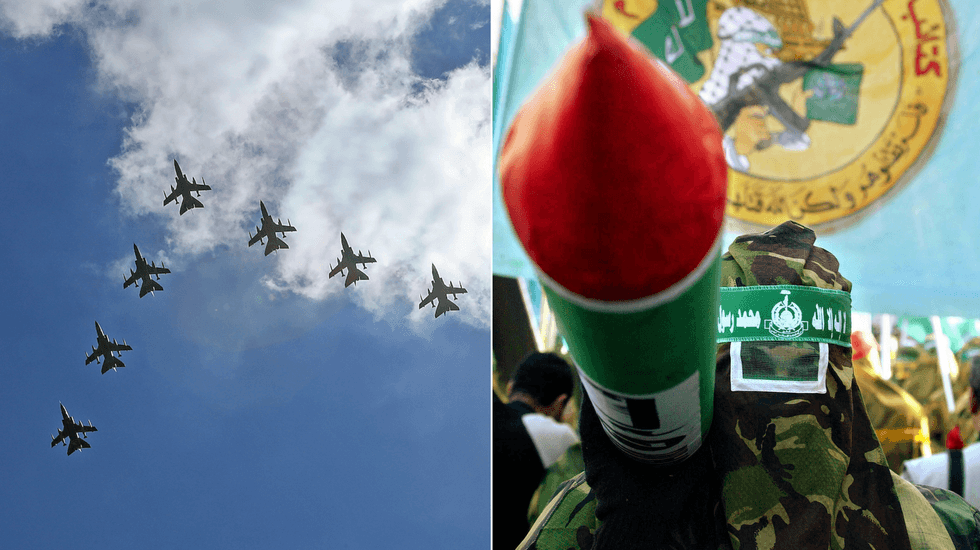
The RAF's blind spot on Islamic extremism threatens our national security - Stephen Pollard
|Getty Images
According to reports, the cadet, who was commenting on a discussion on national security with around 50 fellow cadets, was immediately removed from the course and is now under investigation.
Surely the correct, indeed the only sensible, response would have been to ask what he meant, and then get the other cadets to respond – to test his answer.
Take this example. I am Jewish. I would certainly find it offensive if the cadet had said ‘Israel’ in response to the same question.
But the fact that I take offence should be entirely irrelevant, especially in the context of an armed forces training discussion on national security.
The correct response is to probe why someone would say Israel (or Islam, or anything else) and then to open up the idea to critique from the other cadets.
The very last thing that should happen is to close down a discussion because someone might be offended.
This is a lesson that is, slowly, being learned in academia, where too many ideas and discussions are forbidden because someone may be offended.
It is dangerous and counter-productive, not least because when you close down debate on a topic, you give it an allure it may not deserve.
The armed forces have been denuded in recent years by politicians who have refused to provide the necessary funding.
That damage to national security would be infinitely worse if the armed forces themselves refuse to allow soldiers, sailors and airmen to think widely about the world in which we live.