








Let’s call it The Peston Paradox. It works like this.
A prime minister is on the point of resigning. So Downing Street is full of establishment media journalists.
Broadcast outlets live for these moments. Their viewing figures are in free-fall. But for a few days, while a PM hovers between political life and death, BBC News, Sky News, Channel Four, and ITV feel relevant again.
But they have a problem. There are only so many rumours to report, only so much speculation the viewers and listeners can tolerate.
The answer? The strange ritual which sees broadcasters like ITV’s Robert Peston shout-out questions the moment the door to No10 swings open.
Ministers have no intention of answering. All the hacks know this. But they persist in going through a charade of “finding out”. It is a pantomime. A mania born of frustration.
But if you’re a broadcaster, standing for hours in Downing Street with nothing new to say, it is also a relief. An explosion of yelling that adds drama and creates an illusion that something is happening.
This then is the Peston Paradox. Sound and fury, as Shakespeare wrote, signifying nothing. Ever-louder shouting, for ever-shrinking audiences.
And how those viewing figures are shrinking.
This week, the former boss of BBC News gave a speech, her first since resigning over the Donald Trump misreporting scandal, in which she acknowledged how bad things had got.
Deborah Turness said audiences for traditional TV news were “collapsing”, while the number of people getting their news from YouTube had tripled in the last five years.
She pointed to the huge following of American podcasters like Joe Rogan and said British broadcasters would need “to be more prepared to liberate their talent” in order to survive.
And what will this talent liberation involve? She didn’t say. But I think most of us who have developed a deep-rooted suspicion of the establishment media over the years can take a guess.
It will mean more opinions. Or, put more accurately, more overtly left-wing opinion. The News Agents writ large.
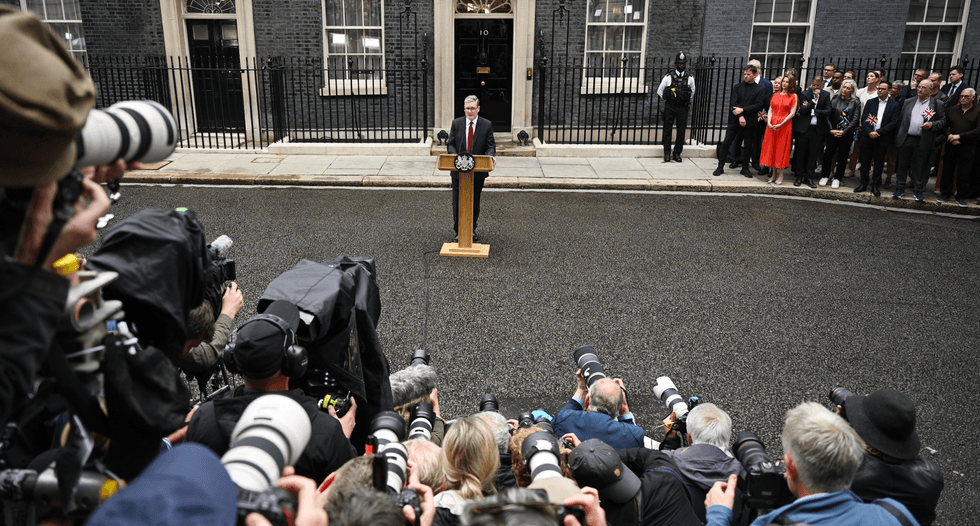
The sight of broadcasters yelling questions outside No10 perfectly sums up the Peston paradox
|Getty Images
Because, make no mistake, the establishment media has opinions already. But it usually takes trouble to hide them. The BBC, in particular, must be careful.
It still has the power to prosecute people who fail to pay the license fee. A kind of forced consumption of news that belongs to the Soviet era. That arrangement becomes harder to justify when consumers start to sniff bias.
The Turness speech put the blame for the establishment media's woes firmly on the shoulders of changing technology. “What we are witnessing is the wholesale shift from one established information ecosystem to another,” she said.
That is blaming the medium when, in reality, it’s the message that’s been the ruin of the old guard.
Turness and the rest of her industry can’t face up to the notion that viewers have not swarmed to the “creator journalism” of Dan Wootton, Andrew Gold and dozens of others like them simply because the barriers to entry have fallen.
Yes, it is undeniable that a content provider like Carl Benjamin or Konstantin Kisin can set up their own channel for a fraction of what it would once have cost the established media.
But that’s not what’s driving the exodus of eyeballs. That wound is self-inflicted. At Sky News, where I worked for nearly 25 years, I saw how this happened.
One-sided coverage of the culture wars. Woke politics. Environmentalist activism. Newsrooms divorced from white working-class worries.
The reason BBC and Sky viewers have deserted traditional news bulletins isn’t just because Mike Graham or Piers Morgan express a point of view. It’s a function of the corrosion of trust in what the BBC, Sky, ITV and Channel Four have spent years telling us.
The way it seemed they were out to thwart Brexit or normalise mass migration, or pretend terrorism had more to do with right-wingers than Islamists.
Anyone struggling to understand how this works needs only look at coverage of the local elections. The MSM saw it wholly through a prism of personality. Labour’s disintegrating vote share was entirely about Keir Starmer.
In reality, while it undoubtedly had something to do with the hapless PM, it also had a lot to do with things the establishment media would rather not grapple with. Southport, Gaza protests, sectarian politics, grooming gangs.
Some people will say that illegal migration and failing integration have been a problem for years, but that didn’t stop Labour winning the election in 2024. True.
But that loveless landslide was a product of despair. A despondent electorate, battered by the Boriswave, and willing to believe a Labour government which said it could do what the Tories couldn’t and “smash the gangs”.
Yes, Starmer made a fool of himself with speeches in which he described Britain as an ‘island of strangers’, only to repudiate those comments when the backlash bit.
Yet the truth is that Labour’s losses last week in council elections were the product of the settled opinion of the British people about a country many feel will one day prove ungovernable. They were not a protest vote about one man’s inadequacies as prime minister.
And so we end up with an establishment media that practises editorial displacement. Obsessing about one story while ignoring many others.
However, increasingly, the game is up. As Turness acknowledges, new players have changed the rules. It’s not just high-profile millionaire podcasters, but ordinary voters.
As the man who coined the phrase “suicidal empathy”, the evolutionary psychologist Gad Saad, told his 1.3 million followers on X this week: “It is impossible to overestimate the historic importance of Elon Musk purchasing this platform. He saved freedom of speech. He saved truth.”
For Leftists and those who derive a living from the traditional gatekeepers of information, such sentiments will sound deranged. But for others, they are a statement of the obvious: the establishment media stranglehold on information has been lifted.
Nowhere is this better exemplified than where I started this column, the scene this week outside Number Ten. The broadcasters, yelling their ever-shriller questions, are there because they are officially accredited to be.
Ordinary members of the public can share the spectacle, but only by pressing their noses up against the gates of Downing Street.
It is a metaphor for the monopoly on information the mainstream media has enjoyed for too long. And the broadcasters know it. No matter how loudly they shout, ministers ignore them.
But the public, for too long deemed irrelevant or stupid, have learned to ignore them much, much more.