






Keir Starmer is poised to approve China’s proposed “super-embassy” at Royal Mint Court in central London — a vast complex that will become Europe’s largest diplomatic facility — while Donald Trump imposes immediate 25 per cent tariffs on any country conducting business with Iran, striking directly at Beijing as the regime’s largest trading partner and buyer of over 80 per cent of its oil exports.
From my vantage point in the United States, it is frankly shocking to watch Britain — once the exemplar of resolute, independent governance — submit to leadership that so willingly embeds danger into its own capital.
A nation that stood alone against tyranny, that engineered Brexit to reclaim sovereignty, now sees its prime minister, home secretary, communities secretary, and London mayor collectively choose diplomatic vanity and short-term trade optics over the elementary obligation to shield the country from a proven strategic adversary.
Trump’s announcement on 12 January 2026 layers this new tariff atop existing US duties on Chinese goods, risking significantly higher effective rates on overlapping trade and forcing Beijing to weigh its lifeline support for Tehran — where bilateral trade exceeded $14billion in the year to October 2025 — against continued access to American markets.
In contrast, unredacted plans obtained by The Telegraph reveal 208 underground rooms in the London project, including a concealed chamber positioned just over a metre from fibre-optic cables carrying sensitive financial data to the City of London and communications traffic for millions of users.
Communities Secretary Steve Reed faces a 20 January deadline to decide, yet reports indicate Starmer will grant approval ahead of his widely expected trip to Beijing later this month—the first by a British prime minister since 2018.
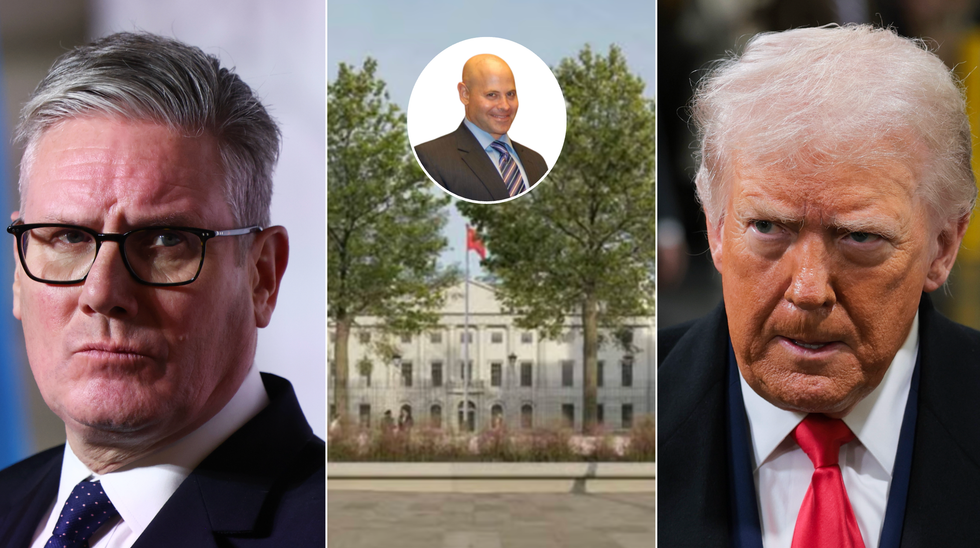 Keir Starmer greenlighting China's spy fortress as Donald Trump waves hammer is national suicide - Lee Cohen |
 GETTY IMAGES/Reuters/Tower Hamlets Council
This likely approval constitutes a calculated concession to Chinese strategic interests at the precise moment Trump applies economic pressure to Beijing over its role in sustaining Iran’s regime.
China does not stumble into sensitive locations by chance; it plans methodically, exploiting perceived vulnerabilities in Western capitals. The site’s proximity to critical infrastructure invites surveillance risks, consistent with MI5’s repeated warnings about Chinese espionage, including November 2025 alerts on LinkedIn-based recruitment targeting Parliament and broader operations against UK institutions.
The lapses are specific. The embassy’s location opposite the Tower of London embeds it in Britain’s financial heart, where drawings show underground facilities dangerously close to essential cables.
Starmer’s national security ministers, including Home Secretary Yvette Cooper, have raised no formal objections despite MI5’s longstanding concerns.
London Mayor Sadiq Khan has consistently declined to intervene, citing no sound planning reasons despite local opposition from Tower Hamlets and community security fears.
These choices prioritise diplomatic reciprocity — securing Chinese approval for Britain’s own embassy expansion in Beijing — over safeguarding national assets.
Starmer treats China as an indispensable counterparty rather than a systemic rival, even as Beijing acquires unregistered properties in the UK and expands its diplomatic footprint.
This managerial ideology, masquerading as pragmatism, erodes sovereignty by embedding long-term risks. Labour’s earlier equivocation on Huawei’s 5G role and hesitation on AUKUS commitments fit the pattern of retreat masked as realism.
Geopolitically, Britain operates at a disadvantage. Trump’s tariffs assert US leverage, deterring Chinese support for regimes like Iran’s and reinforcing alliances such as the Five Eyes.
A post-Brexit UK could mirror this resolve through targeted sanctions, elevated defence commitments, and energy diversification away from unreliable sources.
Instead, Labour’s accommodation diminishes the Special Relationship, reducing Britain to a secondary player in transatlantic deterrence. Europe offers no counterweight; EU members remain heavily dependent on Chinese trade, prioritising exports over security.
The spectacle is excruciating. Trump demonstrates daily what sovereign deterrence looks like: tariffs that impose real costs on adversaries, alliances strengthened through strength, and a refusal to accommodate regimes that threaten the West.
Britain, under Labour, appears locked in the opposite trajectory — concessions dressed as pragmatism, risks hard-wired into the heart of London, and a governing class seemingly more comfortable managing decline than confronting it.
What comes next on the road to 2029 is the question that hangs over this moment. If this embassy approval proceeds unchecked, the precedent will be set: Britain as a capital willing to trade security for access, sovereignty for reciprocity, deterrence for dialogue.
The erosion will accelerate — more unregistered properties, more diplomatic expansion, more opportunities for influence operations that exploit every perceived weakness. By the time voters return to the polls in 2029, the damage may be structural, the Special Relationship diminished, and the transatlantic axis weakened at precisely the moment global challenges demand unyielding unity.
Britain still possesses the tools to reverse course: post-Brexit independence, a security establishment capable of sounding the alarm, and an electorate that has repeatedly demonstrated its preference for strength over accommodation.
The choice remains available — to align with the assertive realism now defining American policy, to impose costs on adversaries rather than invite them in, to govern with the seriousness the realm requires. But time is not infinite.
Leadership that hard-wires capitulation today will bequeath a far weaker nation tomorrow. The verdict on this era will not be kind, and it will be written in the consequences that follow.
Our Standards: The GB News Editorial Charter
More From GB News