






By now, only extremely sentimental onlookers can imagine that the so-called “special relationship” between Britain and America is on an amicable ‘break’ rather than heading towards a divorce.
Watching Donald Trump and Keir Starmer circle each other in 2026 is rather like watching a couple you know well go from comfortable amiability with the odd moment of passive-aggression over the roast potatoes, to any-minute-now bagging up each other’s treasured belongings in bin bags.
The months of passive-aggression are now teetering on the edge of irrevocable, open disdain. And frankly, it’s fascinating. This isn’t just a clash of policy, it’s a clash of personality, tone and national identity. Trump, all bombast and brinkmanship, relishes the theatre of power.
Starmer, cautious, lawyerly, maddeningly restrained, prefers the slow grind of process. One performs strength. The other believes he is insisting upon it quietly. But in Trump’s world, quiet equals weak.
Which is precisely why he mocked Starmer so publicly — impersonating him, no less, at a White House event, portraying him as dithering and indecisive.
Some say that Trump uses humiliation as leverage, but I see this differently: he is overwhelmingly hurt by Starmer. He holds the UK in special regard, not least because his mother was Scottish.
He rarely needs anything from the UK – they are bigger, richer, and stronger than us. So when he asked for access to our military bases, and it was rejected, he was blindsided.
Starmer, for his part, has responded with restraint. No name-calling, no escalation - just a dull insistence on acting in Britain’s “national interest”.
Admirable, perhaps, in the eyes of British voters. But Trump respects strength and is exasperated at Starmer’s reluctance to stand up for himself…Contrary to public opinion, Trump does not want to be the world’s police force: he wants every Western nation to stop relying on the USA and instead, step up to the plate themselves: militarily, economically and geopolitically.
Because beneath the theatrics lies something far more serious: a genuine fracture in how the UK and US see the world right now.
Events in the Middle East pull this into focus: Trump ramps up rhetoric, threatening Iran with a “bigger, better, stronger” military response. Starmer is treading carefully, stressing legality, restraint and self-flagellating over the painful lessons of Iraq.
Britain has supported defensive operations, yes, but stopped short of full-throated participation in Trump’s more aggressive posture, and as Trump spat, “They wanted to help, when the war was already won”.
This divergence isn’t happening in a vacuum. The region itself is teetering: US military build-ups, Israeli strikes, Iranian retaliation and now a fragile ceasefire that could collapse at any moment.
Add in the looming threat to the Strait of Hormuz - through which much of the world’s oil flows - and suddenly this isn’t abstract geopolitics; it’s your petrol bill, your heating costs, your weekly shop.
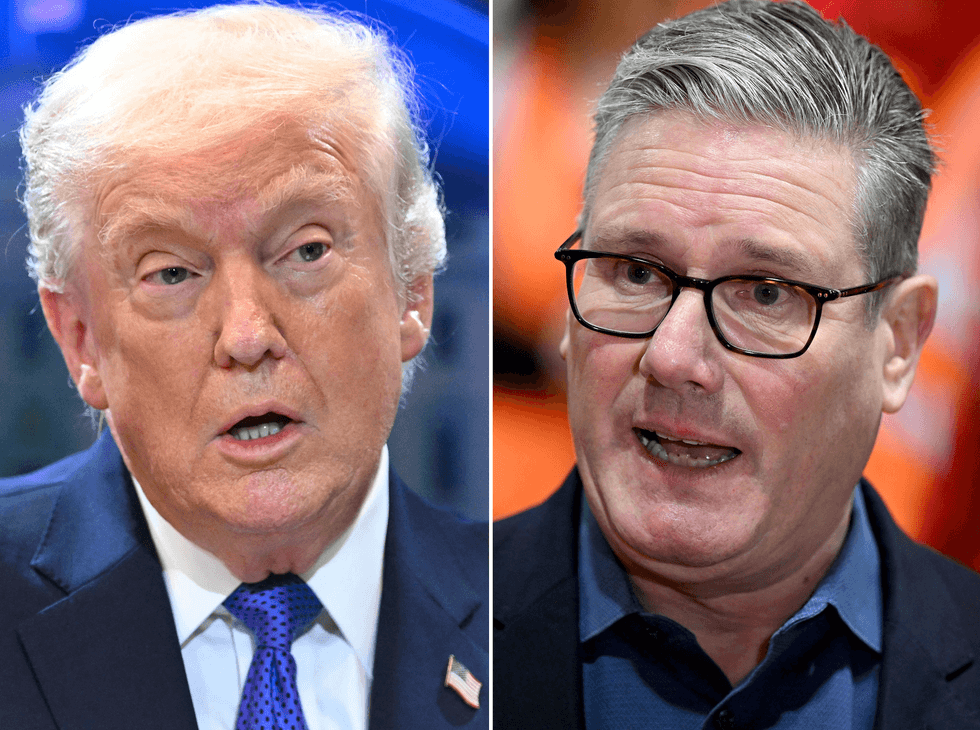
The special relationship isn't on a 'break' - it's heading towards a divorce - Bev Turner
|Getty Images
Ostensibly, Starmer has been in the Gulf this week trying to steady the ship, pushing for stability, for open shipping lanes and calm.
Trump, meanwhile, is trying to get the job done - reminding everyone that America still carries the biggest stick. Peace through strength has been the whole administration’s motto.
And here’s where the tension sharpens into something almost existential: what happens when Britain no longer fully trusts the judgment of its closest ally?
The uncomfortable truth is emerging that British officials are openly critical of Trump’s rhetoric, warning it risks inflaming an already volatile situation.
The public, too, is shifting, less convinced that the “special relationship” is either special or particularly beneficial anymore. Trump notices.
He is a watcher and a listener. I was most surprised in our meetings at how keen he is to listen to the opinions of others, “What’s going on in the UK?” he asked me, leaning forward before our long interview at the end of last year. I was shocked – he struck me as a man on transmit rather than receive – I was wrong.
His irritation with Starmer isn’t just about one decision or one conflict — it’s about a Britain that no longer sits alongside the USA ideologically.
In Trump’s worldview, loyalty is transactional, long-lasting and immediate. In Starmer’s, it’s conditional and considered. That gap is where the friction lives.
Plus, the PM is perpetually concerned by cosying up to the EU. Few things are as uniting as a joint adversary, and it is quite easy to imagine Macron, Von Der Leyen, Starmer et al sitting around nibbling olives and lamenting 'mad-man Trump.'But let’s not pretend Britain is entirely comfortable in its newfound distance from the USA.
There’s a faint anxiety underpinning all this - a recognition that stepping back from America’s shadow is easier said than done. Economically, militarily, culturally, the ties run deep. Even now, cooperation continues behind the scenes: intelligence sharing, joint bases, coordinated defence.
It’s not even as simple as a clean-break divorce. It’s a separation of two wealthy powers with shared assets from which they can never be extricated. We, the people, are like children caught in the crossfire of uncertainty, aware that we are at a disadvantage but not at all sure where our loyalties should lie.
It’s become a relationship in which both sides still need each other, but increasingly dislike how the other behaves. It’s not Britain versus America in any simple sense.
It’s two nations still bound together, but pulling in slightly different directions - one loud, impulsive, determined and convinced of its own indispensability; the other quieter, more cautious, trying to redefine itself without quite knowing how far it can go.
As anyone who understands relationships might say, “It’s complicated.”And like all complicated relationships, it’s only going to get more so.