







I have now seen something in Britain, hitherto, I’d only read about. A dog being pushed, like a baby, in a pram. It was earlier this month in a relatively smart area of London. I’m not sure of the breed, some sort of pug, I think. It was hard to tell because the dog was also ‘wearing’ a woollen sweater.
Fortified by a slurp of caffeine, I took a picture (being careful not to show the owner) and posted it on Twitter thus: “For our ancestors, who gave their all to bring life into the world and sustain it thereafter, the sight of a dog in a pram would’ve been considered baffling, even demonic.”
I hesitated before pressing send because no other frontier of the digital debating space is more fraught than the one containing animals, pets, especially.
And, sure enough, after 30 minutes of being told how callous and unfeeling I was being, I took the keyboard-coward’s way out and deleted the tweet.
I took the line of least resistance partly because I wondered if some of my critics had a point. Several pointed out that a child’s buggy was a good way for an old dog with arthritis or mobility problems to get a breath of fresh air.
Maybe (rarely has the metaphor seemed so apt) I’d got the wrong end of the stick. Perhaps a dog in a pram is not a symbol of a society increasingly choosing pets over children.
What do you think?
Before I tell you what I think, let me start by saying this. I grew up with animals and would, by any measure, be considered a dog lover. Jack Russells, labradors, springer spaniels. You name the breed, we’ve had them. We still have a lurcher and a dachshund. I am sentimental about them, in a way I am not about other animals, with the exception of horses.
I sometimes heave a sigh when a favourite pig shows a reluctance to make its final journey to the abattoir, but I would never shed a tear when we opt for sausages for dinner. Our livestock enjoy a good life. We keep stocking densities low and support rare-breeds. My conscience is clear.
Orwell was right. Not all animals are equal.
In his best-selling ‘Homo Sapiens’, the author Yuval Noah Harari observes that the domestication of dogs (about 30,000 years ago) is a vital punctuation mark in the story of human progress.
No other inter-species collaboration has, he argues, been more successful. Whether helping us to hunt, or protecting us from predators, the dog has often been an indispensable aid to survival.
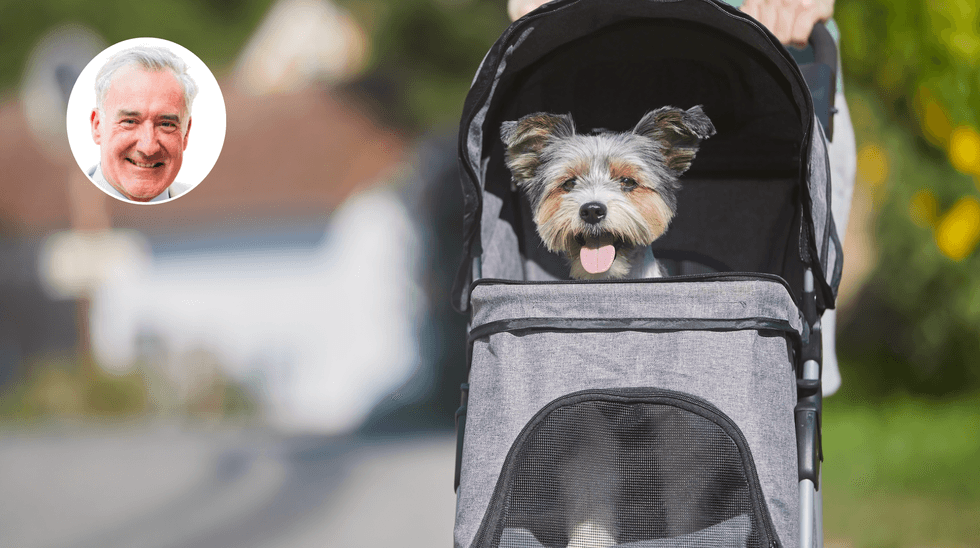
Only our enemies win when we think a dog is a substitute for a child - Colin Brazier
|Getty Images
But when society advances, and dogs are no longer needed to catch boars or deter bears, do we risk anthropomorphising man’s best friend? Where I live, there are still farmers and gamekeepers who have ‘working dogs’. But, not all that far away, in the nearest commuter town, there are dogs kept, not just as fashion accessories, but in lieu of an actual child.
This month, for instance, we learned that in over a third of English postcodes, there are more dogs than children. The Dog’s Trust, the charity, says that two-thirds of 25 to 34-year-olds buying puppies are likely to “see themselves as their dog’s parent”.
I don’t know what had made the woman I saw in the Costa cafe dress her dog in a jumper and pop it in a toddler’s stroller. Perhaps it had stiff joints. Maybe she saw it as a baby substitute.
I don’t know. But, we can say with confidence that thousands of women (and men) now think there is nothing untoward in talking about a dog as their “baby” and treating it to a level of material indulgence previous generations would have found shocking and incomprehensible.
None of this is new. The late Pope, Francis, regularly and publicly fretted about the West’s increasing preference for pooches ahead of little people. I remember, as a presenter at GB News, when the US pulled out of Afghanistan, how Boris Johnson sent a jet to collect dogs and cats from a charity in Kabul, leaving humans (many of whom claimed to have worked for the British Army) to the mercy of the Taliban.
We will all have our own theories about how we got here. The Disneyfication of childhood presents animals to children in TV and film as human-adjacent.
Or the cost of living that makes people who yearn to care for another life choose the cheaper (and briefer) alternative of a dog over offspring.
And many of us will worry about where this takes us as a culture. Not just the demographic wreckage caused by declining birth-rates, but the mass self-delusion of preferring Fido over Hugo.
For one thing, anyone who thinks having a dog in a pram and a child in a pram represents a kind of parental equivalence is seriously misguided. A dog will not grow up to be our equal.
It will simply become older and slower. A dog will not challenge us in the way an emerging human personality does. Cannot change the world for the better or worse, as an actual person can and does.
Pretending that a dog is a child represents a debasement of the currency of parenting. It weakens what it is to be a mother or a father, subtly and noxiously.
It seeks to maintain a fiction that there is any meaningful comparison to be drawn between having a dog and a child when, in reality, there is none: no matter how many sweaters you dress your dog in, no matter how many cuddles and treats you give him.
However, there is another element to this debate (a term I hesitate to use) that is often overlooked. It is the impact left on new arrivals to the West. Imagine.
You have moved to the UK. You may be here because Britain is a land of promise. A high-wage, low-crime, Shangri-La free of corruption and cruelty.
Just as likely, you are here - perhaps illegally - because you see your new home as ripe for exploitation and expropriation. A soft-touch. Or, as the podcaster and conservative commentator Carl Benjamin puts it, “a fallen people” waiting to be displaced.
This idea, of British culture being seen as deracinated, hollowed-out, querulous and dilettante, is not without grounds. Anyone coming from, say, Somalia or Pakistan, will struggle to understand how their countries were once conquered by a people who now struggle to understand whether there is any difference between a man and a woman. Or, indeed, between a dog and a baby.
Historically, the British have been a tolerant people. We tolerate, even celebrate, eccentricity. We think it bad manners to disdain anyone who deviates from the norm, so long as they mind their own business. And so we will continue to behave as if there is nothing more normal in the world than nipping into the local Costa with a dog in a pram.
Sadly, this thinking is anachronistic. Britain now contains many people who look at our excesses, not as foibles, but systemic failures. They see a people who lack the conviction to honour the sacrifices of previous generations by raising the next.
They see a weak culture that lacks the will to disdain what our ancestors would’ve considered baffling and sinful. We, the natives, look at a woman in a cafe with a dog in a pram and dare not even roll our eyes. They, the newcomers, look at a woman in a cafe with a dog in a pram and wonder, with good reason, how long such a civilisation has left.
More From GB News