




Ken Hay considers himself an ordinary man, but to me and millions of others, he is a titan.
The Battle of Normandy veteran, 101-years-old, told me that it was his “duty” to return to Gold Beach every year and remember the men who fought and fell alongside him in France.
“They have more right to be here than me,” said Hay, referring to the 98 new names added to the British Normandy Memorial, joining the 22,540 servicemen and women under British command who fell on D-Day and during the Battle of Normandy in 1944.
As Paul Terry, 100, exited his Hackney Carriage, driven by the Taxi Charity for Military Veterans, he told me that he was more nervous about making his speech to the assembled crowds than he was when he jumped onto Sword Beach as an amphibious warrior. Paul lived up to the motto of the King’s Royal Rifle Corps (swift and bold) as he quickly cut around the veterans and families who had gathered to honour him.
Nothing prepares you for the experience of speaking to these men for the first time.
You can feel the rush of history in their handshake. Their eyes are deep with recollected sights that are not for us to know. Their voices are utterly gravitational; you are drawn to them and everything else disappears around you. The moment is actually quite unsettling as you reckon with the sheer weight of who they are and what they signify: brotherhood, liberty, pure consequence.
Both Terry and Hay expressed to me the same fear: that people had not learned the lessons of the war they fought.
The ongoing war in Ukraine reminds us so much has already been forgotten from the horrors of the 1940s. The invasion in 2022 saw a revival of Second World War tactics: ‘blitzkrieg’ and paratroop assaults and Russian troops rushed to nullify the heart of the Ukrainian government in Kyiv.
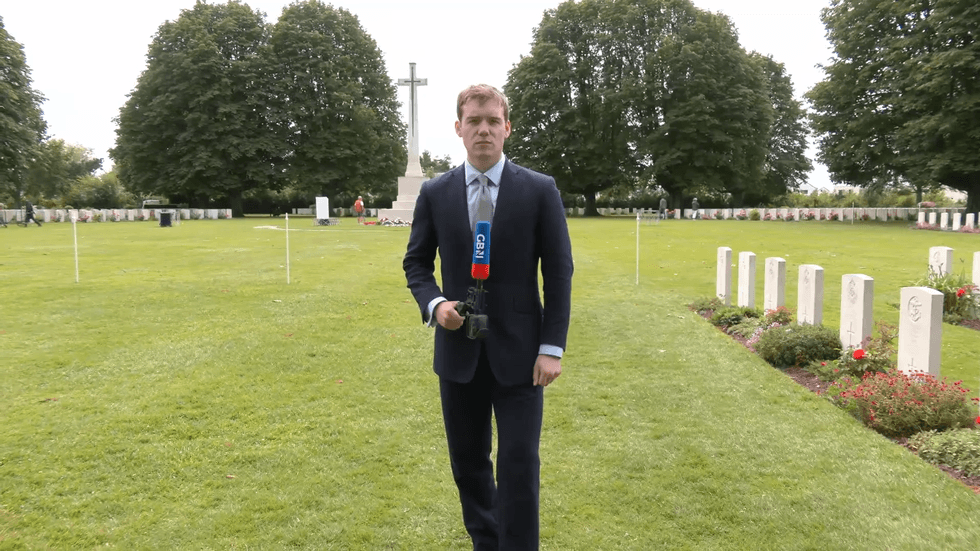
Charlie Peters reporting live from Normandy
|GB NEWS
It has since disintegrated to the combat of the First World War: attritional trench warfare that has turned small towns across the Donbas into macabre meat grinders. How far and how quickly humanity has fallen.
Terry and Hay know it and it clearly breaks their hearts to see those horrible errors repeated in their lifetimes. Hay recalled to me his dear comrades who were killed in Normandy before lamenting that the “powers that be” were “warming up for another one.”
“I bet God above is regretting giving man his free will. That’s all I can think.”
The days here were spent in a haze of historical memory, in awe of the actions taken by our forebears who wore the cloth of the country to secure freedom for Europe and the world.
Before we could think about the current state of the world and what future conflicts might await us, we had to conduct an historical pilgrimage to refresh ourselves with what had already happened on this hallowed turf.
Walking and driving around Normandy, the GB News team encountered echoes of actions taken to secure victory and the evolutions that made them possible.
There are few places that demonstrate the vast transformation that the British Army undertook during the war more than Bénouville.
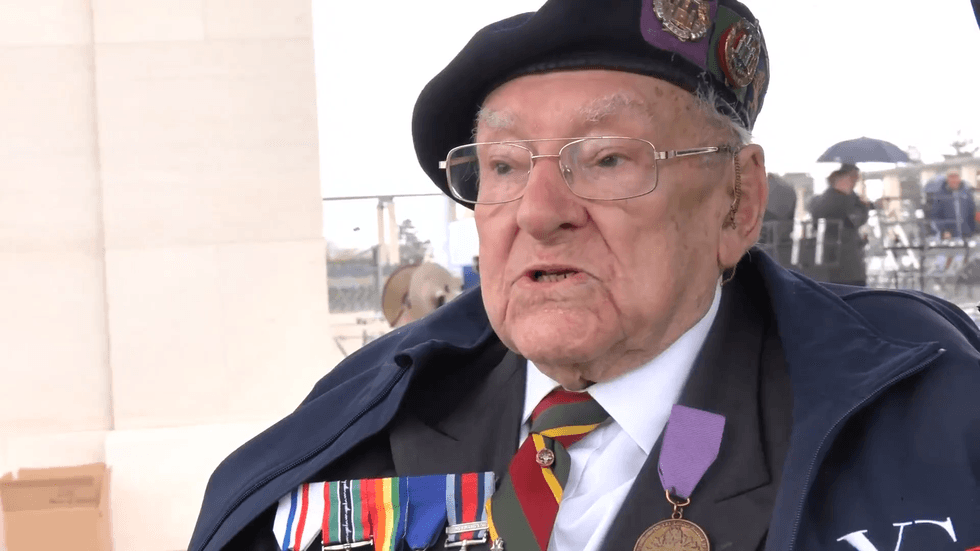
D-Day veteran Ken Hay told GB News it was his 'duty' to return to Gold Beach every year and remember the men who fought and fell alongside him in France
|GB NEWS
Churchill, inspired by the capture of Crete in 1941 by German Fallschirmjäger paratroops, urged his generals to generate their own airborne contingent.
A few years later on D-Day, the first fighting was conducted by Major John Howard, who led D Company of the 2nd Battalion, the Oxfordshire and Buckinghamshire Light Infantry.
The unit had left India in June 1940 in a plain light infantry role; by the end of June 1944, they were the stuff of legend, having taken the bridges over the Orne River and the Caen Canal in a surprise glider-landed assault just 40 metres from the bridges. They hit the ground at 00:16 on the 6th and snapped up their objectives in no time at all.
Eighty-two years on, there were locals in Bénouville - children at the time of the daring assault - who gathered to say thank you to their liberators and their families.
Similar grand transformations took place in the unit’s first battalion. The 1st Buckinghamshire Battalion, a TA unit of the Ox and Bucks, was trained from 1943 to prepare for the invasion of Europe.
The territorials were once weekend soldiers: butchers, bakers, candlestick makers from the gentle corners of Home Counties England.
But on D-Day, an anti-tank platoon of 1st Bucks landed on the first tide of the invasion. The battalion would have carried memories of Aylesbury, Amersham and Wolverton as their landing craft rocked wildly in the stormy seas as they approached the jaws of death.
But these tales barely compare to the transformation endured by the Sherwood Rangers Yeomanry.
Another typical TA unit - the backbone of the army that swelled to deliver its global ambitions and responsibilities - it was still a mounted cavalry country force at the outbreak of war.
In 1940, it was posted to Palestine on horseback. The men conducted a charge with their swords drawn on Arab forces that were causing mischief. But on June 6, 1944, the men of the SRY were aboard the new tank chassis developed for seaborne warfare. The perfect encapsulation of this change is Sgt George Dring. A typical country soldier, he joined the unit as a farrier in 1935, preparing for weekends tending to the unit’s horses. By D-Day, he was experienced in the tanks, having destroyed several German targets in Tunisia. He landed in Normandy and was swiftly thrown into fierce fighting.
During the Normandy campaign, while Sgt Dring was passing reconnaissance information on enemy tanks, an officer is said to have chastised his reports: “Aren’t you under a misapprehension about the target, surely it is a cow?” Dring is said to have replied: “I’ve never seen a cow with a turret on it before.” The German ‘cow’ then fired its turret, only for Sgt Dring’s tank to return fire with a more accurate and destructive shell.
The regimental HQ Sherman tanks of the Sherwood Rangers were named after the tale closely associated with the area: Robin Hood, Maid Marion, Little John, and Friar Tuck. And so, we can say with a great degree of confidence, that Robin Hood fired more vicious arrows on D-Day.
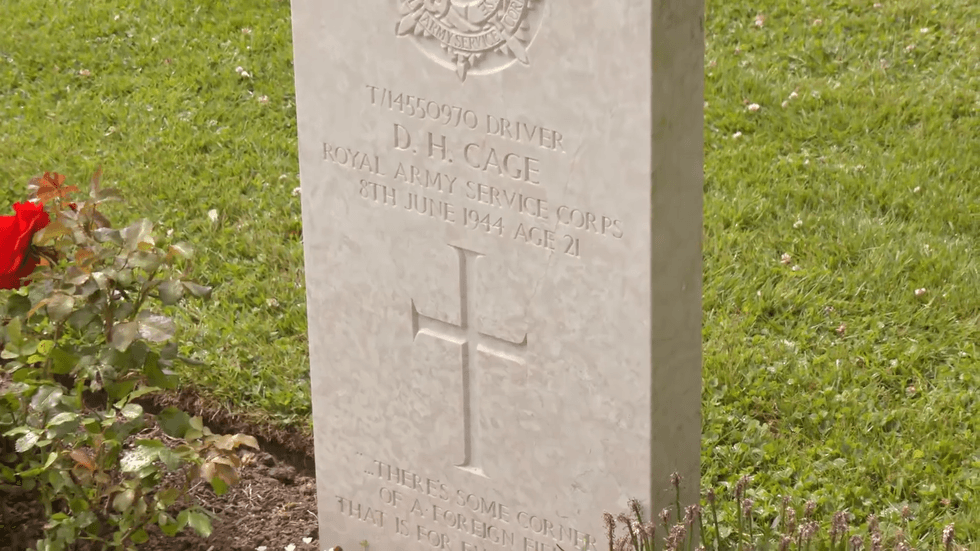
Walking and driving around Normandy, the GB News team encountered echoes of actions taken to secure victory and the evolutions that made them possible.
|GB NEWS
Tales like these and many more were the core conversation with the dozens of veterans, history buffs and fans of the channel who walked up to us to speak with the GB News crew. Our German cameraman Oliver, took the reflections on his nationality and being selected for this gig in good humour.
Of all the chats we enjoyed with fans of the channel who hailed from across Britain, one small natter with a group of former police officers caused me pause for thought more than any.
The five lads, all ex-coppers from Merseyside, had been to Gold Beach together many times before. They were all firearms trained and a couple had served in the military before, including deployments to the Falklands. All were in awe of the men who waded through hell on 06/06/44.
As we all gazed out onto the calm waters that 82 years before were the host to a form of chaos the world has not since seen, conversation quickly turned to what those men fought for. We were all in agreement that Britain was in a tricky situation at the moment. Would those veterans be proud of what we had done with their legacy? Had England lost its touch on what it stood for and what it was all about? We ticked off a few recent examples that gave us real concern that it had.
We shook hands, and as I walked away, I kept thinking: would future generations volunteer for a seaborne invasion to protect our way of life like those men had in 1944?
The question troubled me and forced me to stop and think. Above us was Field Marshal Montgomery’s eve-of-battle address, engraved at the crown of the memorial stone: “To us is given the honour of striking a blow for freedom which will live in history; and in the better days that lie ahead men will speak with pride of our doings.”
All of us were worried that Britons alive now - the men from the better days that lay ahead - would think twice about that obligation. But critical to answering my troubling question lies in the next words that ‘Montie’ gave his soldiers: “We have a great and a righteous cause.”
Given the right cause, and something worth fighting for, and I’m sure that the spirit that saw men climb into the landing craft, gliders and paratroop planes would return in droves. More than a few things will have to change about how Britain is governed to get us back to that point of shared purpose, unity and national pride, but it starts with recognising and appreciating that we are following in the footsteps of giants who gave us the opportunity to shape our own futures. We must be careful not to squander that inheritance by jettisoning the country’s core modes of feeling and thought and replacing them with an uninspired culture of permitting change for the sake of it.
“Everybody was so friendly in those days,” WW2 veteran Dorothea Barron told me in Bénouville. “We had one purpose in life, which was to free the world from Nazism and to get on with enjoying life.”
That message was echoed by the other titans. Speaking about his twin and older brother, Paul Terry told me: “We all came to this country to do what we had to do.”
God forbid that the call should come again, but if it does, I have faith that future generations of Pauls and Kens will stand up and be counted if we make sure we preserve a country worth fighting for.