






As we gorge on mince pies this Christmas, spare a thought for our ill-nourished forebears. Not having enough food to eat kept them petite, often under 5ft in height. Take the skeleton of a woman found in a box in Eastbourne Town Hall in 2012.
The body belonged to a fully-grown female who was no more than 4ft 9 inches. Her origins were unknown. Other than the label attached to the box, which suggested the remains may have come from Beachy Head, the local landmark made famous by its white cliffs - the highest in Britain - and, more sadly, by the number of suicides committed there.
Initial scientific analysis suggested the body was from the Roman era and - possibly - provided a DNA trail that led all the way back to Sub-Saharan Africa. That ‘discovery’ gave ‘Beachy Head Woman’ a burst of posthumous celebrity.
A commemorative plaque was quickly erected locally, announcing with emphatic conviction, that “The remains of Beachy Head Woman were found near this site. Of African origin, she lived in East Sussex 2nd 3rd Century AD.”
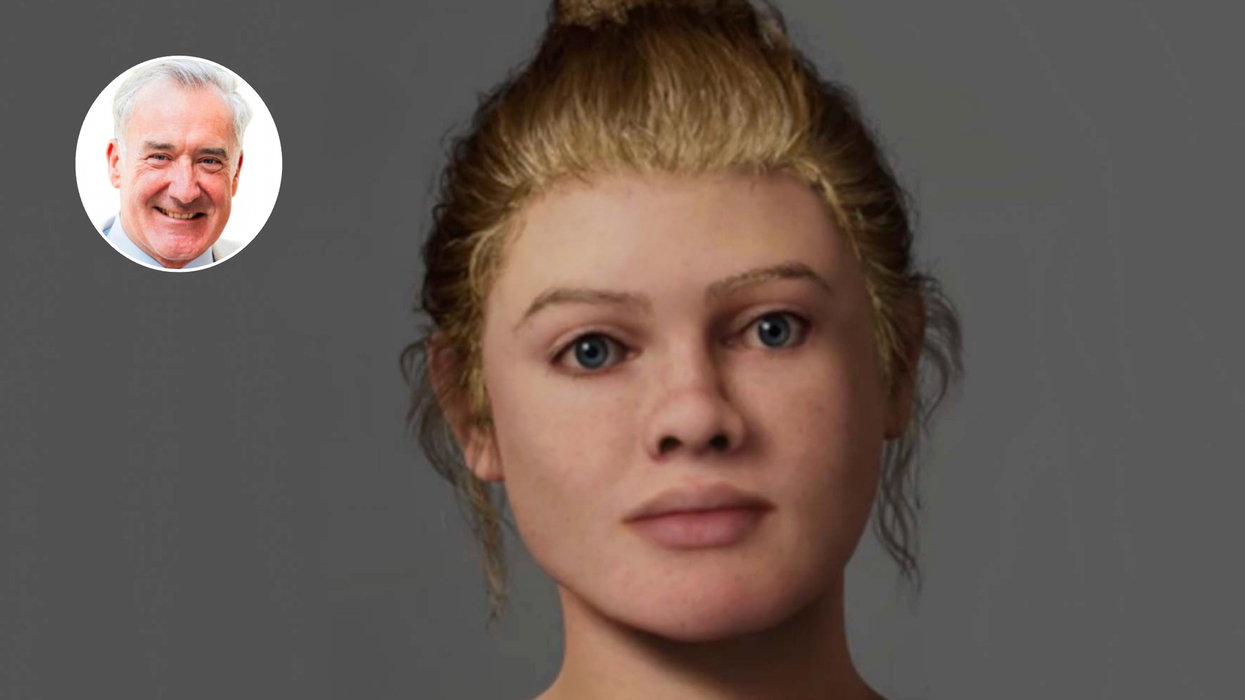
Her cause was quickly taken up by the BBC. A series called ‘Black and British: A Forgotten History” held up the skeleton as proof of the “enduring relationship between Britain and people whose origins lie in Africa.” She was hailed as the ‘earliest black Briton’. A computerised reconstruction of her face depicted her with dark skin.
The only problem was that the story was based entirely on wishful thinking. The tremendous desire within parts of identitarian Britain to expunge any notion that our ancestors were exclusively ethnically white.
Because this week, we learned that - thanks to the latest DNA sampling techniques and radiocarbon dating, Beachy Head Woman was not black, but white.
This is the latest act of ethno-washing to be undermined. The newest example of how far the social engineers within our media, universities, lobby groups and government are prepared to go in order to enforce the idea that Britain has always been an island of migrants.
And, with it, the concomitant notion that we should all be thankful for this: just as the Ghanians or Chinese would be thrilled to know that they are not nearly as Ghanian or Chinese as they thought. Not.
 A newly constructed digital image of the Beachy Head Woman was generated from a 3D scan of her skull | FACE LAB AT LIVERPOOL JOHN MOORES UNIVERSITY
The truth is that there has been nothing hitherto like the recent massive waves of immigration seen in Britain post-1997. There had been modest migrant surges before (the Huguenots, Jews and Irish), as well as a few well-documented cases of former slaves kept in domestic service.
Yet we are peddled a narrative which systematically undermines this settled belief and which encourages young Britons to doubt the veracity of paintings and even photographs which show a sea of white faces. And to believe that any trace of black Britain was airbrushed from history to present an ethnically homogenous national origin story.
The extent to which this is happening is extraordinary. Take the case of an exhibition last year, partly funded by taxpayers. It told visitors that “Britain was black for 7,000 years” before white people arrived.
Support for this claim comes from the tendentious story of Cheddar Man, who - like Beachy Head Woman - made headlines when scientists asserted that his skin was black, not white. The evidence for this claim is equivocal, to put it mildly, and has subsequently been largely debunked.
And yet it has allowed activists to argue that Stonehenge was built by black Britons and that, as the words of the Horrible History song assert, non-white natives have “Been Here From the Start”.
What lies behind this mania? Is it just a desire to tell a new story, to shatter conventions and win a headline or research grant? Or is it less benign than that?
Is it part of a concerted attempt to make black Britons feel more at home on these islands, even if the price of such encouragement requires myth-making? Does it deny white people the pride in their heritage, which is taken for granted by other ethnic groups the world over?
Such sophistry works on several levels. It includes the semantic sleight of hand that, for instance, pretends anyone born in Africa is black.
It means we see exhibitions claiming that Septimius Severus, who was born in Libya and died in York in the 3rd Century AD, was a ‘black Roman Emperor’. And that Hadrian’s Wall was defended by Africans. Or that Cleopatra was black. These interpretations ignore the distinction between North and sub-Saharan Africans.
As Britons, we may not feel strongly about such distinctions (it carries the whiff of Nazi-era racial science), but go to North Africa and observe how sub-Saharan Africans are treated, and you will come away with a strong suspicion that others do see the difference.
Claims that the Britain of Antiquity was not exclusively white are relatively new. It has taken a couple of decades to prepare a disbelieving indigenous population that their ancient foundational stories - from Stonehenge to Roman Britain - are, apparently, bogus.
Already, they’d been told that our Empire had nothing to do with the genius and diligence of dozens of brilliant minds, founding the Agricultural and Industrial Revolutions, which spread prosperity around our islands and, ultimately, much of the world. No, it wasn’t Jethro Tull’s seed drill or James Watt’s steam engine.
Any success we enjoyed was the fruits of slavery and colonial exploitation (note how the villain of the Netflix documentary Adolescence was a keen student of the Industrial Revolution, and this was, somehow, evidence of him being a wrong ‘un).
And then there’s Windrush. This summer, Keir Starmer hosted a reception at Downing Street in which he lauded that cohort of West Indians who came to Britain after Second World War and said they “laid the foundations of modern Britain”.
It’s hard to imagine how, in a country - at that time - of 50 million, a few thousand bus drivers could achieve so much. It’s easier to imagine how a Labour prime minister could feel obliged to overstate the achievements of communities whose contributions to British life are not wholly a success story.
One of the problems with selective - or even plain ‘made up’ history - is that by preferencing some, others are ignored. Race grifters like to pretend that there has been a deliberate policy at every level of British life, for centuries, which has airbrushed black people from the national picture. The evidence for any such thing is negligible, bordering on non-existent.
But when Sadiq Khan renamed London’s Overground train network last year, the Windrush Generation got their own line. There was no such honour for the hundreds of thousands of Irish navvies, who came to Britain and built so many canals, railways, bridges and roads; by the sweat of their brows and the toil of their bodies.
People like my own ancestors, who hailed from County Mayo, on Ireland’s Atlantic coast. I am proud they made the trip to England in the 19th Century, even if Sadiq Khan seems not to be. It gave me a smidgin of genetic diversity. But it does not make Britain an island of migrants who have been here from the beginning.
More From GB News