











School uniforms and household items must be targeted in a new push to phase out toxic “forever chemicals”, MPs say in a new report, which says the public is being needlessly exposed to health risks.
In a report released today, the cross-party Environmental Audit Committee is calling on ministers to phase out non-essential uses of perfluoroalkyl and polyfluoroalkyl substances (PFAS), which have been linked to fertility problems, developmental effects and cancers.
The report warns the UK risks falling behind Europe and leaving the public exposed for longer.
PFAS - a group of more than 10,000 man-made chemicals - are used in a huge range of items from school uniforms and non-stick pans to firefighting equipment, furniture and medical technologies.
TRENDING
Stories
Videos
Your Say
Their durability makes them extremely useful, including in some safety-critical settings. But the same qualities mean they do not break down easily, allowing them to persist in the environment and build up in the human body over time.
The report warns PFAS chemicals are now present in “almost everyone’s blood”, with growing numbers of studies linking them to adverse health effects, although scientists debate about risks at typical exposure levels.
MPs say products like school uniforms, food packaging and cookware should be among the first targeted for restrictions, as part of a shift towards phasing out uses that are not considered essential.
Committee Chair Toby Perkins said: “From frying pans to fire extinguishers, PFAS are now central to everyday and some lifesaving products, and nearly all of us will have some level of PFAS in our bodies. But evidence we heard throughout our inquiry suggests that our dependence on PFAS has come with a cost to the environment, and perhaps to human health too.

School uniforms must be targeted in a new push to phase out toxic 'forever chemicals', MPs have warned
|PA
“The Government has already published a PFAS Action Plan, an important step that the Committee welcomes. But it does not go far enough.
“It appears to be a plan to eventually have a plan, rather than a concrete set of commitments to reduce and remediate PFAS.
“We do not need to panic, but we do need to take sensible precautions.”
While welcoming the Government’s existing PFAS plan, MPs warn it lacks urgency and relies too heavily on monitoring rather than stopping pollution at source.
A key concern is the speed of regulation.
LATEST DEVELOPMENTS:
The report warns new PFAS chemicals are being developed faster than they can be assessed, raising the risk banned substances are simply replaced with similar alternatives.
MPs caution this could lead to a “whack-a-mole” approach unless broader, group-based restrictions are introduced.
They are also urging a more precautionary system, where companies must prove new PFAS are safe before they are approved, rather than regulators acting only after harm is established.
Although the Committee backs moves to tighten limits in drinking water, it says major gaps remain in how exposure is controlled through food, farming and consumer goods.
It calls for clearer limits and better labelling while PFAS-containing products remain on sale.
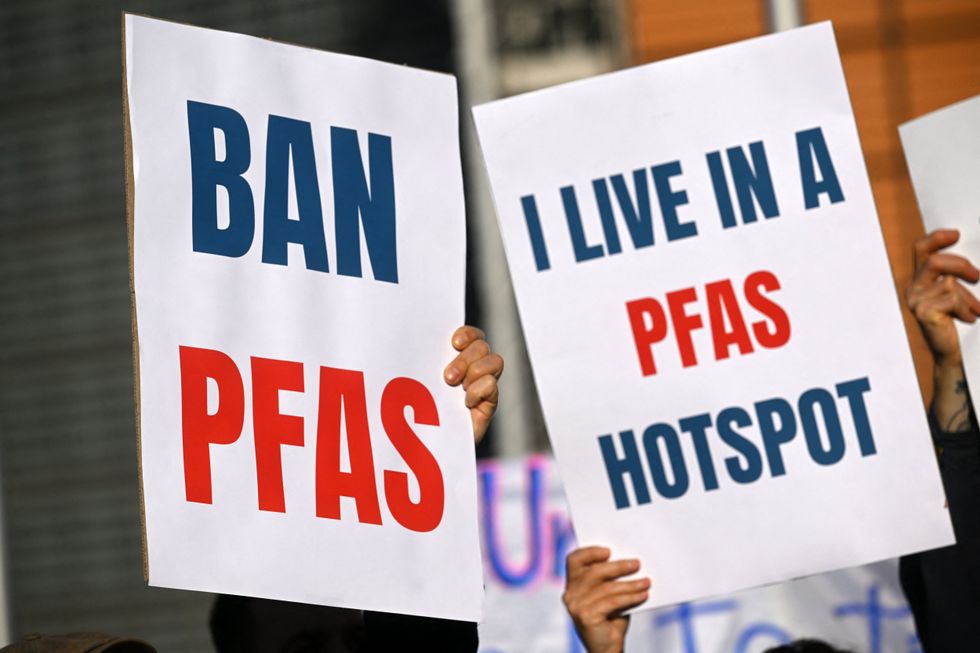
PFAS chemicals can be found in a huge range of items from school uniforms and non-stick pans to firefighting equipment, furniture and medical technologies
|GETTY
The report also lays bare the scale of the clean-up challenge.
PFAS can remain in soil and water for decades, and dealing with contamination is complex and costly.
MPs warn the current system risks leaving taxpayers and bill-payers to shoulder the burden, and say the “polluter pays” principle must be strengthened, including through a potential national remediation fund.
The report also highlights concerns about how PFAS waste is destroyed.
The UK currently relies on high-temperature incineration, with only two facilities able to handle these chemicals.
MPs warn capacity may be stretched as more PFAS is removed from use and call for urgent investment in alternative destruction technologies.
Mr Perkins added: “Other nations in Europe have already taken stronger steps to ban PFAS than we have in the UK.
“We risk our citizens and environment continuing to have greater exposure than our European counterparts if we fail to catch up.
“The Government has all the information it needs to get PFAS out of the environment and deter future pollution.
“Waiting will only make the problem worse. Now is the time to act.”