






Pete Hegseth has warned Europe is facing a "migrant invasion" and an invasion of dangerous ideologies arriving by sea during a D-Day speech.
Addressing attendees at the Normandy American Cemetery in Colleville-sur-Mer during commemorations for the 82nd anniversary of the D-Day landings on Saturday, the US Secretary of War drew a stark comparison between the historic Allied assault and immigration.
"Sadly today, different European beaches are stormed by different, dangerous ideologies," he said.
He specifically identified Spain, Italy, Greece and Bulgaria as locations where "boats and men arrive".
"When will European capitals do something about that invasion or is it too late? I pray not, and I believe not," Mr Hegseth said.
The war secretary's remarks reflect the Trump administration's regular criticisms of European immigration policy.
The commemorations today marked 82 years since the June 6, 1944, operation, when American and Allied troops launched what became the largest amphibious invasion in military history to liberate Western Europe from Nazi control.
Operation Overlord saw five naval assault divisions delivered to the Normandy coastline.
The invasion force comprised 7,000 ships and landing craft, crewed by more than 195,000 naval personnel representing eight allied nations.
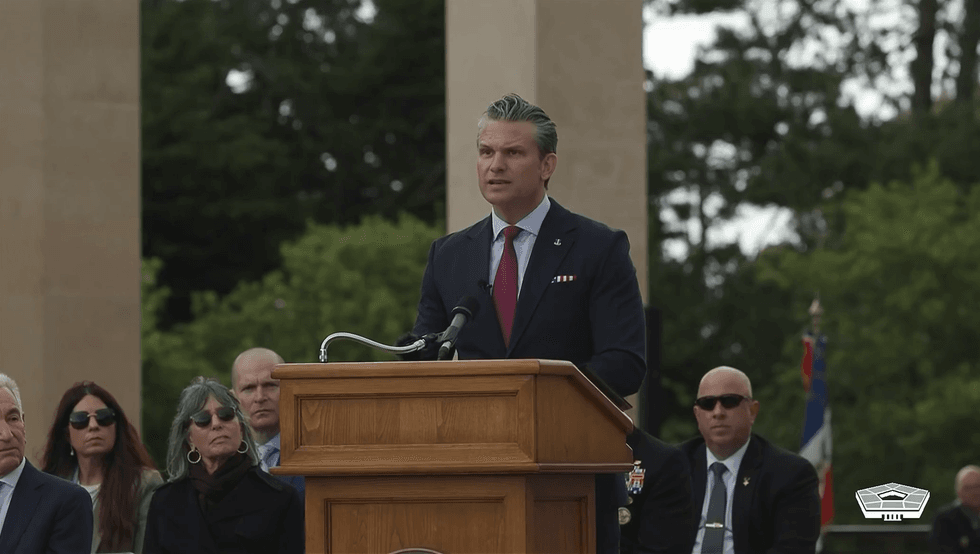
Drawing a comparison to D-Day, Pete Hegseth said 'Sadly today, different European beaches are stormed by different, dangerous ideologies'
|US DEPARTMENT OF DEFENSE
Nearly 133,000 troops from the United States, British Commonwealth and their allies came ashore during the assault.
Mr Hegseth told the audience that the sacrifice of those who fought at Normandy "demands far more than quiet reflection, it requires our active vigilance".
"In the years since these beaches, much of the West in some places, in some quarters and in some capitals, grew comfortable," he said, adding: "We forgot that freedom is not free.
"We forgot that peace is not wished into being, it is bought with purpose, with honour, and with strength."
LATEST DEVELOPMENTS:
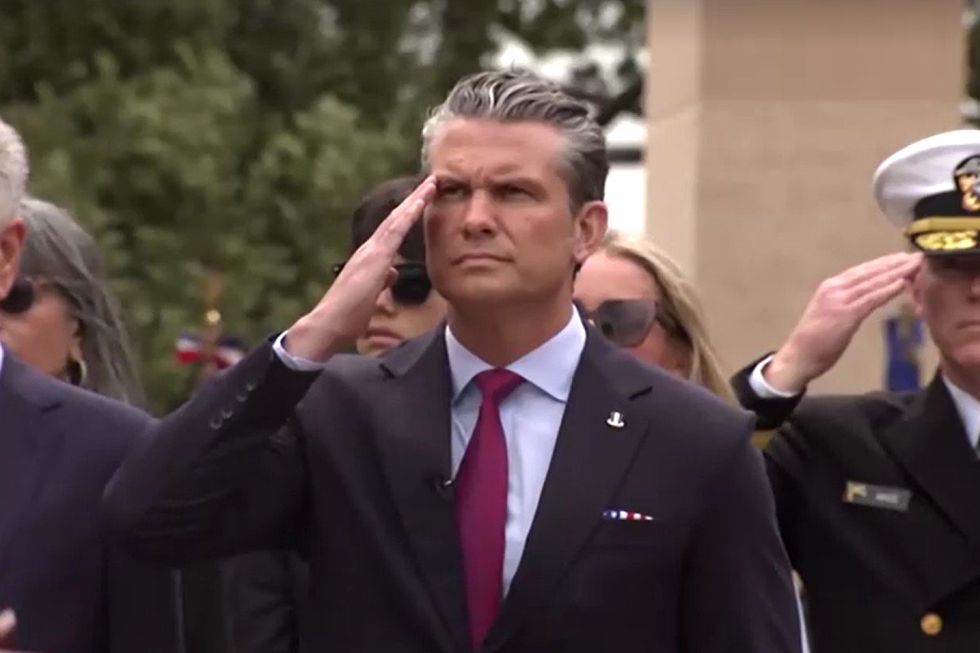
Pete Hegseth told those in attendance the sacrifice of those who fought at Normandy 'demands far more than quiet reflection, it requires our active vigilance'
|REUTERS
The speech comes one day after Vice President JD Vance suggested British student Henry Nowak would still be alive if Britain had taken firmer action on what he termed a "mass invasion of migrants".
Mr Vance characterised the 18-year-old's murder as "tragic as it is enraging".
"Henry Nowak died the same way a civilisation dies, abandoned, handcuffed by authorities who neither trusted nor cared for him, and accused of hate crimes he did not commit," he said.
The Vice President attributed the death to "the politics of self-hatred and the mass invasion of migrants, many of whom despise the West and the people who love it".
A US National Security Strategy document released last year cautioned that Europe faced "civilizational erasure" and needed to change course to maintain its status as a dependable American ally.
A Downing Street spokesman responded to the Trump administration's interventions by telling LBC that recent days had witnessed attempts to interfere in British democracy and stir up division.
The spokesman emphasised the Nowak family remained in mourning following Henry's murder and had explicitly stated they did not want his death exploited to create further division, hatred or tension.
"We should be respecting their wishes," the spokesman said, adding: "Our politics should bring people together even in the most terrible of circumstances. That is who we are as a country."
Mr Hegseth's comments emerged just days after the European Union approved substantial modifications to its immigration framework designed to increase deportations and establish detention facilities outside EU borders, dubbed "return hubs".
Dutch lawmaker Malik Azmani cited an "urgent need" for the revised policies, asserting that only 28 per cent of rejected asylum seekers actually departed, with most staying within the EU.